

Nitrogen blankets on storage tanks, purged vessels before hot work, inerted reactors, hydrogen headers and CO2 lines in beverage plants all have one thing in common in Pakistani plants: someone eventually needs to confirm the oxygen level at a particular point, quickly, without installing an online analyser there (general). That is the job of a portable percent oxygen analyser that can be carried from point to point, connected to the sample, read and moved on (general).
This note looks at the AII GPR-2000 Portable Percent Oxygen Analyzer from Analytical Industries Inc. (Aii), part of the Process Sensing Technologies (PST) group. It covers what the published data says, how to connect and use it, how to look after the battery, sensor and calibration, and where it fits in Pakistani plants. Figures come from the PST GPR-2000 datasheet (PST-DS-3203-00), the GPR portable oxygen analyzers user manual (PST-UM-3005), the AII GPR-2000 web page and the current Tetracon product page. General engineering advice is labelled as general, and nothing here goes beyond the published data. Tetracon (Pvt.) Ltd. is the sole authorized agent for Analytical Industries Inc. in Pakistan.
Why a portable percent oxygen analyser
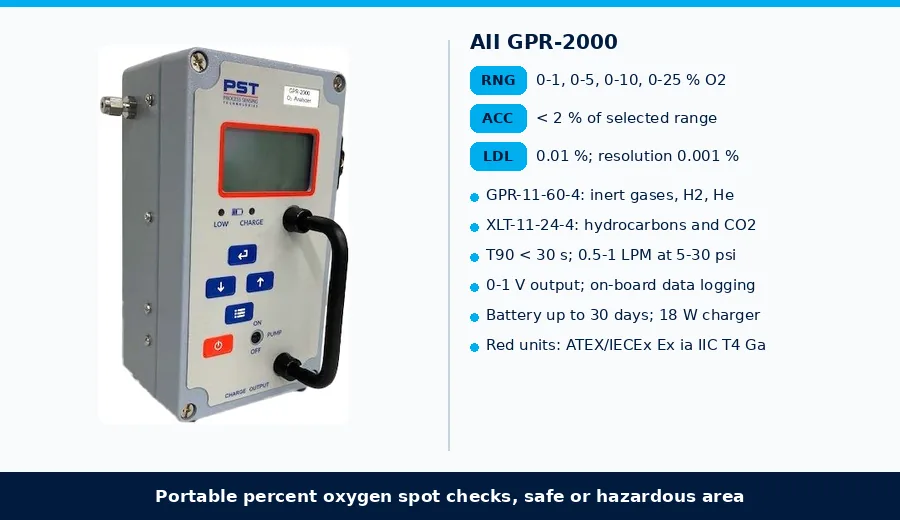
- Made for spot checks. PST describes the GPR-2000 as designed for swift, point-to-point measurements for spot-checking % oxygen contamination in industrial applications (PST datasheet).
- Ranges for percent work. It measures on 0-1, 0-5, 0-10 and 0-25 % O2 ranges, with a lower detection limit of 0.01 % and an output resolution of 0.001 % (PST datasheet).
- A sensor for the background gas. The GPR-11-60-4 sensor is for inert gases, H2 and He; the XLT-11-24-4 sensor is for hydrocarbons and CO2 (PST datasheet). The manual recommends the XLT sensor where the background gas contains more than 0.5 % CO2 (user manual).
- Safe or hazardous area. A blue general-purpose unit is for safe areas only; the red hazardous-area unit carries ATEX II 1 G Ex ia IIC T4 Ga, IECEx Ex ia IIC T4 Ga and cMETus Class I, Division 1, Groups A, B, C and D T4 (PST datasheet).
- Logs as you go. Integrated data logging with a memory token for data transfer, and up to 30 days of battery life (PST datasheet).
GPR-2000 at a glance
| Item | AII GPR-2000 (source) |
|---|---|
| Duty | Portable percent oxygen analyser for point-to-point spot checks (PST datasheet) |
| Ranges | 0-1, 0-5, 0-10 and 0-25 % O2 (PST datasheet); auto range or fixed range, with a default range setting (user manual) |
| Accuracy | < 2 % of selected range at constant conditions (PST datasheet) |
| Resolution / LDL | 0.001 % output resolution; lower detection limit 0.01 % (PST datasheet) |
| Response time | T90 < 30 seconds (PST datasheet) |
| Sensors | GPR-11-60-4 for inert gases, H2 and He; XLT-11-24-4 for hydrocarbons and CO2 (PST datasheet) |
| Sensor life | 60 months in air (GPR-11-60-4) or up to 24 months in air (XLT-11-24-4), application dependent; sensor shelf life up to 3 months (PST datasheet) |
| Operating temperature | +5 to +45 °C with the GPR-11-60-4; -10 to +45 °C with the XLT-11-24-4 (PST datasheet) |
| Sample | 1-2 SCFH (0.5-1 LPM), application dependent; 5-30 psi (0.3-2 bar) (PST datasheet) |
| Output and display | LCD; 0-1 V output (PST datasheet) |
| Data logging | On-board logger, 60-second logging rate, 30 days capacity; data, calibration log, event log and settings saved to the memory token (user manual) |
| Power | Battery life up to 30 days; charger 100-240 V AC in, 9 V DC (2 A) out, 18 W (PST datasheet); integrated rechargeable lead-acid battery (user manual) |
| Housing | Painted aluminium (PST datasheet); 147.3 x 142.2 x 223.5 mm (user manual) |
| Hazardous area (red units) | ATEX II 1 G Ex ia IIC T4 Ga; IECEx Ex ia IIC T4 Ga; cMETus Class I, Div 1, Groups A-D T4 and Class I, Zone 0 AEx ia IIC Ga; Tamb -20 to +50 °C (PST datasheet) |
| Calibration | Monthly calibration recommended, application dependent (PST datasheet) |
AII lists the applications as natural gas safety, blanketing and inerting, O2 in H2 measurements, brewery and beverage, and refineries (PST datasheet), and notes that the GPR-2000 can be used in applications from process refinery to laboratory (AII web page). The Tetracon product page carries the same ranges, sensors and certifications (product page).
Connecting and using it in the field
- Pick the ports. The GPR-2000 has two gas ports; assign one as the vent and the other as Sample In (user manual). PTFE sample inlet tubing is recommended for the GPR-2000 (user manual).
- Regulate the sample. The standard flow-through configuration is designed for positive-pressure samples; regulate the inlet to 5-30 psig (0.34-2 barg) and set the flow to 1-2 SCFH (0.5-1 LPM) (user manual).
- Purge, then read. Start the gas flow and let it run for 2-3 minutes before taking the reading (user manual). Vent the sample to atmospheric pressure or to a flare at atmospheric pressure; if that is not possible, vent to a pressure lower than the inlet (user manual).
- Keep the pressure steady. Electrochemical oxygen sensors respond to partial pressure, so the sensor pressure must stay constant, including during span calibration, and a sudden pressure change can cause electrolyte leakage (user manual). Do not test the flow indicator by covering the vent with a finger (user manual).
- Let it range for you, or fix it. In Auto mode the range moves up to the next level as the reading rises; selecting a range switches to Fixed, and a Default Range can be set so the analyser returns to it after checks by other users (user manual). Above the range maximum, readings are shown up to 10 % above it before an OVER RANGE warning (user manual).
- Record the round. Switch on the data logger to record every 60 seconds for up to 30 days, then save the data, calibration log and event log to the memory token (user manual), which makes a walk-round of tanks or vessels easy to file (general).
Battery, sensor and calibration
- Charge in a safe area only. All GPR portables, general purpose or hazardous area, must be charged in a safe area (user manual).
- Do not let the battery go flat. When the Low LED lights there are 72 hours of battery life left, and the battery must be recharged within that window to prevent permanent damage (user manual). The charging cycle is 12 hours, and the analyser can run continuously while plugged in (user manual).
- Calibrate regularly. PST recommends monthly calibration, depending on the application (PST datasheet). Calibrate at or close to the sample temperature and pressure, use certified zero and span gases at the same pressure and flow as the sample, and always zero before span (user manual).
- Re-calibrate after a sensor change. Calibration is needed each time the sensor is replaced, ideally before it reaches the end of its life, and the new sensor serial number must be entered, which resets calibration and clears the calibration log (user manual).
- Plan spare sensors. Sensor shelf life is up to 3 months (PST datasheet), so order spares close to when they will be fitted rather than holding them for long (general).
- Protect the sensor. Contaminants in the sample can affect the sensor; keep the sample clean and liquid free and ask about sample conditioning where needed (user manual).
Where it fits in Pakistan
- Blanketing and inerting. Monitoring inertization and blanketing gases for the storage or transport of hydrocarbons is a listed application (user manual), for example checking nitrogen-blanketed tanks in oil terminals and refineries before and after transfers (general).
- Natural gas safety. Natural gas safety and natural gas quality are listed applications (PST datasheet, user manual); the XLT sensor suits hydrocarbon backgrounds (PST datasheet).
- Oxygen in hydrogen. O2 in H2 measurement is listed (PST datasheet), with the GPR-11-60-4 sensor for H2 backgrounds (PST datasheet), and the red unit is IIC rated (PST datasheet), relevant to hydrogen in fertilizer, refinery and power plant service (general).
- Beverage and food. Brewery and beverage, and pure feed gas quality for beverages, food packaging and N2 generators, are listed (PST datasheet, user manual); CO2 lines call for the XLT sensor (user manual).
- Pharma and metals. Oxygen in pharmaceutical reactors and centrifuges, steel production, heat-treatment furnaces and solder re-flow ovens are listed (user manual).
Related products
| Need | Product | Key point |
|---|---|---|
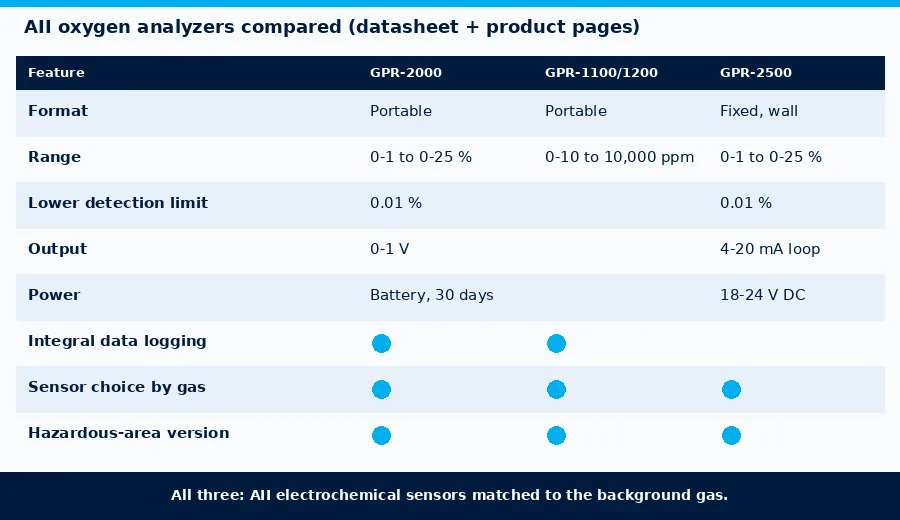
| Portable percent O2 spot checks | AII GPR-2000 | 0-1 to 0-25 % O2, < 2 % of range, 0.01 % LDL, safe or Ex ia versions (PST datasheet) |
| Portable trace (ppm) O2 spot checks | AII GPR-1100 / GPR-1200 | Four ranges from 0-10 ppm to 0-10,000 ppm; GPR-1200 adds bypass valve, metering valve and flowmeter (product page) |
| Online percent O2 at a fixed point | AII GPR-2500 | 0-1 to 0-25 %, 4-20 mA loop-powered, 18-24 V DC, hazardous-area rated (product page) |
| Explosion-proof online O2 | AII GPR-18 / GPR-28 | Explosion-proof (Ex db) oxygen analysers for petrochemical and refinery service (product page) |
| Sensor families | GPR-11-60 and XLT-11-24 | Galvanic 0-100 % O2 sensors (product pages); the GPR-2000 uses the -4 versions, so confirm the replacement part with us (general) |
For trace oxygen on the move read our portable and process trace oxygen note, and for fixed hazardous-area analysers our GPR-18 and GPR-28 note. More analysers are on the Oxygen Analysis category page, with more in our selection guides, and the full range is on the Analytical Industries manufacturer page.
What to send with an enquiry
- The background gas: nitrogen or other inert gas, hydrogen or helium, hydrocarbons, or CO2.
- The oxygen level you expect and the range you need (0-1, 0-5, 0-10 or 0-25 %).
- Whether the analyser will be used in a hazardous area (red unit) or only in safe areas (blue unit).
- The sample pressure and how you will vent the sample, and whether you need a sample system or scrubber.
- Your calibration plan: zero and span gases, frequency, and whether you need calibration certificates.
Send these to Tetracon and our engineers will confirm the right sensor, configuration, accessories and lead time. Our services team in Islamabad supports commissioning, training and calibration across Pakistan.
FAQ
What is the AII GPR-2000?
It is a portable percent oxygen analyser from Analytical Industries Inc. (Aii), designed for swift point-to-point spot checks of % oxygen contamination in industrial applications (PST datasheet).
What ranges and accuracy does the GPR-2000 have?
It measures on 0-1, 0-5, 0-10 and 0-25 % O2 ranges with accuracy better than 2 % of the selected range at constant conditions, a 0.01 % lower detection limit, 0.001 % resolution and a T90 under 30 seconds (PST datasheet).
Which sensor should I choose?
The GPR-11-60-4 is for inert gases, H2 and He, and the XLT-11-24-4 is for hydrocarbons and CO2 (PST datasheet). The manual recommends the XLT sensor when the background gas contains more than 0.5 % CO2 (user manual).
Can it be used in hazardous areas?
Yes, in its red hazardous-area version, certified ATEX II 1 G Ex ia IIC T4 Ga, IECEx Ex ia IIC T4 Ga and cMETus Class I, Division 1, Groups A, B, C and D T4. The blue general-purpose version is for safe areas only, and all units must be charged in a safe area (PST datasheet, user manual).
Who supplies Analytical Industries in Pakistan?
Tetracon (Pvt.) Ltd., Islamabad, is the sole authorized agent for Analytical Industries Inc. in Pakistan and supplies the AII oxygen analyser range with local technical support. Contact us with your background gas, range and quantity for a quotation.
Need to check percent oxygen in blanketing, inerting or process gas in Pakistan? Contact Tetracon with the background gas, the range and the number of instruments. You can also browse the GPR-2000 product page and the Analytical Industries manufacturer page, or the full product catalogue and all manufacturers.