

Many oxygen measurements in a plant are not for a laboratory but for a panel: a nitrogen generator that must prove its purity before gas reaches the line, a tank that must stay blanketed below a safe oxygen level, a glove box, a sintering furnace atmosphere or a bleaching stage in a paper mill. In each case the operator wants a reading on the control panel, a 4-20 mA signal to the PLC and an alarm relay, while the sensor sits next to the process. In Pakistan that need comes up with nitrogen-generator users in food, pharma and electronics, chemical and pharma tank farms, powder-metallurgy and heat-treatment shops, and pulp and paper mills.
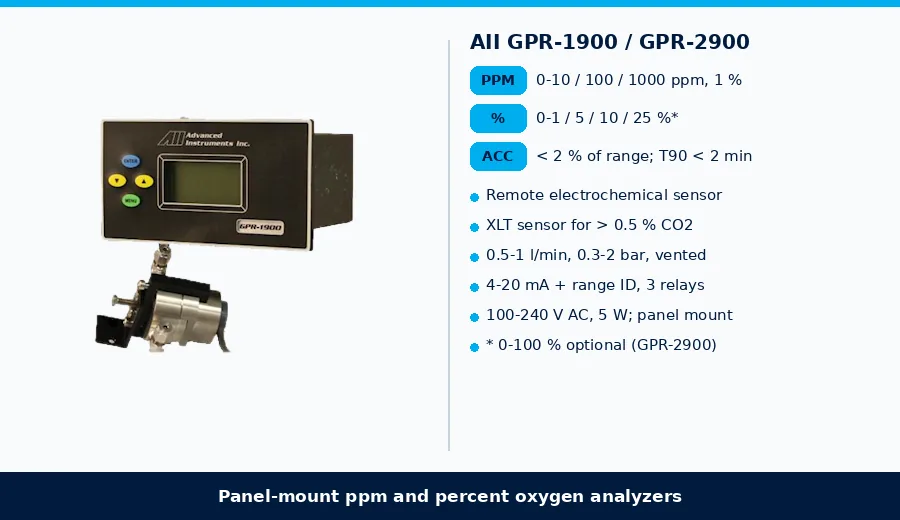
This note looks at the Analytical Industries (AII) GPR-1900 and GPR-2900, compact panel-mounted oxygen analyzers with a remote electrochemical sensor: the GPR-1900 measures in ppm and the GPR-2900 in percent. Figures come from the AII GPR-x900 datasheet (AII-DS-3003-00) hosted on our product page and from the current Tetracon product pages. Where we give general engineering advice, it is labelled as general. No performance claim here goes beyond the manufacturer's published data.
Why a panel analyzer with a remote sensor
- The sensor goes to the process, the display stays in the panel. The GPR-x900 sensor can be located near or inside the process, and the analyzer is panel-mounted with an LCD and a four-button interface (datasheet). That keeps the sample path short while operators read and acknowledge alarms at the control panel (general).
- One family from trace ppm to 100 %. The GPR-1900 covers 0-10, 0-100 and 0-1000 ppmV and 0-1 % oxygen; the GPR-2900 covers 0-1, 0-5, 0-10 and 0-25 %, with 0-100 % as an option (datasheet).
- Alarms built in. Each analyzer has three relays: two user-configurable set-point alarms and one power-failure alarm (datasheet). A nitrogen generator or blanketing system can therefore trip a valve or a horn directly, without waiting for the PLC (general).
- Real process gases. The electrochemical sensor measures in background gases containing hydrocarbons, and the XLT sensor option is for processes with more than 0.5 % CO2 (datasheet).
How the GPR-1900 and GPR-2900 work
Both analyzers use AII's electrochemical oxygen sensors, with temperature compensation, and are designed for inline and extractive gas applications (datasheet). The GPR-1900 (ppm) uses the GPR-12-333 sensor, or the XLT-12-333 where CO2 is present; the GPR-2900 (percent) uses the GPR-11-60-4 or XLT-11-24-4 sensor (datasheet). The same percent sensor families are also listed on our catalogue as the GPR-11-60 and XLT-11-24 sensors (product pages).
Sample gas flows past the sensor at 1-2 SCFH (0.5-1 l/min) and a pressure of 5-30 psi (0.3-2 bar) with the sensor vented to atmosphere (datasheet). The analyzer gives an analogue output (4-20 mA or voltage), a separate range ID signal (4-20 mA or 1-5 V) so the PLC knows which range is active, and the three relays, all from a 100-240 V AC supply drawing at most 5 W (datasheet).
AII GPR-1900 and GPR-2900 at a glance
| Item | GPR-1900 (ppm) | GPR-2900 (%) |
|---|---|---|
| Sensors | GPR-12-333 or XLT-12-333 (CO2 backgrounds) | GPR-11-60-4 or XLT-11-24-4 (CO2 backgrounds) |
| Measuring ranges | 0-10, 0-100, 0-1000 ppmV, 0-1 %; 0-25 % for calibration only | 0-1, 0-5, 0-10, 0-25 %; 0-100 % optional |
| Accuracy | < 2 % of selected range at constant conditions | |
| Resolution / lower detection limit | 0.01 ppmV / 0.05 ppmV | 0.001 % / 0.005 % |
| Response time | T90 < 2 minutes | |
| Sample flow and pressure | 1-2 SCFH (0.5-1 l/min); 5-30 psi (0.3-2 bar) with atmospheric vent | |
| Operating temperature | +5 to +45 °C with GPR sensors; -10 to +45 °C with XLT sensors | |
| Sensor life (application dependent) | 24 months in 1000 ppmV | 60 months in air (GPR-11-60-4); 24 months in air (XLT-11-24-4) |
| Calibration interval | 30 days recommended (application dependent) | |
| Outputs | 4-20 mA or voltage output; range ID 4-20 mA or 1-5 V; 3 relays (2 set-point alarms, 1 power-failure alarm) | |
| Power | 100-240 V AC, 5 W maximum | |
| Display and housing | LCD with four-button interface; painted sheet-metal housing; panel mounting | |
The accuracy figure is a percentage of the selected range, so choose the lowest range that still covers your alarm point: on the 0-100 ppmV range, 2 % of range is 2 ppmV, while on the 0-1000 ppmV range it is 20 ppmV (worked example from the datasheet figure).
Where it fits
- Nitrogen or oxygen generators. Listed in the datasheet. A PSA or membrane nitrogen generator for food packaging, pharma or electronics is usually checked for residual oxygen, which suits the ppm GPR-1900 or the low ranges of the GPR-2900 depending on the purity grade; oxygen generators need the percent analyzer with the optional 0-100 % range (datasheet ranges; general application).
- Inert gas blanketing. Listed in the datasheet. Tanks and reactors blanketed with nitrogen are typically kept below a set oxygen level, and the two set-point alarms can warn and then act (general).
- Glove boxes. Listed in the datasheet. The GPR-1900's 0-10 and 0-100 ppmV ranges suit a box purged with inert gas (datasheet ranges; general application).
- Confined space monitoring. Listed in the datasheet. The percent analyzer can watch the oxygen level in a fixed enclosed area (general). Note that the GPR-x900 datasheet does not give a hazardous-area rating, so for classified areas look at the certified AII models below (datasheet; general).
- Sintering and other metal processing. Listed in the datasheet. Furnace atmospheres for powder metallurgy and heat treatment are checked for oxygen before and during the run (general).
- Delignification and bleaching in pulp and paper. Listed in the datasheet. Oxygen-based bleaching stages use percent-level oxygen, which suits the GPR-2900 (datasheet application; general).
Practical notes for good readings
- Pick the sensor for the background gas. Use the standard GPR sensor for inert and hydrocarbon backgrounds and the XLT sensor when more than 0.5 % CO2 is present (datasheet). Tell us the full gas composition so we can confirm the choice (general).
- Control flow and pressure. Keep the sample at 0.5-1 l/min and between 0.3 and 2 bar, with the sensor vented to atmosphere (datasheet). On a nitrogen header at several bar, fit a regulator and a needle valve with a flowmeter ahead of the sensor (general).
- Keep the sensor inside its temperature limits. GPR sensors are rated +5 to +45 °C and XLT sensors -10 to +45 °C (datasheet). In a Pakistani summer a sensor in an outdoor shelter or near a furnace can exceed 45 °C, so mount it in shade or a ventilated or air-conditioned panel; in a northern winter the XLT version's lower limit helps (general).
- Calibrate on schedule. AII recommends a 30-day calibration interval, depending on the application (datasheet). The GPR-1900's 0-25 % range is provided for calibration only, which allows a check in air (datasheet), while a span gas near the working range gives the best confidence at low ppm (general).
- Protect trace sensors from air. Sensor life is quoted as 24 months in 1000 ppmV for the ppm sensors (datasheet). Leaving a trace sensor open to air for long periods is generally avoided, so keep it purged during shutdowns (general).
- Use the relays and range ID. Wire the power-failure relay to the control system so a dead analyzer is never mistaken for a good reading, and use the range ID signal so the PLC scales the 4-20 mA correctly (datasheet features; general practice).
- Clean power. The analyzer accepts 100-240 V AC (datasheet). Where load-shedding or generator changeovers cause dips, a small UPS keeps the reading and alarms alive (general).
Related AII oxygen products and when to choose them
| Duty | Product | From the datasheet / product page |
|---|---|---|
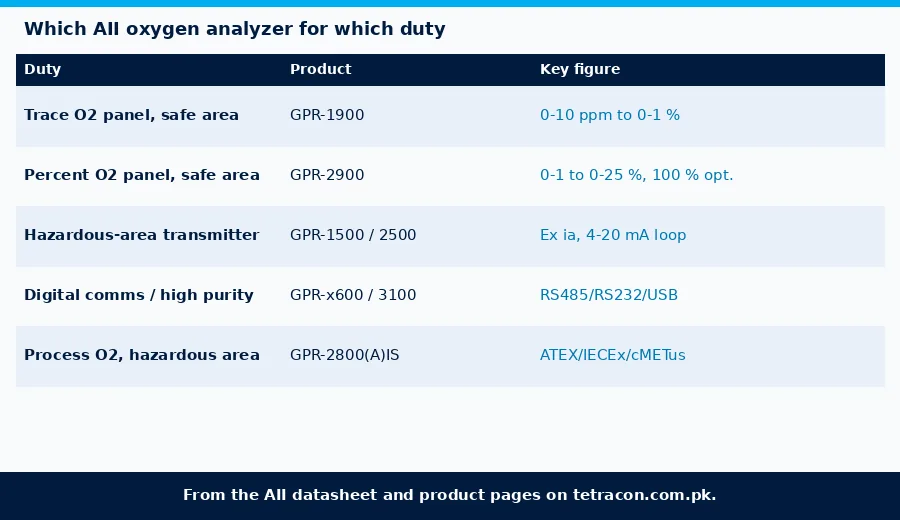
| Panel analyzer, trace ppm O2, safe area | AII GPR-1900 | 0-10 / 100 / 1000 ppmV, 0-1 %; < 2 % of range; LDL 0.05 ppmV; 3 relays; 100-240 V AC |
| Panel analyzer, percent O2, safe area | AII GPR-2900 | 0-1 / 5 / 10 / 25 %, 0-100 % optional; GPR-11-60-4 sensor life 60 months in air |
| Loop-powered transmitter, hazardous area | AII GPR-1500 / GPR-2500 | 0-10 ppm to 0-25 %; 4-20 mA, 18-24 V DC; wall mount; ATEX / IECEx Ex ia IIC T4, cMETus Class I Div 1 |
| Glove box transmitter | AII GPR-1500GB / GPR-2500GB | 0-10 ppm to 0-25 %; 2-wire 4-20 mA; KF-40 flange or flow-through base; XLT option |
| Higher-spec analyzer with digital comms | AII GPR-1600 / 2600 / 3100 | Graphical LCD; isolated 4-20 mA plus 0-1 / 0-5 V; RS485, RS232 or USB; GPR-3100 for 0-100 % with suppressed-zero ranges |
| Process O2 in hazardous areas | AII GPR-2800(A)IS | 0-1 % to 0-25 %; ATEX, IECEx, cMETus and UKEx |
As a rule of thumb, choose the GPR-1900 or GPR-2900 when you want a simple, low-power panel analyzer with local display and alarm relays in a safe area, a GPR-x500 transmitter when the measurement point is in a classified area and only a 4-20 mA signal is needed, and a GPR-x600 or GPR-3100 when you need digital communications or high-purity oxygen ranges (general). Replacement percent sensors are available as the GPR-11-60 and XLT-11-24 (product pages).
What to send with an enquiry
- The application (nitrogen or oxygen generator, blanketing, glove box, confined space, furnace atmosphere, bleaching stage) and the oxygen level at your alarm point.
- The range you need: ppm (GPR-1900) or percent (GPR-2900), and whether 0-100 % is required.
- The background gas composition, especially hydrocarbons and CO2 content (above 0.5 % CO2 needs the XLT sensor).
- Sample pressure, temperature and flow at the take-off point, and where the sensor and panel will be mounted.
- Outputs and alarms: 4-20 mA or voltage, range ID, and what the two set-point relays should do.
- Whether the location is a safe or classified (hazardous) area.
FAQ
What is the difference between the GPR-1900 and the GPR-2900?
The GPR-1900 measures trace oxygen in ppm, with ranges of 0-10, 0-100 and 0-1000 ppmV and 0-1 %. The GPR-2900 measures percent oxygen, with ranges of 0-1, 0-5, 0-10 and 0-25 % and an optional 0-100 % range.
How accurate are they?
The datasheet gives an accuracy of better than 2 % of the selected range at constant conditions, with a T90 response time of under 2 minutes.
Can they measure oxygen in CO2 or hydrocarbon gases?
Yes. The standard electrochemical sensor measures in background gases containing hydrocarbons, and the XLT sensor option is used when more than 0.5 % CO2 is present.
What outputs and alarms do they have?
Each analyzer has an analogue output (4-20 mA or voltage), a range ID signal (4-20 mA or 1-5 V) and three relays: two user-configurable set-point alarms and one power-failure alarm.
How often do they need calibration?
AII recommends a 30-day calibration interval, depending on the application. The GPR-1900 includes a 0-25 % range for calibration only.
Can they be used in hazardous areas?
The GPR-x900 datasheet does not list a hazardous-area certification. For classified areas, AII's certified GPR-1500 / GPR-2500 transmitters or the GPR-2800(A)IS analyzer are the usual choices.
Next steps
Tetracon (Pvt.) Ltd. is the sole authorized agent for Analytical Industries Inc. in Pakistan and supplies its trace and percent oxygen analyzers, transmitters and sensors with local technical support. Send us your application, oxygen range, background gas and sample conditions, and we will propose the right analyzer and sensor. Use the contact page or see our services. Start with the GPR-1900 / GPR-2900, compare the GPR-x500 transmitters and GPR-x600 / GPR-3100 analyzers, browse oxygen analysis and gas analysis, or see all Analytical Industries products and the full product catalogue. Related notes: oxygen monitoring for blanketing and inerting, explosion-proof AII GPR-18 and GPR-28 oxygen analyzers and portable and process trace oxygen with AII. Free technical guides are collected under Guides.