

Two numbers decide whether many industrial gases are fit for use: how much oxygen they contain and how dry they are. A nitrogen generator feeding a food-packaging line, a laser cutter or a heat-treatment furnace has to prove low residual oxygen, and the same gas must also be dry, because moisture causes oxidation, corrosion and quality defects downstream. Metal additive-manufacturing machines, glove boxes and inert-gas systems ask the same two questions. In Pakistan this pairing comes up with nitrogen-generator users in food, pharma and electronics, with heat-treatment and powder-metallurgy shops, and with plants that buy or blend industrial gases and want to check what they receive.
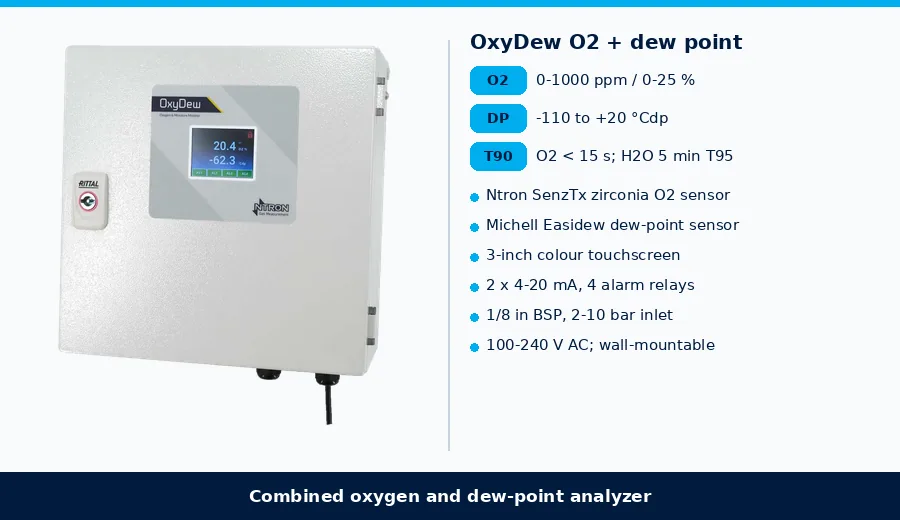
This note looks at the OxyDew oxygen and moisture analyzer, a wall-mounted instrument that measures oxygen and dew point together and shows both on one colour touchscreen. It is built by Ntron Gas Measurement around an Ntron SenzTx zirconia oxygen sensor and a Michell Easidew dew-point sensor. Figures come from the OxyDew datasheet (NT-DS-2300-EN-v1, 04/2026) hosted on our product page and from the current Tetracon product pages. Where we give general engineering advice, it is labelled as general. No performance claim here goes beyond the manufacturer's published data.
Why measure oxygen and dew point in one analyzer
- Both purity and dryness on one screen. The OxyDew combines oxygen and dew-point measurement, with dual, simultaneous readings shown on a 3-inch (76.2 mm) colour touchscreen (datasheet). Operators see both values at a glance instead of walking between two instruments (general).
- Trace and percent oxygen. The oxygen measurement ranges are 0-1000 ppm and 0-25 % (datasheet), which covers nitrogen-generator purity checks at ppm level and percent-level inerting and air checks (general application).
- Very dry gases. The dew-point range is -110 to +20 °Cdp (-166 to +68 °Fdp) (datasheet), from cylinder-grade dry gas up to wet compressed air (general).
- Signals and alarms for the control system. There are two 4-20 mA outputs and four user-configurable alarm relays (datasheet), so one output can carry oxygen and the other dew point to a PLC, while the relays warn or act locally (general).
- Stable readings. Ntron describes the measurements as stable and reliable with virtually no drift, using its intelligent sensor technology (datasheet).
How the OxyDew works
Oxygen is measured with the Ntron SenzTx zirconia (ZR) sensor, and moisture with the Michell Easidew dew-point sensor (datasheet). Both sensing technologies are also sold separately: the Ntron SenzTx is a compact OEM oxygen transmitter whose zirconia version is listed with up to 5 years' life and a 12-month calibration interval, and the Michell Easidew Online is a dew-point hygrometer covering -110 to +20 °Cdp with a traceable 13-point calibration (product pages). In the OxyDew the two are brought together in one enclosure with a shared display, outputs and alarms (datasheet).
The sample enters and leaves through 1/8 in BSP connections, at an inlet pressure between a minimum of 2 bar (30 psi) and a maximum of 10 bar (147 psi) (datasheet). That makes the OxyDew a natural fit at the outlet of a nitrogen generator, a gas header or a cylinder manifold that is already under pressure (general). The oxygen reading responds with a T90 of less than 15 seconds at 25 °C within the selected range, and the moisture reading reaches T95 in 5 minutes when going from dry to wet (datasheet).
OxyDew at a glance
| Item | Oxygen | Moisture |
|---|---|---|
| Measuring technology | Ntron SenzTx zirconia (ZR) | Michell Easidew |
| Measurement range | 0-25 %; 0-1000 ppm | -110 to +20 °Cdp (-166 to +68 °Fdp) |
| Response time | T90 < 15 s at 25 °C within selected range | 5 min to T95 (dry to wet) |
| Display | 3-inch (76.2 mm) colour touchscreen, dual simultaneous readings | |
| Analogue outputs | 2 x 4-20 mA | |
| Alarms | 4 user-configurable alarm relays: 2 x SPDT, 2 x SPST, 30 V DC (5 A) | |
| Power supply | 100-240 V AC | |
| Sample connections | Inlet and outlet 1/8 in BSP | |
| Sample pressure | Minimum 2 bar (30 psi); maximum 10 bar (147 psi) at the inlet | |
| Mounting and size | Wall-mountable enclosure, about 300 x 300 mm with 155-165 mm depth; cable glands underneath (datasheet drawing) | |
The datasheet does not quote an accuracy figure, an operating temperature range, a digital communication port or a hazardous-area certification for the OxyDew. If your specification needs any of these, send it to us and we will confirm with the manufacturer before you order (general).
Where it fits
- Gas generation. Listed in the datasheet. PSA and membrane nitrogen generators are usually specified by residual oxygen, and the gas should also be dry for the process it feeds; the ppm range suits high-purity grades and the percent range suits lower-purity nitrogen for inerting (datasheet ranges; general application).
- Additive manufacturing. Listed in the datasheet. Powder-bed metal printers run under argon or nitrogen, where both oxygen and moisture affect part quality, so a fixed OxyDew on the supply gas pairs well with a portable check inside the build chamber (general).
- Gas quality measurement. Listed in the datasheet. Plants receiving bulk or cylinder nitrogen and argon can check incoming gas for oxygen and dew point before it reaches a furnace, a laser cutter or a packaging line (general application).
- Heat treatment and brazing atmospheres. Not listed in the datasheet, but a common need: inert or protective atmospheres in furnaces are typically checked for oxygen and dew point because both cause oxidation. Check the gas composition with us first, see the notes below (general).
Practical notes for good readings
- Give it the pressure it needs. The inlet needs at least 2 bar and no more than 10 bar (datasheet). Most nitrogen-generator outlets and gas headers sit in this band; on a higher-pressure line, fit a regulator ahead of the analyzer, and for a source near atmospheric pressure (such as a build chamber) a pumped portable like the AM Trace is the better tool (general).
- Use clean, dry sample lines. At -60 °Cdp and below, plastic tubing and long dead legs release moisture and slow the reading; stainless-steel tubing and short runs give faster, more representative dew-point readings (general). Expect the dry-to-wet response of 5 minutes to T95 quoted in the datasheet, and allow longer when drying down a new line (datasheet; general).
- Check the background gas. Zirconia oxygen sensors are generally not used where hydrogen or hydrocarbons are present, because combustibles react with oxygen at the hot sensor and the reading falls; the electrochemical SenzTx option exists for such backgrounds (SenzTx product page; general). Tell us if your gas contains any hydrogen, forming gas or hydrocarbons.
- Pick the oxygen range for the alarm point. Use the 0-1000 ppm range for high-purity nitrogen and the 0-25 % range for inerting or air-ingress checks (datasheet ranges; general).
- Plan alarms and outputs. Assign one 4-20 mA output to oxygen and one to dew point, and use the four relays for high-oxygen and wet-gas warnings and actions, for example closing a supply valve or venting off-spec gas from a generator (datasheet features; general practice).
- Mount it where it is easy to read. The enclosure is wall-mountable with cable glands underneath (datasheet). Keep it out of direct sun and away from furnace heat; in a Pakistani summer a shaded, ventilated location protects the electronics (general).
- Clean power. The OxyDew runs on 100-240 V AC (datasheet). Where load-shedding or generator changeovers cause dips, a small UPS keeps readings and alarms alive (general).
Related Ntron and Michell products and when to choose them
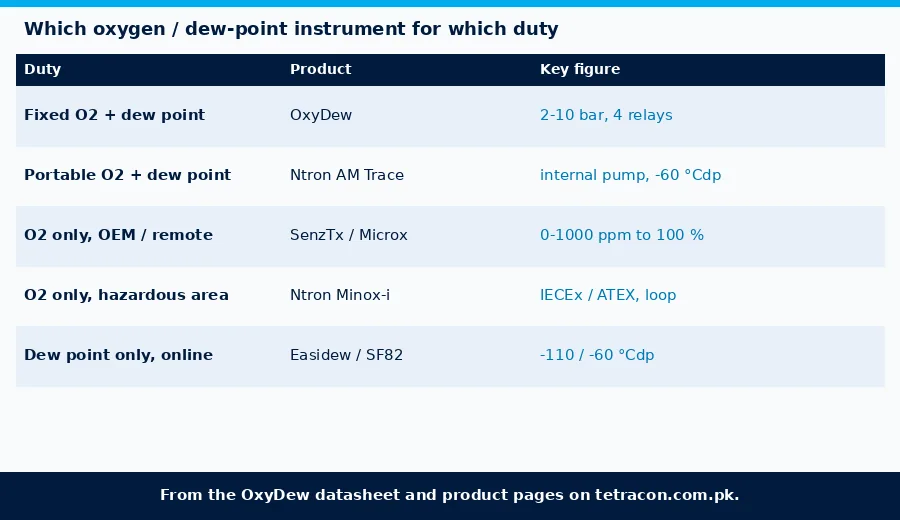
| Duty | Product | From the datasheet / product page |
|---|---|---|
| Fixed oxygen + dew point on pressurised gas | OxyDew | O2 0-1000 ppm / 0-25 %; -110 to +20 °Cdp; 2 x 4-20 mA; 4 relays; 2-10 bar inlet; 100-240 V AC |
| Portable oxygen + dew point, AM build chambers | Ntron AM Trace | O2 0-1000 ppm / 0-25 % (electrochemical); -60 to +20 °Cdp (SF82); internal sample pump; 7-inch touchscreen with logging |
| Oxygen only, OEM transmitter | Ntron SenzTx | Zirconia or electrochemical; 0-1000 ppmV up to 0-100 % (zirconia); 4-20 mA and RS485 Modbus; 24 V DC |
| Oxygen only, analyzer with remote sensor | Ntron Microx | 0-1000 ppm up to 0-100 %; 3 alarm relays; 4-20 mA and RS232; DIN-rail, panel or wall mounting |
| Oxygen only, hazardous area | Ntron Minox-i | 0-10 ppmV up to 0-25 %; 2-wire loop-powered 4-20 mA; IECEx, ATEX, cQPSus, UKEX and JPN Ex |
| Dew point only, online | Michell Easidew Online / Easidew Advanced Online | -110 to +20 °Cdp; ±2 °Cdp (Advanced: ±1 °Cdp from -60 to +20 °C); Advanced adds pressure compensation and 3 x 4-20 mA |
| Dew point only, fast response | Michell SF82 Online | -60 to +60 °Cdp; T95 to -60 °Cdp in under 3 minutes; dual relay alarms |
As a rule of thumb, choose the OxyDew when one fixed instrument should watch both oxygen and dryness of a pressurised gas in a safe area; the AM Trace when you need to carry the check from machine to machine; a SenzTx, Microx or Minox-i when only oxygen matters (the Minox-i for classified areas); and an Easidew or SF82 system when only dew point matters (general).
What to send with an enquiry
- The application (nitrogen generator, additive manufacturing, gas supply check, furnace atmosphere) and the oxygen and dew-point levels at your alarm points.
- The oxygen range you need (0-1000 ppm or 0-25 %) and the driest dew point you expect.
- The background gas (nitrogen, argon, air) and whether it contains any hydrogen or hydrocarbons.
- Sample pressure, temperature and flow at the take-off point, and where the analyzer will be mounted.
- Which signals go to your PLC or SCADA, and what the four alarm relays should do.
- Whether the location is a safe or classified (hazardous) area.
FAQ
What does the OxyDew measure?
It measures oxygen and dew point at the same time. Oxygen ranges are 0-1000 ppm and 0-25 %, and the dew-point range is -110 to +20 °Cdp.
Which sensors does it use?
Oxygen is measured with the Ntron SenzTx zirconia sensor and moisture with the Michell Easidew dew-point sensor.
How fast does it respond?
The datasheet gives an oxygen T90 of less than 15 seconds at 25 °C within the selected range, and 5 minutes to T95 for moisture when going from dry to wet.
What outputs and alarms does it have?
It has two 4-20 mA outputs and four user-configurable alarm relays (2 x SPDT and 2 x SPST, rated 30 V DC, 5 A), and it runs on 100-240 V AC.
What sample pressure does it need?
The inlet pressure must be between 2 bar (30 psi) and 10 bar (147 psi), through 1/8 in BSP inlet and outlet connections.
Can it be used in hazardous areas?
The OxyDew datasheet does not list a hazardous-area certification. For oxygen in classified areas, the Ntron Minox-i intrinsically safe transmitter is the usual choice.
Next steps
Tetracon (Pvt.) Ltd. is the sole authorized agent for Michell Instruments Ltd. and Ntron Gas Measurement Ltd. in Pakistan and supplies their oxygen analyzers and dew-point hygrometers with local technical support. Send us your application, oxygen and dew-point levels, background gas and sample pressure, and we will confirm whether the OxyDew or another instrument is the right fit. Use the contact page or see our services. Start with the OxyDew, compare the AM Trace, SenzTx and Easidew Online, browse oxygen analysis and moisture and dew point, or see all Michell Instruments and Ntron products and the full product catalogue. Related notes: oxygen and moisture in metal 3D printing with the AM Trace, online dew-point monitoring with Easidew and oxygen monitoring for blanketing and inerting. Free technical guides are collected under Guides.