

Gloveboxes, purged enclosures, metal 3D printers and gas purifiers all depend on an inert atmosphere of argon, helium or nitrogen that stays clean. In many of these systems two impurities matter at the same time: oxygen, which oxidises sensitive materials and powders, and nitrogen, which shows that air has leaked into an argon or helium line or that a purifier is losing performance. In Pakistan, that need comes up in research and university laboratories, battery and materials labs, specialty gas filling, medical gas work and the first additive-manufacturing installations.
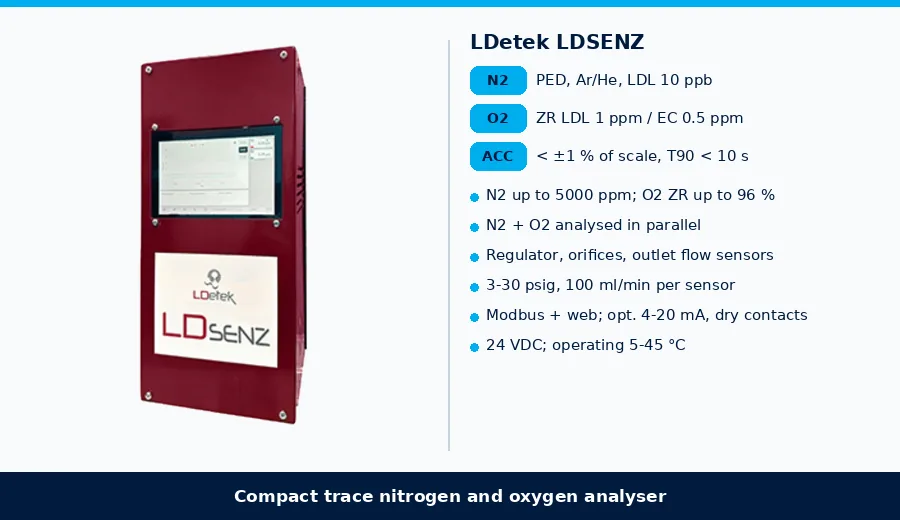
This note looks at the LDetek LDSENZ, LDetek's most compact analyser for trace nitrogen and/or oxygen in one instrument. Figures come from the LDetek LDSENZ datasheet (LDSENZ_V1_EN_DATASHEET_0622) hosted on our product page and from the current Tetracon product pages. Where we give general engineering advice, it is labelled as general. No performance claim here goes beyond the manufacturer's published data.
Why measure nitrogen and oxygen together
- Two impurities, two different stories. Oxygen tells you how reactive the atmosphere is; trace nitrogen in argon or helium is a sensitive sign of air ingress or purifier break-through (general). The LDSENZ combines both measurements in the same instrument (datasheet).
- Continuous, parallel analysis. Trace N2 and O2 are analysed continuously and in parallel, each on its own sensor (datasheet), so there is no switching delay between the two readings.
- A small footprint. LDetek describes the LDSENZ as its most compact nitrogen and/or oxygen analyser (datasheet), which suits space-constrained glovebox lines, lab benches and skid panels (general).
How the LDSENZ works
The LDSENZ pairs LDetek's plasma emission detector (PED) for nitrogen with the Senz-Tx oxygen sensor series from Ntron, available as a zirconia (ZR) or an electrochemical (EC) sensor (datasheet). In the PED, helium or argon is used as the discharge gas in a sealed quartz chamber, and nitrogen is measured continuously at its specific wavelength through a quartz window (datasheet). The PED is used for trace nitrogen in argon or helium sample gas (datasheet).
Inside the module an integrated ultra-high-purity mini pressure regulator holds the sensor inlet pressure steady, a dedicated flow orifice sits before each sensor to set a static flow, and a flow sensor at the outlet of each detector measures the real flow through it (datasheet). An Ethernet port gives access to the web interface, Modbus is standard, and an optional 4-20 mA output per sensor comes with a dry contact that can trigger alarms (datasheet).
The zirconia oxygen sensor is a non-depleting solid-electrolyte sensor heated above 400 °C, with unlimited shelf life without loss of calibration and low cross-sensitivity to other gases; a calibration interval of once per year is given (datasheet). The electrochemical sensor gives no output in the absence of oxygen, so only one calibration is required (datasheet).
LDetek LDSENZ at a glance
| Item | Senz-Tx zirconia (ZR) | Senz-Tx electrochemical (EC) | PED (LDetek) |
|---|---|---|---|
| Impurity detected | O2 | O2 | N2 |
| Sample gas | Multiple gases | Multiple gases | Argon / helium |
| Default ranges (resolution) | 0-10 ppm (0.5 ppm), 0-100 ppm (1 ppm), 0-1000 ppm (1 ppm); up to 96 % available | 0-10 ppm (0.1 ppm), 0-100 ppm (1 ppm), 0-1000 ppm (1 ppm); up to 25 % available | 0-10 ppm (100 ppb), 0-100 ppm (1 ppm), 0-1000 ppm (1 ppm); up to 5000 ppm available |
| Limit of detection | 1 ppm | 0.5 ppm | 10 ppb |
| Accuracy | < ±1 % of scale | < ±1 % of scale | < ±1 % of scale |
| Response time (T90) | < 10 s | < 10 s | < 10 s |
| Sensor life expectancy | 3-5 years | 1 year | > 10 years |
| Common item | LDSENZ datasheet |
|---|---|
| Operating temperature | 5-45 °C |
| Sample gas temperature | 0-100 °C |
| Sample flow | 100 ml/min per sensor installed |
| Sample pressure | 3-30 psig (an additional high-purity pump is used for lower sample pressure); outlet atmospheric |
| Fittings (inlet / outlet) | 1/8" or 1/4" Swagelok compression or VCR face seal |
| Communications | Modbus and web interface (admin) standard; options 4-20 mA outputs and dry contact outputs |
| Supply | 24 VDC |
| Ordering code | LDSENZ - PED (N2) - EC or ZI (O2) - 2S / 4S / 2FS / 4FS (fittings) - mA (4-20 mA) |
One range is available per sensor, and other ranges are available on request (datasheet), so choose the range for each sensor at the time of order. The datasheet does not give an ingress rating or a hazardous-area approval, so treat the LDSENZ as a safe-area instrument for laboratories, clean rooms and indoor skids (general reading of the datasheet).
Where it fits
- Gloveboxes and purged boxes. Listed in the datasheet. Oxygen in the ppm ranges shows whether the box atmosphere is fit for sensitive work, and nitrogen in an argon box warns of air ingress before oxygen alone would (general).
- Additive manufacturing. Listed in the datasheet. Powder-bed metal printers run under argon or nitrogen; the zirconia sensor covers ppm up to 96 % O2, and the PED tracks nitrogen in argon or helium (datasheet ranges; general application).
- Gas purification. Listed in the datasheet. Watching trace N2 and O2 at a purifier outlet shows when the purifier needs regeneration or service (general).
- Laboratory and medical gases. Industrial, medical and laboratory uses are listed in the datasheet. Typical tasks include checking argon or helium purity at the point of use and verifying gas supplies to sensitive instruments (general).
Practical notes for good readings
- Match the sensor to the background gas. The Senz-Tx sensors work in multiple gases, but the PED nitrogen measurement is for argon or helium sample gas (datasheet). Tell us the background gas before ordering (general).
- Choose zirconia or electrochemical with intent. Zirconia gives a 3-5 year life expectancy and up to 96 % O2; electrochemical gives the finer 0.1 ppm resolution on the 0-10 ppm range and a 0.5 ppm detection limit, with a 1 year life expectancy (datasheet). The Ntron SenzTx datasheet notes that the electrochemical sensor allows measurement in background gases containing hydrocarbons, so ask us which suits your gas (general).
- Keep the sample line clean and tight. At ppm and ppb levels, a leaking fitting or a plastic tube can add more oxygen and nitrogen than the process (general). Use the 1/8" or 1/4" compression or VCR face-seal fittings offered (datasheet) with clean stainless tubing and purge new lines well (general).
- Respect the flow and pressure window. Supply 3-30 psig at the inlet, allow 100 ml/min per sensor and vent to atmosphere; for lower sample pressure an additional high-purity pump is used (datasheet). The internal regulator, orifices and outlet flow sensors then keep the flow stable (datasheet).
- Plan the PED calibration gases. The PED is calibrated with a zero reference and a span reference: typically 99.999 % argon or helium through an LDetek LDP1000 purifier for zero, and a certified gas of about 10 ppm N2 in argon or helium for span (datasheet). Arrange these with your gas supplier in advance (general).
- Watch the room temperature. The LDSENZ operates from 5 to 45 °C (datasheet). Summer lab and plant rooms in Pakistan can exceed that without air conditioning, so site the analyser in a cooled space (general).
Related LDetek and Ntron analysers and when to choose them
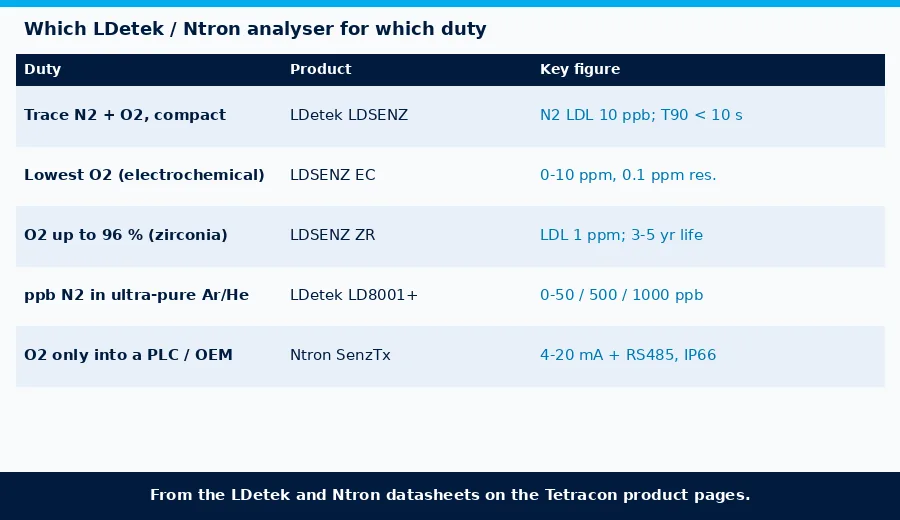
| Duty | Product | From the datasheet |
|---|---|---|
| Compact trace N2 and O2 in one instrument | LDetek LDSENZ | PED N2 in Ar/He, LDL 10 ppb, up to 5000 ppm; Senz-Tx O2 ZR (up to 96 %) or EC (up to 25 %); < ±1 % of scale; T90 < 10 s; 24 VDC; Modbus and web interface |
| ppb trace nitrogen in ultra-pure argon or helium | LDetek LD8001+ | PED with integrated ppt/ppb oscillation module; 0-50, 0-500 or 0-1000 ppb; < ±1 %; response < 1 min; 7" touchscreen; 3U rackmount; 115 or 220 VAC |
| Oxygen only, built into an OEM system or gas line | Ntron SenzTx | ZR 0-1000 ppmV up to 0-100 % or EC 0-1000 ppmV up to 0-25 %; T90 < 15 s; 4-20 mA and RS485 Modbus; 24 V DC; IP66 |
As a rule of thumb, choose the LDSENZ when both trace nitrogen and oxygen matter and space is tight, the LD8001+ when an air separation, specialty gas or semiconductor line needs nitrogen at low ppb, and the SenzTx when an OEM or skid builder only needs an oxygen signal into a PLC (general). For several impurities on several streams, a gas chromatograph such as the LDetek MultiDetek3 EX is the next step (general).
What to send with an enquiry
- The application (glovebox, purged box, 3D printer, purifier, gas supply) and the background gas: argon, helium, nitrogen or other.
- Whether you need nitrogen, oxygen or both, and the normal and alarm levels for each, so we can set one range per sensor.
- Your sample pressure and temperature at the take-off point, and whether a pump is needed below 3 psig.
- Preferred fittings (1/8" or 1/4", compression or VCR) and outputs (Modbus, web interface, 4-20 mA, dry contacts).
- Available calibration gases and your calibration and record-keeping requirements.
FAQ
What is the LDetek LDSENZ?
LDetek's most compact analyser for trace nitrogen and/or oxygen. It combines LDetek's plasma emission detector for nitrogen with a Ntron Senz-Tx zirconia or electrochemical oxygen sensor, and analyses both continuously in parallel.
How low can it measure?
The datasheet gives a limit of detection of 10 ppb for nitrogen with the PED, 0.5 ppm for oxygen with the electrochemical sensor and 1 ppm for oxygen with the zirconia sensor. Accuracy is better than ±1 % of scale on each sensor.
Which gases can it analyse?
The PED measures nitrogen in argon or helium. The Senz-Tx oxygen sensors are specified for multiple gases.
How fast does it respond?
The datasheet gives a T90 response time of less than 10 seconds for the zirconia, electrochemical and PED sensors.
What outputs and power does it need?
Modbus and an admin web interface over Ethernet are standard; 4-20 mA outputs with dry contacts are optional, one per sensor. The supply is 24 VDC.
What sample conditions does it need?
3-30 psig inlet pressure (an additional high-purity pump is used for lower pressure), 100 ml/min per sensor installed, sample gas from 0 to 100 °C and an atmospheric outlet. The analyser operates from 5 to 45 °C.
Next steps
Tetracon (Pvt.) Ltd. is the sole authorized agent for LDetek in Pakistan and supplies its trace gas analysers and gas chromatographs with local technical support. Send us your background gas, impurity levels and sample conditions, and we will propose the right configuration. Use the contact page or see our services. Start with the LDSENZ, compare the LD8001+ and the Ntron SenzTx, browse gas analysis and oxygen analysis, or see all LDetek and Ntron products and the full product catalogue. Related notes: trace nitrogen analysis for specialty gas and air separation plants, oxygen and moisture in metal 3D printing and oxygen monitoring for nitrogen blanketing and inerting. Free technical guides are collected under Guides.