

A gas smell reported near a service line, a reading at a bar hole over a buried main, a newly laid pipe that has to be purged before it goes live: these are everyday jobs for the field teams who run Pakistan's natural gas distribution networks and for the contractors, factories and housing schemes connected to them. Each job needs a handheld detector that is safe to carry into a gassy area, reads from a few ppm up to pure gas, and leaves a record of where and when the reading was taken.
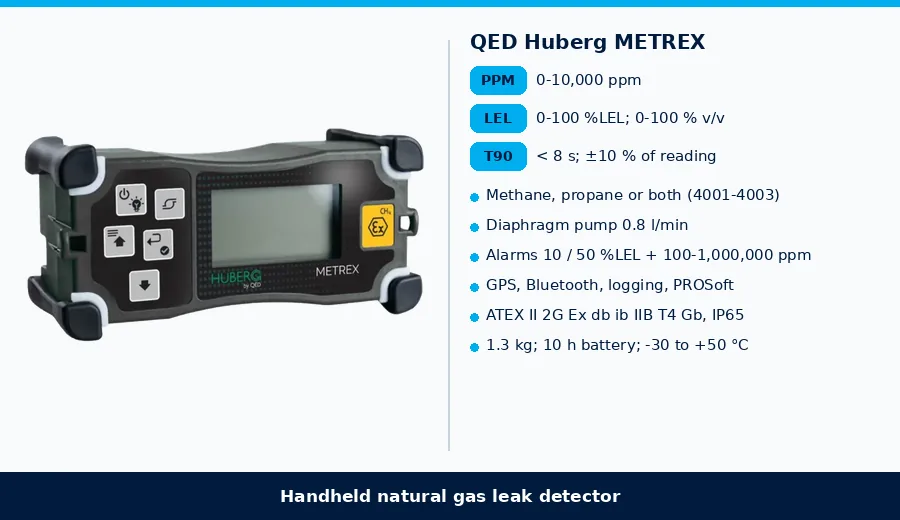
This note looks at the QED Huberg METREX handheld natural gas leak detector, an ATEX-certified instrument designed for pre-localisation, localisation and classification of natural gas leaks in gas distribution networks. Figures come from the METREX technical datasheet (QED DS 073 issue 02) hosted on our product page and from the current Tetracon product pages. Where we give general engineering advice, it is labelled as general. No performance claim here goes beyond the manufacturer's published data.
Why a handheld leak detector for gas distribution work
- One instrument from trace to pure gas. The METREX automatically scales between ppm, %LEL and % volume, with ranges of 0-10,000 ppm, 0-100 %LEL and 0-100 % v/v (datasheet). The same unit can sniff out a small leak at a meter, classify a bar-hole reading and confirm that a purged line is full of gas (general application).
- Built for first responders. QED describes it as ideal for first-responder technicians handling suspected gas leaks, with a robust design, five large keys and a simple menu (datasheet).
- Safe to take into the leak. It is ATEX certified II 2G Ex db ib IIB T4 Gb and performance certified to EN 60079-29-1 (datasheet).
- Evidence, not just a beep. Onboard data logging, integrated Bluetooth and GPS, and compliance reporting with QED's PROSoft software let a survey be mapped and reported afterwards (datasheet).
- Light enough for a full shift. It weighs 1.3 kg in operation, is 50 % lighter than the legacy model and runs 10 hours on a charge at 20 °C with the backlight on (datasheet).
How the METREX works
An internal diaphragm pump draws the sample at 0.8 l/min (800 cc/min) through a 25 mm PTFE 0.45 µm dust and water filter and a push-lock quick-connect coupler (datasheet). Gas is detected within 5 seconds, with a T90 of less than 8 seconds (datasheet). The reading is shown on an 86 x 47 mm LCD with a three-level adjustable backlight, and it moves between ppm, %LEL and % volume on its own as the concentration rises (datasheet).
Three gas versions are listed: the METREX 4001 for methane (CH4), the 4002 for propane (C3H8) and the 4003 for both methane and propane, each with an accuracy of ±10 % relative to reading and a minimum threshold of 100 ppm (datasheet). For pipeline natural gas the methane version is the usual choice; the propane options are relevant to LPG and LPG-air networks (general).
Alarms are audible and visual. Two LEL alarms are fixed at 10 % and 50 % LEL, a ppm/volume alarm can be set anywhere from 100 to 1,000,000 ppm, and the unit also warns when the gas threshold is reached or the pump has stopped (datasheet).
METREX at a glance
| Item | From the datasheet (DS 073 issue 02) |
|---|---|
| Gas versions | 4001 methane; 4002 propane; 4003 methane + propane |
| Ranges | 0-10,000 ppm; 0-100 %LEL; 0-100 % v/v, auto-scaling |
| Accuracy | ±10 % relative to reading; minimum threshold 100 ppm |
| Response | Gas detection in 5 s; T90 < 8 s |
| Sampling | Diaphragm pump, 0.8 l/min; PTFE 0.45 µm dust and water filter |
| Alarms | Fixed 10 % and 50 % LEL; user-set 100-1,000,000 ppm; audio and visual; pump-stopped warning |
| Data | Onboard logging; integrated Bluetooth and GPS; USB via the communication charger; PROSoft reporting |
| Certification | ATEX II 2G Ex db ib IIB T4 Gb; EN 60079-29-1; IP65 |
| Battery | Li-ion 3.7 V 4000 mAh; 10 h at 20 °C (backlight on); 4.5 h charge; 100-240 V ATEX charger; optional ATEX hot-swap battery |
| Environment | -30 to +50 °C operating; < 95 % RH non-condensing; 800-1,100 mbar |
| Size and weight | 230 x 97.5 x 110 mm; 1.3 kg in operation; carbon-reinforced polyamide case with impact bumpers |
| Calibration | Bump test with certified cylinder and Quicktest kit H-100157; calibration every 12 months by QED or an authorised QED service centre |
Where it fits
- Leak response on distribution networks. Listed in the datasheet as emergency services and leak detection in natural gas distribution networks. A crew answering a gas-smell complaint can check the air at the meter, inside the premises and along the service line, and move from ppm to %LEL readings as they close in on the source (datasheet applications; general practice).
- Bar-hole surveys over buried mains. Listed in the datasheet. A bar hole is driven into the ground above the pipe and the bar-hole sampling probe draws gas from it; comparing readings from neighbouring holes helps pinpoint where the leak is (general).
- Purging gas lines. Listed in the datasheet. During commissioning or after a repair, the % volume range shows when air has been displaced and the line is full of gas, and when a line being decommissioned is clear (general application).
- Enclosed spaces. Listed in the datasheet. Valve pits, meter rooms, basements and pump houses can be checked before entry (general).
- Industrial and commercial gas users. Not listed separately in the datasheet, but the same checks apply to factory gas trains, boiler houses, CNG stations and housing-scheme networks in Pakistan; tell us your duty and we will confirm fit (general).
Practical notes for good surveys
- Pick the right gas version. Order the 4001 for natural gas, the 4002 for propane/LPG, or the 4003 if your teams cover both (datasheet models; general).
- Bump test before the shift. The datasheet lists a gas calibration test with a certified cylinder and the H-100157 Quicktest kit, plus calibration every 12 months by QED or an authorised centre. A quick daily bump test confirms the sensor and alarms respond before the instrument is relied on (datasheet; general practice).
- Use the right probe. QED lists telescopic probes with air-sampling bells, bar-hole probes, a flexible-neck probe, a carpet probe and a 45° angled probe (datasheet). Bell probes suit walking surveys along a pipe route, bar-hole probes suit buried mains, and the flexible neck reaches behind meters and fittings (general).
- Keep water and dust out. Change the PTFE dust and water filter regularly; after rain or on wet ground, a blocked filter or water in the line will trip the pump-stopped warning (datasheet filter and warning; general).
- Mind the heat and the battery. The operating range is -30 to +50 °C, and battery life is quoted at 20 °C (datasheet). In a Pakistani summer, keep the unit out of a closed vehicle in direct sun and charge it overnight (4.5 h from empty); an ATEX hot-swap battery keeps long survey days going (datasheet; general).
- Know the area classification. The certification is Ex db ib IIB T4 Gb (datasheet). Natural gas and propane fall in gas group IIA, which a IIB instrument covers; hydrogen and hydrogen blends need a IIC-rated instrument, so ask us before using it on such duties (general).
- Map and report. Switch on GPS and logging so each reading carries a time and position, then download the survey to PROSoft for a map-based report (datasheet; general practice).
PROSoft survey reporting
PROSoft (part number H-707060P) is QED's software for mains gas leak detection, developed for gas distribution network operators. It links each logged reading by time, geographic location and detected gas level, overlays the survey on OpenStreetMap views, accepts the operator's own digital network maps and exports to KMZ, ESRI and .shp formats; it also supports live connection to a PC (datasheet). The licence listed is perpetual, single user (datasheet). For a utility or a contractor working to a utility's specification, this turns a walking survey into a record that shows where leaks were found relative to the pipe network (general).
Related QED products and when to choose them
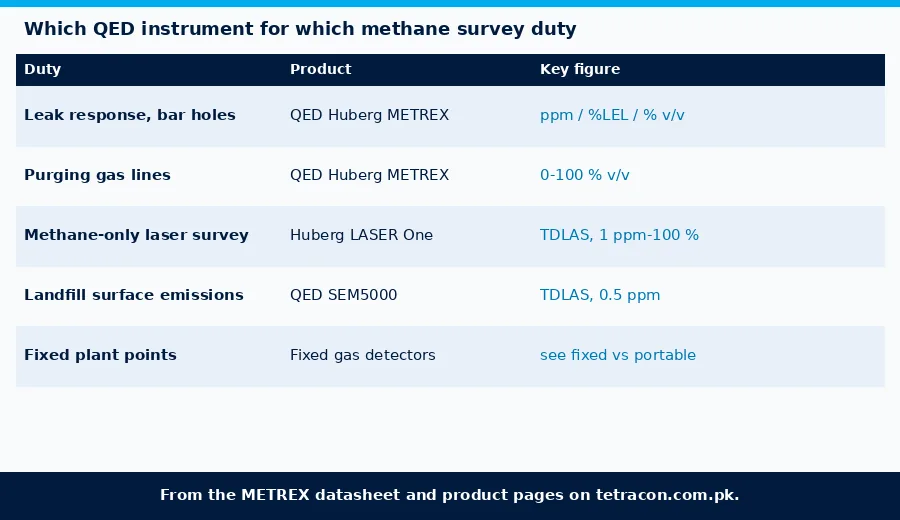
| Duty | Product | From the datasheet / product page |
|---|---|---|
| General leak response, bar holes, purging; methane and/or propane | QED Huberg METREX | 0-10,000 ppm / 0-100 %LEL / 0-100 % v/v; ±10 % of reading; T90 < 8 s; 0.8 l/min pump; ATEX II 2G Ex db ib IIB T4 Gb; 1.3 kg |
| Methane-only leak survey with laser selectivity | Huberg LASER One | TDLAS methane-only; 1 ppm to 100 % by volume; T90 2.5 s; ATEX Zone 1; factory calibration every 2 years |
| Landfill surface emissions walkover surveys | QED SEM5000 | TDLAS methane; 0.5 ppm to 100 % by volume; T90 2.5 s; daily field calibration meets Method 21 |
As a rule of thumb, choose the METREX as the everyday instrument for leak response, bar-hole classification and purging, especially where propane is also present; the LASER One when crews need methane-only readings that are not confused by other gases; and the SEM5000 for landfill surface-emission surveys. Fixed points such as compressor rooms and boiler houses are better covered by fixed detectors, see our note on fixed vs portable gas detection (general).
What to send with an enquiry
- The gases you need to detect (natural gas, propane/LPG or both), so we can confirm the 4001, 4002 or 4003 version.
- The main jobs: leak response, bar-hole surveys, purging, enclosed-space checks or plant walk-downs.
- The probes you need (telescopic bell, bar-hole, flexible neck, carpet, 45°) and whether a full package with carry case and chargers is preferred.
- Whether you need GPS-tagged logging and PROSoft reporting, and how many users will download data.
- The area classification of the sites, and whether any hydrogen or hydrogen-blend duty is planned.
- How many crews and shifts will use the instruments, to size spare batteries, filters and bump-test kits.
FAQ
What does the METREX measure?
It measures natural gas (methane), propane, or both, depending on the version, with automatic scaling across 0-10,000 ppm, 0-100 %LEL and 0-100 % by volume.
How accurate and fast is it?
The datasheet gives an accuracy of ±10 % relative to reading, a minimum threshold of 100 ppm, gas detection within 5 seconds and a T90 of less than 8 seconds.
Is it certified for hazardous areas?
Yes. It is ATEX certified II 2G Ex db ib IIB T4 Gb and performance certified to EN 60079-29-1, with an IP65 enclosure.
How long does the battery last?
The Li-ion battery runs for 10 hours at 20 °C with the backlight on and recharges in 4.5 hours; an ATEX hot-swap battery is available as an option.
Can survey data be mapped?
Yes. The METREX logs readings with integrated GPS and Bluetooth, and QED's PROSoft software maps the survey on OpenStreetMap views and exports to KMZ, ESRI and .shp formats.
How often does it need calibration?
The datasheet lists calibration every 12 months by QED or an authorised QED service centre, with gas tests using a certified cylinder and the H-100157 Quicktest kit in between.
Next steps
Tetracon (Pvt.) Ltd. is the sole authorized agent for QED Environmental Systems in Pakistan and supplies its gas detection and gas analysis instruments with local technical support. Send us your gases, survey jobs, probe needs and area classification, and we will confirm whether the METREX or another instrument is the right fit. Use the contact page or see our services. Start with the METREX, compare the Huberg LASER One and SEM5000, browse gas detection, or see all QED Environmental Systems products and the full product catalogue. Related notes: natural gas leak detection with the LASER One, fixed vs portable gas detection and electronic volume correctors for natural gas metering. Free technical guides are collected under Guides.