

Natural gas reaches Pakistani factories, captive power plants, CNG stations, hotels and commercial buildings through the SNGPL and SSGC networks, and industrial and commercial supplies are usually metered at elevated pressure. That creates a measurement problem many plant engineers underestimate. A turbine, rotary or diaphragm meter counts the cubic metres that pass through it at line pressure and temperature, but gas is bought, sold and allocated in standard cubic metres or energy at agreed base conditions. The device that turns one into the other, continuously and with an audit trail, is an electronic volume corrector (EVC).
This note explains what an EVC corrects, why small pressure and temperature errors become large billing errors, and how Galvanic Applied Sciences' GAS MICRO NG electronic volume corrector is specified and installed. Instrument figures come from Galvanic's GAS MICRO NG datasheet (Rev. 1, February 2025), the GAS MICRO NG product page and the GAS MICRO NG user operation manual (Rev. 1, January 2025). The worked numbers are our own illustrative arithmetic and are labelled as such. No prices are given. Your base conditions, calculation methods and sealing requirements come from your gas supply agreement and should be confirmed at quotation.
Why a gas meter alone does not tell you how much gas you used
Gas is compressible. The same mass of gas takes up less space when the pressure rises or the temperature falls, so a cubic metre counted at 3.5 bar contains several times more gas than a cubic metre at atmospheric pressure. To compare like with like, the metered (uncorrected) volume Vm is converted to the volume at base conditions Vb with the standard PTZ correction:
Vb = Vm × (P ÷ Pb) × (Tb ÷ T) × (Zb ÷ Z)
Here P and T are the absolute pressure and temperature of the gas at the meter, Pb and Tb are the base pressure and temperature in your contract, and Zb and Z are the compressibility factors at base and line conditions. The GAS MICRO NG shows each of these factors separately on its display: the pressure factor P/Pb, the temperature factor Tb/T, the supercompressibility FPV and the overall correction factor.
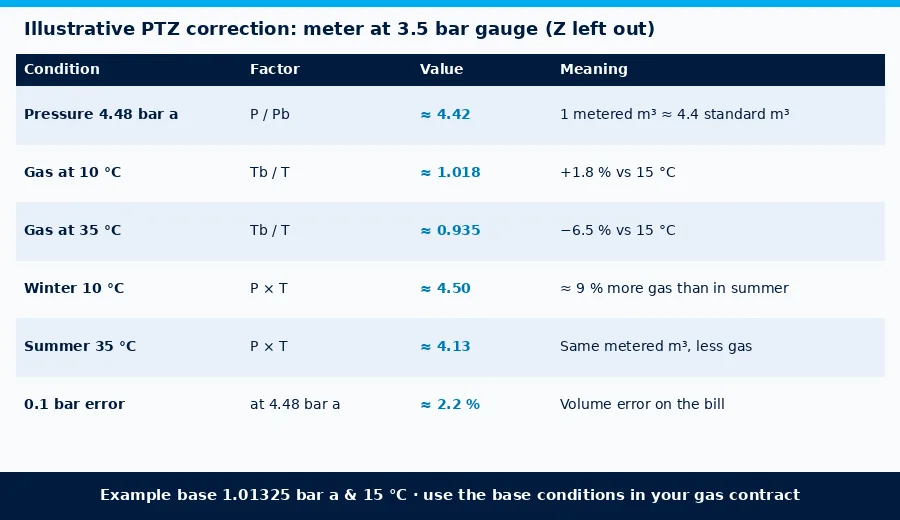
A simple worked example (our arithmetic, using example base conditions of 1.01325 bar absolute and 15 °C, with compressibility left out):
| Condition at the meter | Factor | What it means |
|---|---|---|
| 3.5 bar gauge on a day when the atmosphere is 0.98 bar, so 4.48 bar absolute | P/Pb ≈ 4.42 | Each metered m³ holds about 4.4 standard m³ |
| Gas at 10 °C (winter morning) | Tb/T ≈ 1.018 | About 1.8 % more gas per metered m³ than at 15 °C |
| Gas at 35 °C (summer afternoon) | Tb/T ≈ 0.935 | About 6.5 % less gas per metered m³ than at 15 °C |
| Combined, 3.5 bar(g): winter 10 °C vs summer 35 °C | ≈ 4.50 vs ≈ 4.13 | The same metered volume differs by about 9 % in standard volume between seasons |
The same arithmetic shows why measurement quality matters. At 4.48 bar absolute, a 0.1 bar pressure error is a 2.2 % volume error, and a 1 °C temperature error is about 0.3 %. Compressibility adds a further correction that is small at a few bar and grows with line pressure, which is why AGA 8 or NX-19 calculations are used rather than ignoring it. On a large industrial or captive-power supply, a few percent is a lot of money every month, for the buyer or for the seller.
Altitude is a Pakistan-specific trap. If a gauge pressure sensor is used and the EVC assumes sea-level atmosphere (1.013 bar) at a site where the real atmosphere is nearer 0.95 bar, such as Islamabad at about 540 m, the absolute pressure at 3.5 bar(g) is overstated by about 1.4 %. The GAS MICRO NG's pressure sensors can measure gauge or absolute pressure, and an on-board barometer is available, so the correct atmospheric pressure is used instead of a fixed assumption.
How an EVC works
- Volume input. The EVC reads the meter's output: low-frequency pulses from a reed switch, high-frequency pulses from a NAMUR proximity sensor on a turbine meter, or, on meters with an instrument drive, a mechanical pulse transmitter index (MPTI) that bolts onto the meter. Galvanic's MPTI is an ANSI/ASME B109.3 universal base mount with three reed switches: two count volume and detect flow direction, and the third detects external magnetic fields used to tamper with the count.
- Pressure and temperature. A pressure transducer on a tapping near the meter and a temperature probe in a thermowell measure line conditions every scan.
- Compressibility. The EVC calculates Z from the gas composition or from simpler inputs such as relative density and CO2 and N2 content, depending on the method chosen.
- Corrected totals and records. It keeps uncorrected and corrected volume registers, flow rates, hourly, daily and monthly archives, alarm and event logs, and a log of every parameter change, so the corrected volume can be audited later.
An EVC does not replace a good meter. Meter sizing, installation and proving still decide the uncorrected volume. The EVC makes sure that volume is converted correctly and that the evidence is kept.
Galvanic GAS MICRO NG at a glance
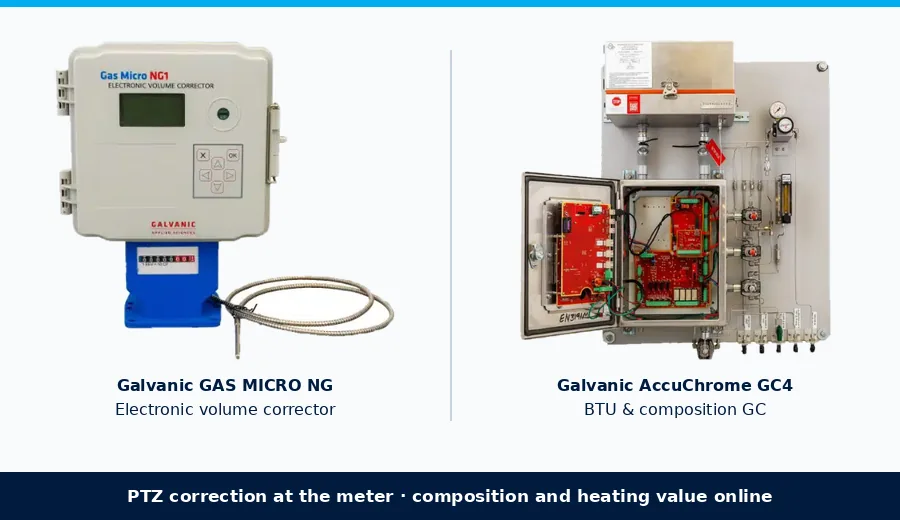
The GAS MICRO NG is Galvanic's next-generation EVC, building on the original GAS MICRO. It is a battery-powered, single-stream PTZ corrector for turbine, rotary and diaphragm meters, with optional 4G communication for remote reading and configuration.
| Item | Galvanic specification |
|---|---|
| Meter types and inputs | Turbine, rotary and diaphragm meters; low-frequency and high-frequency pulse inputs; direct NAMUR sensor interface; universal base mount for instrument-drive meters |
| Flow direction | Unidirectional, bidirectional and reverse flow, with rocking detection and compensation |
| Pressure | Smart digital pressure sensors, gauge or absolute; measurement range 15 to 1,500 psia (1 to 100 bar absolute); accuracy ±0.05 % of reading. Two pressure inputs: one for metering, one for monitoring |
| Temperature | Four-wire PT1000 probe; accuracy ±0.15 % of reading |
| Compressibility methods | AGA 8 Detailed, AGA 8 Gross 1, AGA 8 Gross 2, AGA NX-19 |
| Meter correction | AGA 7, K or Q factor |
| Energy | ISO 6976 heating value; AGA 5 mass and volume methods |
| Sensor failure handling | Configurable default values used when a sensor fails, for pressure, temperature, supercompressibility and corrected volume |
| Other I/O | 3 analogue inputs, 8 digital inputs, 4 digital outputs |
| Communication | Optical interface, RS-232 and RS-485; Modbus RTU, Modbus TCP and Enron Modbus; optional 4G LTE modem with 3G fallback, SMS alarms to up to 3 recipients, report by exception, AMR/AMI compatible |
| Data archive | Hourly 365 days, daily 365 days, monthly 120 months; alarm, event, communication and parameter-change logs of 500 records each |
| Power | 3.6 V lithium; up to 10-year EVC battery life; cellular version up to 5-year battery life when reporting twice a day |
| Environment | −40 to +70 °C ambient; IP67, f1 outdoor-rated enclosure; 240 × 120 backlit graphics LCD and keypad |
| Hazardous area | Class I Div 1 Groups ABCD T3; Ex ia IIC T3 Ga (Zone 0); Class I Div 2; Ex ic IIC T3 Gc |
| Metrology | Measurement Canada (listed under metrology in the datasheet); Galvanic also lists compliance with AER Directive 017 and API MPMS Chapter 21; certified for legal metering and sealable |
CORE, PRO or FLOW?
Galvanic offers the GAS MICRO NG in three feature levels. Choose by how the meter is read and what the contract needs.
| Level | Main features (Galvanic product page) | Typical fit |
|---|---|---|
| CORE | 1-stream PTZ correction; LF pulse input or universal base mount; no-calibration pressure sensors; 10-year battery life; 12 months of hourly and daily logs and 10 years of monthly logs; 500 alarm and event logs; Modbus RTU over RS-232 and RS-485 | Rotary or diaphragm meters read on site or by a local SCADA/RTU link |
| PRO | CORE plus wireless modem, report by exception, Modbus TCP, time synchronisation, 5-year modem battery, external DC power input, NAMUR sensor compatibility, AGA 7 meter correction and presence sensor | Remote reading over 4G; turbine meters needing AGA 7 correction |
| FLOW | PRO plus HF pulse input, AGA 5 energy and mass calculation, ISO 6976 heating value, extra analogue channels and digital I/O control channels | Energy-based billing, larger turbine meters, sites that also need valve control or extra monitoring |
One detail from the manual is worth knowing: the high-frequency input and the NAMUR sensor supply only work when the unit is on external DC power. On battery the EVC scans its sensors every 30 seconds, and every 5 seconds on external DC. A turbine meter with an HF NAMUR pickup therefore needs a certified DC supply or a supply through a certified intrinsic-safety barrier, while a rotary meter with an LF reed switch can run on the battery alone.
Checks that matter at Pakistani metering stations
- Heat and sun. The −40 to +70 °C rating covers summer in Sindh and southern Punjab, but the manual warns that several units in a confined cabinet or next to other heat sources can push the internal temperature beyond its limit. Mount it at eye level, shaded and ventilated, and keep the temperature probe in a thermowell in the gas, not exposed to the sun on the pipe surface.
- Atmospheric pressure. Use absolute pressure or the on-board barometer at sites well above sea level such as Islamabad, Murree or Quetta, as shown in the example above.
- Gas composition. Where imported RLNG is blended with domestic gas, the composition and heating value can change. AGA 8 Detailed uses a full composition. If you buy on energy, the heating value has to come from a reliable composition source, such as an online chromatograph like the Galvanic AccuChrome GC4 or the utility's published analysis. See our note on natural gas BTU and composition analysis.
- Tamper evidence. The GAS MICRO NG records magnetic tamper events (from the MPTI's third reed switch or a tamper input), lid-open events and every parameter change. A magnetic tamper flag stays set until an admin-level user clears it. Metrological seals, wire seals and an internal programming-protection switch prevent changes to metrological settings locally or remotely. At each reading, compare the EVC's uncorrected register with the meter's mechanical counter.
- Faults are recorded, not hidden. When a pressure or temperature sensor fails, the EVC uses the configured default values and keeps the volume measured during the fault in separate "disturbed" volume registers, so both parties can see and settle it.
- Hazardous area. Metering skids are usually classified areas. The GAS MICRO NG is intrinsically safe (Ex ia IIC T3 Ga), but its RS-232 port may only be connected to certified intrinsically safe circuits, or used with the unit outside the hazardous area. External DC power must come from a certified supply in a safe area (or Zone 2 in some cases) or through a certified barrier.
- Remote reading. With the 4G option, the EVC can push hourly and daily data to a central server, send SMS alarms and wake up on exceptions. Check mobile coverage at the meter and plan for an external high-gain antenna if the station is in a pit or a steel kiosk.
Installation and commissioning
- Agree the basis first. Base pressure and temperature, units, the compressibility method (AGA 8 Detailed, Gross 1 or 2, or NX-19), the gas composition or relative density inputs, and whether billing is on volume or energy. These come from the gas supply agreement.
- Mount it. Directly on an instrument-drive meter with the MPTI (set the bevel gears to match the meter's clockwise or anticlockwise drive), or on a 3-inch pole, wall or flange with the mounting kits when the meter has a pulse output.
- Connect pressure and temperature. Pressure via the G ¼ port on the back of the housing using a pressure connection kit, holding the counter-nut so the composite housing is not stressed. The PT1000 goes into a thermowell close to the meter. Galvanic supplies the sensors as part of the instrument; substitutes can void the hazardous-area approval.
- Configure. With Galvanic's free NGConnect software over the optical port or RS-232, set the site ID, meter factor (pulses per m³), base conditions, calculation method, alarms, archive interval and, for 4G units, the APN and server addresses.
- Verify and seal. Check pressure and temperature against reference instruments, compare uncorrected volume with the meter index over a test period, set the programming-protection switch, then fit the metrological and wire seals as your contract requires.
What to send with an enquiry
- Meter type, make, size and output: rotary, turbine or diaphragm; instrument drive, LF reed or HF NAMUR; pulses per m³.
- Line pressure range (minimum, normal, maximum) and whether you need a second pressure input for monitoring.
- Gas temperature range, site altitude and whether the station is shaded or in a kiosk.
- Base conditions, compressibility method and whether billing is on volume or energy.
- Power available at the meter (battery only, or a safe-area DC supply) and the hazardous-area classification.
- How data will be read: on site, Modbus to an RTU or SCADA, or 4G to a central server, plus any alarm outputs or slam-shut valve signals needed.
FAQ
What does an electronic volume corrector do?
It reads the pulses from a gas meter together with the gas pressure and temperature, calculates compressibility, and converts the metered volume at line conditions into volume at the base conditions in the gas contract. It also keeps time-stamped archives, alarms and an audit trail of changes.
How much difference does volume correction make?
A lot at elevated pressure. In our illustrative example, a meter at 3.5 bar gauge registers about 4.4 standard m³ for every metered m³, and the same metered volume is worth about 9 % more gas at 10 °C than at 35 °C. A 0.1 bar pressure error at that pressure is roughly a 2 % volume error.
Which meters can the GAS MICRO NG work with?
Turbine, rotary and diaphragm meters. It can mount directly on meters with an instrument drive using the mechanical pulse transmitter index, or take low-frequency or high-frequency pulses (including NAMUR sensors) from meters with a pulse output.
Which compressibility methods does it support?
AGA 8 Detailed, AGA 8 Gross 1, AGA 8 Gross 2 and AGA NX-19. It also supports AGA 7 meter correction, ISO 6976 heating value and AGA 5 energy and mass calculations, depending on the feature level.
Can it be installed in a hazardous area?
Yes. It is certified intrinsically safe, including Ex ia IIC T3 Ga for Zone 0 and Class I Division 1. Connections to its RS-232 port and external DC power must follow the intrinsic-safety rules in the manual, using certified circuits or barriers.
How long does the battery last?
Galvanic quotes up to 10 years of EVC battery life on lithium, and up to 5 years for the cellular version when it reports twice a day. Actual life depends on configuration and reporting frequency. The battery can be changed without breaking the metrological seals.
Where can Pakistani gas users see the product and ask for a quotation?
See the GAS MICRO NG catalogue page, browse process instrumentation, or contact Tetracon with your meter details, pressure range and how you want to read the data.
Next steps
Tetracon supplies Galvanic Applied Sciences gas measurement and analysis instruments to gas utilities, industry, captive power and process plants across Pakistan. Send us the meter type and output, pressure and temperature range, base conditions, power available and how the data should be read, and we will propose the right GAS MICRO NG level, sensors and mounting. Use the contact page or see our services. Start with the GAS MICRO NG catalogue page, the original GAS MICRO and the AccuChrome GC4 BTU analyser, browse gas analysis instruments, or see all Galvanic Applied Sciences products. Gas quality matters as much as quantity: see our notes on hydrocarbon and water dew point, H2S and total sulfur monitoring and natural gas leak detection. Free technical guides are collected under Guides.