

Electricity is one of the largest controllable costs in Pakistani factories, hospitals, commercial buildings and cold stores, yet many sites still see energy only once a month, as a single figure on the utility bill. That bill tells you what the whole site used; it does not tell you which compressor, chiller, production line or tenant drove the maximum demand, or how much a new rooftop solar plant is actually delivering to a particular panel. Sub-metering, a meter on each important feeder or load, closes that gap and turns energy into a number the maintenance and production teams can act on.
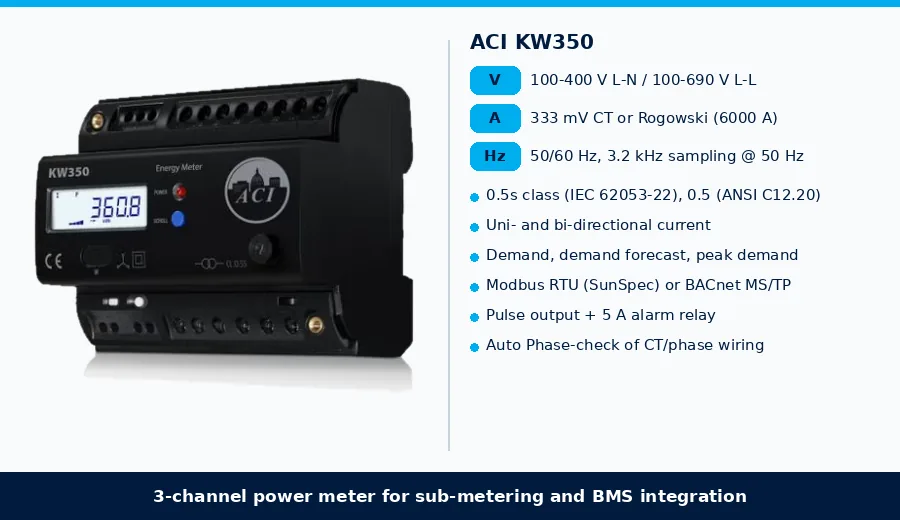
This note looks at the ACI KW350 bi-directional power meter from Automation Components, Inc. (ACI), a DIN-rail energy meter with serial Modbus RTU and BACnet MS/TP communication, and at how it fits into Pakistani panels. Figures come from the ACI KW350 product datasheet (the copy hosted on our product page) and the current Tetracon product pages. Where we do our own arithmetic it is labelled. No prices are given; meter version, current sensors and lead time should be confirmed at quotation.
Why sub-metering pays back in Pakistani plants and buildings
ACI lists the KW350 for sub-metering electrical panels, equipment load monitoring, industrial applications, predictive maintenance, renewable energy, overhead cost reduction, "Net Zero", LEED and green buildings, and refrigeration. In a Pakistani context those duties usually look like this:
- Finding where the demand comes from. Industrial and commercial bills in Pakistan include a maximum-demand component as well as energy. The KW350 records demand for current, active, reactive and apparent power, gives a demand forecast and keeps the peak demand, so you can see which loads overlap to create the peak.
- Solar and other on-site generation. The meter monitors uni-directional and bi-directional current. On a panel that both imports from the grid and receives power from a rooftop solar inverter, a bi-directional meter shows energy flowing each way instead of only a net figure.
- Cost allocation. Splitting consumption between production lines, buildings, tenants or departments, so that each one sees its own kWh and kW.
- Equipment health. A compressor, pump or chiller that slowly draws more current or runs at a worse power factor for the same duty is telling you something; trending those values is a simple form of predictive maintenance.
ACI KW350 at a glance
| Item | ACI KW350 datasheet |
|---|---|
| Type | 3-channel power meter, 0.5 class accuracy, serial communication protocols; DIN rail mounting, or panel upgrade version in a NEMA 4X enclosure |
| Service type | Single phase; three phase four wire (WYE); three phase three wire (Delta) |
| Rated voltage | 100-400 V AC line to neutral, or 100-690 V AC line to line; 50/60 Hz |
| Current inputs | 3 CT inputs: 333 mV CTs, or Rogowski coils for 0 to 6000 A (current sensors sold separately) |
| Accuracy | Revenue grade: IEC 62053-22 0.5s class / ANSI C12.20 0.5 class |
| Direction | Uni-directional and bi-directional current |
| Measurement | Real-time true RMS voltage, current, power, frequency and power factor; sampling 3.2 kHz at 50 Hz |
| Update rate | Real-time parameters 200 ms; accumulated parameters 1 s |
| Communication | RS-485 Modbus RTU (SunSpec, IEEE-754 single precision float) or BACnet MS/TP, user selectable; up to 1200 m at 100 kbit/s or less |
| Other outputs | Energy pulse output (isolated, 5-60 V DC, 10 mA max, external 24 V DC supply required); built-in alarm relay (5 A at 250 V AC / 30 V DC resistive) |
| Meter power | 100-415 V AC 50/60 Hz or 100-300 V DC; under 2 W or 10 VA; external 1 A / 600 V AC fuse |
| Display and set-up | Built-in LCD with 3 display modes; password-protected settings; sealed, tamper-proof cover; AcuRev 1310 utility software (Windows) via a USB-RS485 converter |
| Environment | Operating -25 to 70 °C; 5-95% RH non-condensing; IP67 (EN 60529) as stated in the datasheet |
| Approvals | BTL Certified, CE, UKCA, RoHS2, cULus Listed |
| Size, weight | 108 x 90 x 62.5 mm; 0.372 kg |
| Warranty | ACI five-year limited warranty |
What the KW350 measures
Table 1 of the datasheet lists the parameters, each with its accuracy and resolution:
- Energy: active (1 Wh resolution), reactive (1 varh) and apparent (1 VAh), each at 0.5% accuracy.
- Instantaneous values: voltage (0.1 V), current (0.001 A), active, reactive and apparent power (1 W / var / VA), power factor (0.001), all at 0.5%; frequency at 0.2% with 0.01 Hz resolution.
- Demand: power demand and current demand at 0.5%, plus demand forecasting and peak demand.
- Events: the meter records time and event information for important parameter events, such as the run time of the meter and alarm functions.
The Auto Phase-check function automatically checks for common wiring mistakes, such as current transformer direction and voltage and current phase alignment. On a retrofit where CTs are clipped onto existing cables in a crowded panel, that check is worth more than it sounds: a reversed CT on one phase is one of the most common reasons a sub-meter reads nonsense.
Choosing the current sensor: 333 mV CT or Rogowski coil
The meter version is chosen by the type of current sensor, and the sensors themselves are ordered separately (ACI offers hinged, split-core, solid-core and Rogowski coil types on their own datasheets):
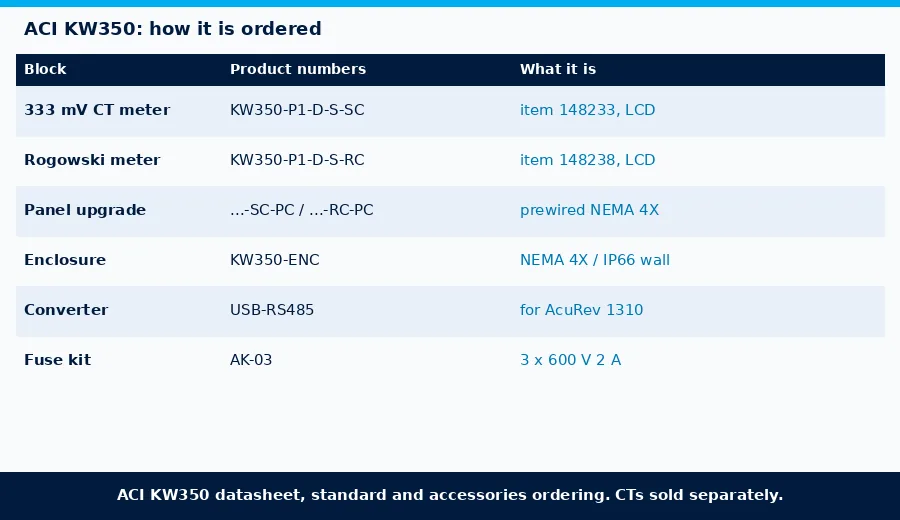
- KW350-P1-D-S-SC (item 148233): 333 mV CT input. Suits most sub-metering on feeders and individual loads. To keep accuracy, the current should stay within 150% of the CT rating. As our own arithmetic: a 200 A rated 333 mV CT covers loads up to about 300 A, so size the CT to the real load, not only to the breaker.
- KW350-P1-D-S-RC (item 148238): Rogowski coil input. Flexible coils wrap round large cables or busbars and cover up to 6000 A, which suits main incomers and large LV feeders where a rigid CT will not fit.
- Panel upgrade versions KW350-P1-D-S-SC-PC (148973) and KW350-P1-D-S-RC-PC (148972). The same meters installed in a NEMA 4X enclosure with labelled, prewired supply voltage and CT terminal blocks and fuses, so the electrician lands cables on terminals instead of building a meter panel.
- Accessories. KW350-ENC NEMA 4X / IP66 wall-mount enclosure (148240) with DIN rail, swing panel and tamper-proof locking options; USB-RS485 converter (148243) for the utility software; AK-03 inline fuse kit, three 600 V 2 A slow-blow fuses (150827).
What 0.5 class means in kWh
The examples below are our own arithmetic, applying the 0.5% figure from the datasheet to typical numbers. Class accuracy is defined under the conditions of the standards quoted, and the error of the CTs or Rogowski coils adds to the meter's own error, so treat these as an order of magnitude for planning rather than a guaranteed band.
| Case | Datasheet figure | What it works out to (Tetracon arithmetic) |
|---|---|---|
| Feeder using 50,000 kWh a month | Active energy 0.5% | About ±250 kWh a month from the meter |
| Compressor drawing 150 kW | Active power 0.5% | About ±0.75 kW |
| Load at 400 A | Current 0.5%, resolution 0.001 A | About ±2 A |
| Power factor 0.90 | Power factor 0.5%, resolution 0.001 | About ±0.005 |
For cost allocation and trend monitoring this is more than enough: a sub-meter's job is to show where energy goes and when it changes. The datasheet says the tamper-proof design is approved for revenue applications; in Pakistan, however, the meter your distribution company bills from (including any net-metering meter) remains the utility's own meter, so use the KW350 for in-house metering, verification and allocation.
Getting the data out: Modbus RTU, BACnet MS/TP, pulses and a relay
- Modbus RTU. RS-485, 1200 to 115200 baud (19200 default), 8 data bits, none/even/odd parity, 1 or 2 stop bits. Registers follow SunSpec with IEEE-754 single-precision floats, which most PLCs, SCADA packages and energy-management software can read directly.
- BACnet MS/TP. 9600 to 115200 baud (38400 default), up to 127 MS/TP masters (MAC 0-127), device instance field-adjustable from 1 to 4194303, and BTL certification for building management systems.
- Bus length. Up to 1200 m at 100 kbit/s or less. Fit a 120-300 Ω, 1/4 W termination resistor at the end of the RS-485 bus; it is not included.
- Energy pulses. A two-wire isolated pulse train (2500 V AC isolation, 5-60 V DC, 10 mA max, pulse width 20-100 ms, pulse constant 1-60,000) for counters or older data loggers. It needs an external 24 V DC supply; ACI recommends a 1 kΩ current-limiting resistor.
- Alarm relay. A built-in relay (250 V AC / 30 V DC, 5 A resistive) that can trigger an alarm.
Because the KW350 speaks the same protocols as other ACI field devices, one RS-485 trunk can carry energy data alongside, for example, ACI Q6/B6 dual-sensor gas detectors (Q6 Modbus RTU, B6 BACnet MS/TP) in a plant room or car park, as covered in our note on CO and NO2 monitoring in car parks. Keep to one protocol per bus.
Installation points for Pakistani sites
- Voltage and frequency. Pakistani LV supply at 230 V line to neutral and 400 V line to line, 50 Hz, sits within the KW350's 100-400 V L-N / 100-690 V L-L rating. Medium-voltage feeders are metered on the LV side of the transformer or through voltage transformers; confirm the configuration at quotation.
- Keep the meter alive through load shedding. The meter accepts 100-415 V AC or 100-300 V DC on its own supply terminals, so it can be powered from a UPS or DC supply instead of the monitored circuit, and keeps communicating during changeover. Fit the external 1 A / 600 V AC fuse ACI specifies.
- Generators and solar. Decide where each meter sits relative to the grid / generator changeover and the solar inverter connection, and which direction counts as import. Bi-directional measurement only helps if the CT orientation and the meter's direction convention are agreed on the drawing.
- Heat and dust. The operating range is -25 to 70 °C, but a closed panel in direct summer sun in Sindh or Punjab can run very hot inside; shade and ventilate it. For dusty or wash-down areas use the KW350-ENC NEMA 4X / IP66 enclosure or the panel upgrade version. Humidity must stay non-condensing.
- Wiring. Screw terminals take 14-22 AWG (2.5 to 0.34 mm²). As a general engineering point, 333 mV CTs and Rogowski coils give a low-voltage output rather than the 5 A secondary of a conventional CT, but the meter's voltage taps are still at line voltage: isolate before working.
- Commissioning. Run the Auto Phase-check after installation, set a password for the settings, and record the Modbus address or BACnet instance of every meter on the single-line diagram.
What to send with an enquiry
- Number of meters and what each one monitors (incomer, feeder, machine, tenant, solar inverter)
- Supply type: single phase, three phase four wire or three phase three wire, and the voltage
- Maximum current and cable or busbar size at each metering point (to choose CT or Rogowski coil)
- Whether power flows both ways at that point (solar, generator, export)
- DIN rail in an existing panel, or the prewired NEMA 4X panel upgrade
- Where the data must go: PLC or SCADA over Modbus RTU, BMS over BACnet MS/TP, or pulse counters
- Panel location conditions: indoor or outdoor, sun, dust, wash-down
FAQ
What does the ACI KW350 measure?
Active, reactive and apparent energy and power, voltage, current, power factor and frequency, plus current and power demand with demand forecasting and peak demand, on single-phase, three-phase four-wire or three-phase three-wire services.
Can the KW350 measure solar export as well as import?
Yes. The datasheet says the meter monitors both uni-directional and bi-directional current, so it can separate energy flowing in each direction at a panel that also receives power from on-site generation.
How accurate is it?
The datasheet gives revenue-grade accuracy to IEC 62053-22 class 0.5s and ANSI C12.20 class 0.5, with 0.5% for energy, power, voltage, current and power factor and 0.2% for frequency. The current sensors add their own error.
Which current transformers does it use?
Either 333 mV output CTs (KW350-P1-D-S-SC) or Rogowski coils for up to 6000 A (KW350-P1-D-S-RC). The current sensors are sold separately.
How does it connect to a PLC, SCADA or BMS?
Over RS-485 using Modbus RTU (SunSpec registers, IEEE-754 floats) or BACnet MS/TP, selectable in the meter, up to 1200 m. There is also an isolated energy pulse output and an alarm relay.
Can it replace the utility billing meter?
The datasheet says the tamper-proof design is approved for revenue applications, but in Pakistan the meter your distribution company bills from stays the utility's own. Use the KW350 for sub-metering, cost allocation and checking the bill.
Next steps
Tetracon supplies ACI (Automation Components, Inc.) building and process sensors across Pakistan, including the KW350 power meter, Q5/B5 and Q6/B6 gas sensors and DLP differential pressure transmitters. Send us your single-line diagram or a list of the loads you want to meter, and we will help choose the meter version, current sensors and communication set-up. Use the contact page or see our services. Start with the ACI KW350 power meter, see the Q6/B6 and Q5/B5 BACnet/Modbus gas sensors and the DLP differential pressure transmitter, browse process instrumentation, or see all ACI products and the full product catalogue. Related notes: CO and NO2 monitoring in car parks with ACI Q6/B6, differential pressure monitoring for cleanrooms and HVAC and CO2 monitoring for indoor air quality and HVAC. Free technical guides are collected under Guides.