

The Bourdon-tube pressure gauge is the most common instrument in almost every Pakistani plant. There are dozens on a single wellhead skid in Sindh, Khyber Pakhtunkhwa or the Potohar plateau, and hundreds across a gas compression station, a fertilizer complex, a refinery, a power station boiler house, a sugar mill or a textile processing unit. Gauges are often bought on price and replaced only after they fail: a pointer that flutters on a pump discharge until the movement wears out, a window fogged by summer sun, a brass tube corroded by the process, or, worst of all, a Bourdon tube that ruptures in front of an operator.
This note explains the decisions that matter when you specify or replace a gauge, and maps them to real catalogue gauges on this site from Miljoco and Weiss Instruments. All specifications below come from the published product pages and manufacturer datasheets.
Five questions to answer before you order a gauge
| Question | Why it matters | Rule of thumb |
|---|---|---|
| Range | An over-ranged gauge loses calibration; an oversized range is hard to read | Full scale about twice the normal operating pressure |
| Accuracy grade | Sets how much you can trust the reading for control, testing or custody decisions | Grade B for utilities, Grade 1A for general process, Grade 2A for critical or test points |
| Wetted parts | The Bourdon tube and socket touch the process fluid | Brass/bronze for water, air and oil; 316 stainless steel for gas, chemicals and outdoor service; Monel for special media |
| Dry or liquid filled | Fill damps vibration and pulsation but narrows the temperature limits | Liquid filled on pumps, compressors and engines; dry on hot or stable service |
| Case and safety | Decides what happens if the tube fails | Solid front with blow-out back where operators stand in front of high-pressure gas, steam or chemicals |
Choosing the range
A Bourdon tube is most accurate and lasts longest when it works in the middle of its scale. Weiss's selection guidance is simple: the gauge range should be about twice the operating range, with ASME B40.1 as the reference standard. A pump discharging at 6 bar (about 90 psi) is better served by a 0–160 or 0–200 psi gauge than a 0–100 psi one that every start-up surge pushes past full scale. Where a line can go under vacuum, choose a compound range. The Miljoco P4520L process gauge, for example, is offered in compound ranges from 30" Hg vacuum to 0–300 psi and in pressure ranges from 0–15 psi up to 0–10,000 psi.
If a gauge regularly ends up at the stop pin, or you suspect surges you never see, a Miljoco maximum indicating gauge helps. Its red drag pointer stays at the highest pressure reached until it is reset. It comes as a 4½" cast-aluminium P4509LX-M (±1/2% full scale, Grade 2A) or a 2½" stainless P2598LZSS-M (±1.6% full scale).
Accuracy grades in plain language
ASME B40.100 (successor to B40.1) defines accuracy grades as a percentage of span, and Miljoco and Weiss publish their gauges against them:
| Grade | Accuracy | Typical use | Catalogue examples |
|---|---|---|---|
| Grade B | 3-2-3% (2% in the middle half of the scale, 3% at the ends) | Utilities, pumps, compressors, irrigation, general service | PLF4098L, PLF2598L |
| Grade A | 2-1-2% | Commercial and light industrial panels | P20157L, P2036 |
| Grade 1A | ±1% of span | General process, wellheads, refrigeration | P4098LY-SS, P6098LY-SS, Xmas Tree gauge |
| Grade 2A | ±0.5% of span | Critical process points, test and reference use | P4520L, Weiss NF4UGY / LF4UGY, P4509LX |
Grade accuracy is only part of the story. Weiss notes that mid-scale accuracy of a non-filled gauge shifts by roughly 1% per 100 °F (about 55 °C) change in ambient temperature. A Grade 2A gauge baking on a pipe rack in Sukkur in June will not stay a Grade 2A gauge unless it is shaded and checked.
Wetted parts: brass, stainless steel or Monel
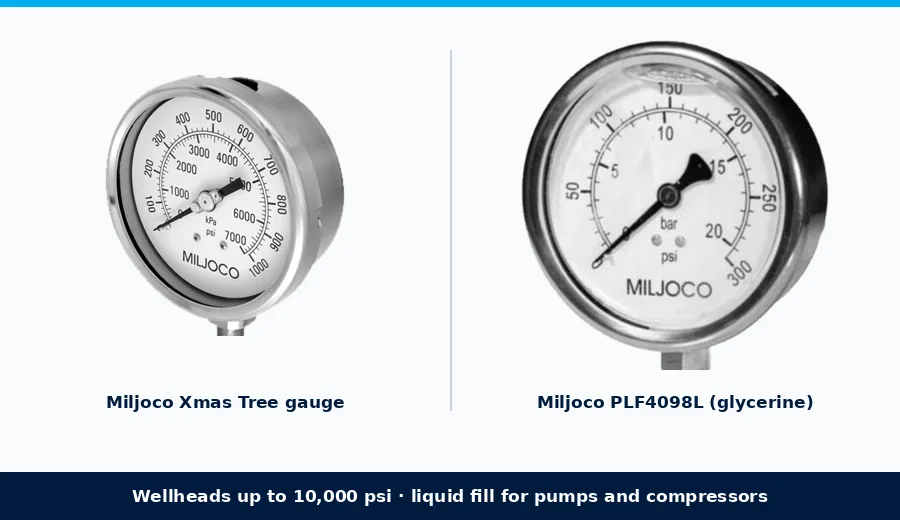
- Brass and phosphor bronze are economical and fine for water, air, lubricating and hydraulic oil. The PLF4098L (brass tube and socket in a glycerine-filled stainless case) and the P4098LY (brass wetted parts, Grade 1A) are typical choices.
- 316 stainless steel is the default for natural gas, hydrocarbons, chemicals, ammonia and outdoor plants exposed to coastal or industrial atmospheres. The P4098LY-SS (4") and P6098LY-SS (6") both have 316 SS tube and socket in a 300-series stainless case, are rated −40 to 120 °C process temperature when dry, and can be liquid filled.
- Monel is offered as an option on the P4520L and as the "5" internal on the Weiss NF4UGY5 / LF4UGY5 for media that attack stainless steel.
For highly corrosive, viscous or crystallising fluids, Weiss recommends isolating the gauge with a diaphragm seal rather than exposing the tube. For sour gas containing H2S, specify the material standard your project requires (for example NACE MR0175 / ISO 15156) at enquiry stage so it can be confirmed with the manufacturer. Do not assume a standard stainless gauge meets it. (See our H2S and total sulfur note.)
Dry or liquid filled
Pumps, reciprocating compressors, engines and hydraulic power packs make a dry gauge's pointer flutter and wear its gear teeth. Glycerine or silicone fill damps that movement and protects the internals. Miljoco's PLF4098L datasheet describes it as weather-proof and suited to pumps, air compressors and irrigation systems. Most Miljoco industrial gauges are offered with glycerine (PLF prefix) or silicone (PSF prefix) fill, and the P4098LY family is field liquid-fillable.
The trade-off is temperature. Miljoco rates its liquid-filled gauges at 0 to 60 °C process and ambient, against −40 to 120 °C process for dry stainless models. Much of Pakistan passes 45 °C in summer and a gauge in direct sun gets hotter still, so shade liquid-filled gauges and keep them off hot lines. On steam, Miljoco states that a coil syphon must be installed, so the gauge sees cooled condensate, not live steam. That applies to every boiler house, from textile dyeing units to sugar mills.
Solid-front safety gauges for high-pressure and hazardous service
In a conventional gauge, the only thing between a ruptured Bourdon tube and the operator's face is the window. A solid-front gauge puts a solid wall between the tube and the dial, and a blow-out back releases pressure out of the rear of the case instead.
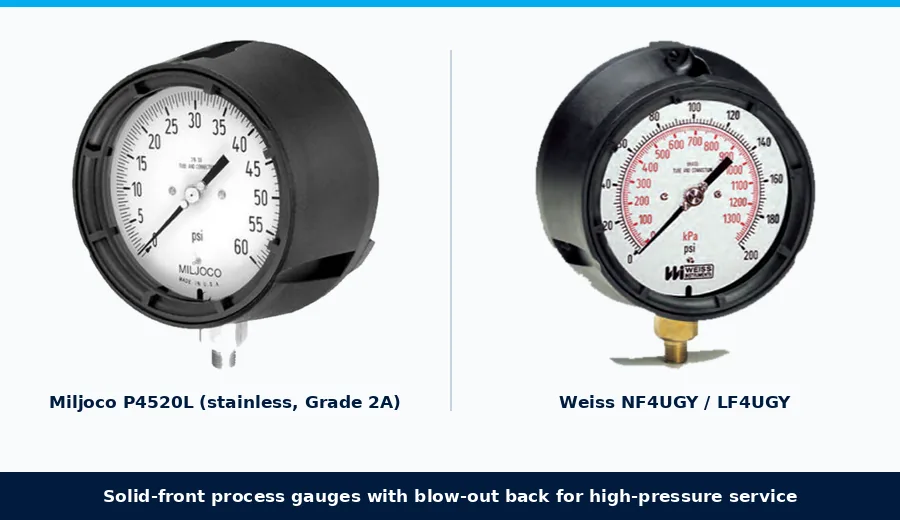
- Weiss NF4UGY (dry) / LF4UGY (liquid filled): 4½" solid-front process gauge with a solid wall isolating the dial from the tube and a blow-out back that releases if the tube ruptures. It has ±0.5% ASME B40.1 Grade 2A accuracy, a bushed stainless rotary movement, a black fiberglass-reinforced thermoplastic case and dual psi/kPa scales. Internals are brass/bronze (1), 316L stainless (2) or Monel (5), with 1/4" or 1/2" NPT lower or lower-back connections. It can be filled in the field without extra kits. Weiss positions it for the process, power and chemical industries.
- Miljoco P4520L / PLF4520L / PSF4520L: 4½" solid-front, turret-style case in fiberglass-reinforced polypropylene with a blow-out back and a sealed lens for weather-proof operation. It has stainless steel tube, socket and rotary movement, ±1/2% full scale (ASME B40.100 Grade 2A) and ranges from vacuum to 0–10,000 psi. Options include brass or Monel wetted parts, a safety glass lens and a stainless tag.
Specify a solid-front gauge on gas compression, separators, high-pressure hydrocarbon lines, steam headers and chemical dosing, especially at points that operators read standing directly in front of the gauge.
Gauge picks for Pakistani industries
| Application | What matters | Catalogue fit |
|---|---|---|
| Wellheads and Christmas trees (oil and gas fields) | High pressure, outdoor exposure, 1/2" NPT tappings | Miljoco Xmas Tree gauge (datasheet model P4099LY-SS-50): stainless case and wetted parts, glass lens, hermetically sealed for outdoor use, ±1% Grade 1A, 0–1,000 to 0–10,000 psi with kPa scale, glycerine or silicone fillable |
| Gas processing, compression and pipelines | Operator safety, stainless wetted parts, accuracy | Weiss NF4UGY2 / LF4UGY2 (316L) or Miljoco P4520L |
| Pumps, compressors, hydraulics, cooling water | Pulsation and vibration | PLF4098L (glycerine, brass) or liquid-filled P4098LY-SS for corrosive media |
| Ammonia refrigeration (fertilizer plants, cold stores, food processing) | Ammonia-compatible materials, dual pressure/temperature scale | Miljoco P4098LY-SSA ammonia gauge (stainless, ±1% Grade 1A, 30" Hg–150 psi or 30" Hg–300 psi with °F scale) and silicone-filled PSF2598L / PSF4098L |
| Boiler houses (textile, sugar, food, captive power) | Readability at distance, steam protection | 6" P6098LY-SS with a coil syphon; PB3008 combined pressure/temperature gauge on boiler and HVAC piping |
| Potable water and food service | Lead-free compliance | Weiss 4CTSLF: 4½", ±1% Grade 1A, UL certified to NSF/ANSI 372, 0–30 to 0–300 psi |
| Control panels and skids | Panel cut-out mounting | Miljoco P2036 front flange, P35147 rear flange, P2567 U-clamp; P4509LX-R red set pointer to mark a target pressure |
When the reading must reach a control room or SCADA system as well as being seen locally, pair the gauge with a pressure transmitter such as the Omega PX309 (4–20 mA, 316L wetted parts). For low differential pressures across filters and cleanrooms, see our differential pressure monitoring note.
Installation and maintenance tips that extend gauge life
- Always fit an isolation valve (gauge cock or needle valve) so the gauge can be removed, zero-checked and replaced without shutting the line.
- Damp pulsation at the source. Use liquid fill, and add a snubber where the pulsation is severe. The Weiss catalogue also covers siphons, snubbers, gauge cocks, needle valves and diaphragm seals.
- Protect from heat. Use a coil syphon on steam, keep liquid-filled gauges below 60 °C, and shade gauges on sun-exposed racks.
- Check zero at every shutdown. A pointer that does not return to zero, a discoloured fill or a cracked window means the gauge should be recalibrated or replaced.
- Calibrate critical gauges on a schedule against a reference standard and record the result.
FAQ
What range should I choose for a pressure gauge?
Choose a full-scale range of about twice the normal operating pressure, so the pointer sits near mid-scale. Weiss gives this guidance with reference to ASME B40.1. Use a compound (vacuum and pressure) range where the line can go under vacuum.
What do Grade B, A, 1A and 2A accuracy mean?
They are ASME B40.100 (formerly B40.1) accuracy grades: Grade B is 3-2-3% of span, Grade A 2-1-2%, Grade 1A ±1% and Grade 2A ±0.5%. The PLF4098L is Grade B, the P4098LY-SS Grade 1A, and the P4520L and Weiss NF4UGY Grade 2A.
When should I use a glycerine-filled gauge?
Use one on pumps, compressors, engines and hydraulic systems where pulsation or vibration makes a dry pointer flutter. Miljoco rates its liquid-filled gauges at 0 to 60 °C process and ambient temperature, so use a dry gauge on hotter service, and always fit a coil syphon on steam.
What is a solid-front pressure gauge?
A solid-front gauge has a solid wall between the Bourdon tube and the dial, plus a blow-out back. If the tube ruptures, pressure vents out of the back of the case instead of through the window towards the operator. The Weiss NF4UGY / LF4UGY and Miljoco P4520L are solid-front process gauges.
Which gauge suits a wellhead or Christmas tree?
The Miljoco Xmas Tree gauge: stainless steel case and wetted parts, glass lens, 1/2" NPT connection, hermetically sealed for outdoor use, ±1% (Grade 1A), ranges 0–1,000 to 0–10,000 psi, and glycerine or silicone fillable.
Do you have lead-free gauges for drinking water systems?
Yes. The Weiss 4CTSLF is a 4½" lead-free gauge, UL certified in accordance with NSF/ANSI 372, with a stainless case, phosphor bronze tube, ±1% Grade 1A accuracy and ranges from 0–30 to 0–300 psi.
How Tetracon helps with pressure gauge selection
Tetracon supplies process instrumentation to Pakistan's oil and gas, power, fertilizer, chemical, pharmaceutical, textile and water sectors, including Miljoco and Weiss Instruments pressure gauges and thermometers. Send us the fluid, normal and maximum pressure, temperature, connection and mounting, and we will propose range, grade, wetted material and fill. Use the contact page or see our services. Start with the catalogue pages for the Miljoco P4520L, Xmas Tree gauge, P4098LY-SS, P6098LY-SS, PLF4098L, P4098LY-SSA and Weiss NF4UGY / LF4UGY, browse the process instrumentation category, or see all Miljoco and Weiss Instruments products. Free technical guides are collected under Guides.
Key takeaways
Size the range at about twice operating pressure, pick the grade the job needs, match wetted parts to the fluid, fill gauges that see pulsation (and keep them under 60 °C), use coil syphons on steam, and specify solid-front, blow-out-back gauges wherever operators face high-pressure gas, steam or chemicals. In catalogue terms: the Miljoco P4520L or Weiss NF4UGY/LF4UGY for safety-critical process points, the Xmas Tree gauge for wellheads, the P4098LY-SS and P6098LY-SS for general stainless service, the PLF4098L for pumps and compressors, the P4098LY-SSA for ammonia, and the Weiss 4CTSLF for potable water.