

Walk through almost any Pakistani plant and you will find small glass-look flowmeters with a float in a tapered tube: on the sample line of a dew-point or oxygen analyser in a refinery or fertilizer plant, on the nitrogen purge to an instrument cabinet, on the argon or CO2 line in a laboratory, on an air sampler run by an environmental contractor, on a chemical dosing skid at a water treatment plant. These are variable-area flowmeters, usually called rotameters. They need no power, they show flow at a glance, and they are cheap enough to fit on every line. They are also very easy to misread, because the number on the scale is only true at the conditions the meter was calibrated for.
This note explains how a rotameter works, how to choose the range, why pressure, temperature, altitude and the type of gas change the reading, and how DwyerOmega's Series RM Rate-Master® polycarbonate flowmeter is specified, installed and maintained. Instrument figures come from Dwyer's Series RM datasheet (DS-RM Rev. 3), the Series RM installation and operating instructions (Bulletin F-43, Rev. 26) and the current DwyerOmega Series RM product page. The worked correction numbers are our own illustrative arithmetic using Dwyer's published correction formulas, and are labelled as examples. No prices are given; ranges, options and lead time should be confirmed at quotation.
How a variable-area flowmeter works
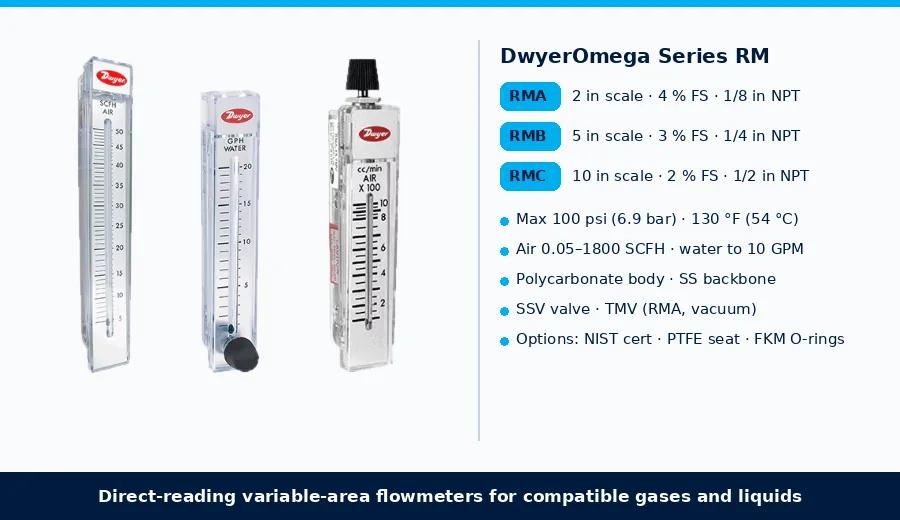
Fluid enters at the bottom of a vertical tapered tube and lifts a float. As the float rises, the annular gap around it gets wider, so the float settles where the upward force of the flow balances its weight. Higher flow, higher float. In the Rate-Master, the "tube" is a precision-tapered pin moulded into a clear polycarbonate body, with integral flow guides that steady the float, and scale graduations on both sides of the tube so it can be read straight on. Dwyer moulds the body around the tapered pin to get high repeatability, and a stainless-steel backbone carries the piping loads so that tightening a fitting does not crack the body.
Because the float position depends on the density of the fluid and, for gases, on its pressure and temperature, every scale is a calibration for one fluid at one set of conditions. Gas scales marked "S" (standard, for English units such as SCFH and SCFM) or "N" (normal, for metric units) are valid only at the stated reference conditions. For Dwyer's standard-unit air scales those conditions are 14.7 psia and 70 °F (21.1 °C). Anything else needs a correction.
DwyerOmega Series RM Rate-Master at a glance
| Item | Dwyer specification (DS-RM Rev. 3 and F-43) |
|---|---|
| Models and scale length | RMA 2 in (51 mm) scale; RMB 5 in (127 mm) scale; RMC 10 in (254 mm) scale. Panel or surface mounted; bodies interchangeable within the same scale size without disturbing the piping |
| Accuracy | RMA 4 % of full scale; RMB 3 % of full scale; RMC 2 % of full scale |
| Gas ranges (air) | From 0.05 to 0.4 SCFH (RMA) up to 200 to 1,800 SCFH (RMC), and 1 to 10 up to 3 to 30 SCFM (RMC); RMA also in cc/min (from 5 to 50 cc/min up to 1,000 to 10,000 cc/min) and L/min (from 0.5 to 5 up to 10 to 100 LPM); RMB dual SCFH/LPM scales |
| Liquid ranges (water) | From 5 to 50 cc/min (RMA) up to 1.2 to 10 GPM (RMC), with GPH and dual GPH/LPM scales in between |
| Pressure limit | 100 psi (6.9 bar) |
| Temperature limit | 130 °F (54 °C) |
| Wetted materials | Polycarbonate body; Neoprene and Buna-N O-rings; stainless-steel metal parts; float of stainless steel, black glass, aluminium, K-Monel or tungsten carbide depending on range |
| Process connections | RMA 1/8 in female NPT; RMB 1/4 in female NPT; RMC 1/2 in female NPT |
| Valves | No valve, SSV stainless-steel metering valve, or TMV top-mounted valve (RMA only, for vacuum service). The brass valve option has been discontinued; SSV is its replacement. Valves are for flow adjustment only, not shut-off |
| Options | NIST-traceable calibration certificate, arbitrary scale, adjustable pointer flag, PTFE valve seat, fluoroelastomer O-rings, special cleaning, aluminium tag, body only |
| Compliance | Meets the technical requirements of EU Directive 2011/65/EU (RoHS II) |
| Dwyer's listed applications | Medical equipment, air samplers, gas analysers, pollution monitors, chemical injectors, cabinet purging |
For a rough feel in metric units (our conversions): 1,800 SCFH is about 850 L/min of air at Dwyer's standard conditions, and 10 GPM is about 38 L/min of water.
Choosing the range: what "% of full scale" really means
Rotameter accuracy is quoted as a percentage of full scale, not of reading. On an RMB with a 10 to 100 SCFH scale, 3 % of full scale is ±3 SCFH anywhere on the scale. At a reading of 80 SCFH that is under 4 % of reading; at 20 SCFH it is 15 % of reading. The practical rules:
- Pick a range where your normal flow sits in the upper half of the scale, with room above it for the maximum.
- Choose the scale length for the accuracy you need: the 10 inch RMC (2 % FS) is easier to read closely than the 2 inch RMA (4 % FS), which suits compact panels and analyser sample lines.
- If the same line runs at very different flows, two meters with different ranges are better than one meter read at the bottom of its scale.
- Order a scale in the units your operators use. RMB dual scales show SCFH and LPM on one tube, and an arbitrary scale can be specified when a reading is converted with a chart for a particular gas or liquid.
Pressure, temperature, altitude and gas type: correcting the reading
Dwyer publishes two approximate correction formulas for meters calibrated on air or water. For pressure and temperature, the standard flow is Q2 = Q1 × √[(P1 × T2) ÷ (P2 × T1)], where Q1 is the observed reading, P1 and T1 are the actual absolute pressure and temperature, and P2 and T2 are the standard values (14.7 psia and 530 °R, which is 70 °F). For a different gas or liquid, Q2 = Q1 × √(1 ÷ S.G.), where S.G. is the specific gravity of the actual medium relative to air or water. Dwyer's own example: a 10 to 100 SCFH air meter reading 60 with 5 psig and 85 °F at the outlet is actually passing 68.5 SCFH of air at standard conditions.
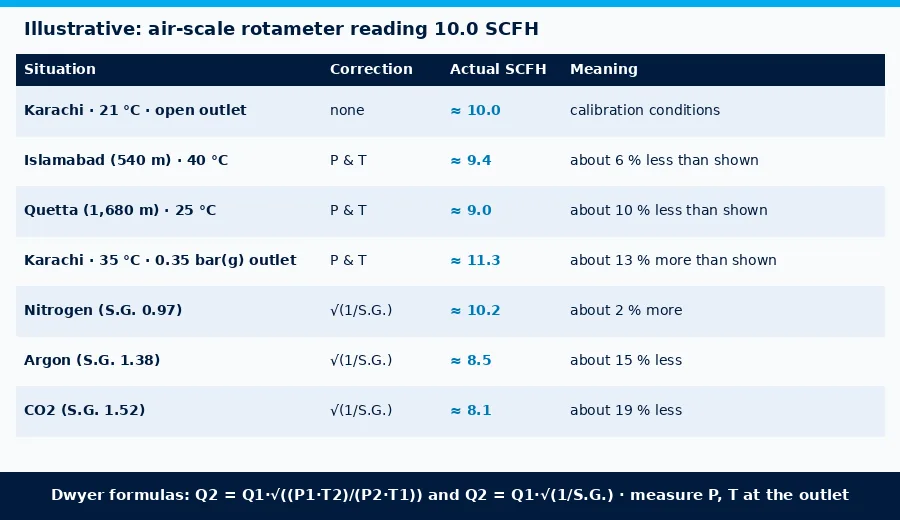
Two details matter. First, measure pressure and temperature at the outlet of the meter, except for top-mounted-valve units on vacuum service, where they are measured at the inlet. Second, Dwyer writes P1 as 14.7 psia plus gauge pressure, which assumes sea-level atmosphere. Our reading is that at altitude you should use the real absolute pressure, local atmospheric plus gauge, and that is where Pakistan's geography shows up. Here is what an air-scale meter showing 10.0 SCFH is really passing in a few typical situations (our arithmetic, standard atmosphere for each altitude, rounded):
| Situation (air scale reading 10.0 SCFH) | Correction | Actual standard flow |
|---|---|---|
| Karachi, sea level, outlet open to atmosphere, 21 °C | None (calibration conditions) | ≈ 10.0 SCFH |
| Islamabad, about 540 m (atmosphere about 0.95 bar), open outlet, gas at 40 °C in summer | Pressure and temperature | ≈ 9.4 SCFH (about 6 % less than shown) |
| Quetta, about 1,680 m (atmosphere about 0.83 bar), open outlet, 25 °C | Pressure and temperature | ≈ 9.0 SCFH (about 10 % less than shown) |
| Karachi, 35 °C, outlet into a vent header at 0.35 bar(g) (5 psig) | Pressure and temperature | ≈ 11.3 SCFH (about 13 % more than shown) |
| Nitrogen (S.G. about 0.97) at standard conditions | Specific gravity | ≈ 10.2 SCFH |
| Argon (S.G. about 1.38) at standard conditions | Specific gravity | ≈ 8.5 SCFH |
| CO2 (S.G. about 1.52) at standard conditions | Specific gravity | ≈ 8.1 SCFH |
Corrections multiply, so a nitrogen purge read on an air-scale meter in Islamabad in summer has both the altitude and temperature factor and the specific-gravity factor. Dwyer notes that these formulas cover specific gravity and pressure only; viscosity and changes between laminar and turbulent flow can need further correction, particularly at very low flows of light gases. For helium, hydrogen or anything far from air, or where the number goes into a report, order a meter calibrated or scaled for the actual gas and conditions rather than correcting an air scale.
Back-pressure is the easiest error to miss. If an analyser bypass rotameter discharges into a flare or vent header instead of to atmosphere, the float is sitting in compressed gas and the reading is low. Dwyer's instructions say discharge piping for gas service should be as short and open as possible, so the tube operates near atmospheric pressure. Where that is not possible, put a pressure gauge or a transmitter such as the PX309 at the meter outlet and correct the reading.
Where rotameters earn their place in Pakistani plants
- Analyser sample and bypass lines. Extractive moisture, oxygen and gas analysers in refineries, fertilizer and petrochemical plants, power stations and gas processing facilities need a steady sample flow within the range in their manuals. A small RMA or RMB with a metering valve lets technicians set it and lets anyone see at a glance that sample is flowing. See our gas analysis, oxygen analysis and moisture and dew point ranges.
- Purging and blanketing. Dwyer lists cabinet purging as an application: a rotameter shows that nitrogen or instrument air is actually reaching an instrument cabinet or analyser enclosure. It is a flow indicator, not a certified purge controller for pressurised hazardous-area enclosures. Correct for nitrogen's specific gravity if the scale is for air.
- Laboratories and QC rooms. Carrier and purge gases in textile, pharmaceutical, food and cement laboratories, where cc/min and LPM scales are convenient.
- Air sampling and pollution monitoring. Dwyer lists air samplers and pollution monitors; environmental consultants use rotameters to set and check sampling flow. For compliance work, order the NIST-traceable calibration certificate and keep it with the sampling records.
- Chemical injection and water treatment. Small water-scale meters indicate dosing flow on compatible chemicals. Check compatibility first (see below): many common treatment chemicals are outside the polycarbonate body's limits.
- OEM equipment and medical devices. Dwyer lists medical equipment as an application. Medical device approvals are the equipment maker's responsibility, not the flowmeter's.
Know the limits: heat, chemicals and pressure
- 54 °C is a hard limit. Dwyer says do not exceed 100 psi (6.89 bar) or 130 °F (54 °C). Summer air temperatures in parts of Sindh and Balochistan pass 50 °C, and a closed panel in direct sun runs hotter than the air. Mount Rate-Masters in shaded, ventilated analyser shelters or indoor panels, and keep hot sample gas cooled before it reaches the meter.
- Chemical compatibility. Dwyer says caustic solutions, antifreeze (ethylene glycol) and aromatic solvents should definitely not be used, and to avoid solutions of acids, bases or salts with a pH below 5.0 or above 8.5. The installation should not be exposed to strong chlorine atmospheres or to solvents such as benzene, acetone and carbon tetrachloride. That rules out caustic soda, glycol coolant loops and solvent lines, and means chlorination rooms are the wrong place for a polycarbonate meter. For questionable gases or liquids, Dwyer asks to be consulted, and so do we.
- Toxic or high-pressure service. Dwyer asks to be contacted for high-pressure or toxic gases or fluids. Never unscrew the valve stem fully unless the meter is depressurised and drained; gas or liquid can escape from the front of the valve body.
- Static on low ranges. On low-range gas meters, static electricity can make a ball float behave erratically or read falsely. Design the installation to minimise or dissipate static.
Installation, reading and maintenance
- Mount vertically. Inlet at the bottom rear, outlet at the top rear, on a panel free of excessive vibration. For through-panel mounting, use Dwyer's cut-out dimensions and do not tighten the clamp bolts beyond 5 in-lb.
- Pipe it properly. Inlet and discharge piping at least as large as the meter connection (1/8, 1/4 or 1/2 in), as few elbows and restrictions as possible on the inlet, and a short, open discharge on gas service. On vacuum air service, keep the inlet short and open and put the control valve on the discharge side (the TMV unit or a separate valve). Use thread-sealant tape and avoid excess torque.
- Start up gently. Open the valve slowly. On SSV models, clockwise reduces flow and anticlockwise increases it; a nylon insert in the stem thread holds the setting against vibration. If inlet pressure fluctuates widely and constant flow is needed, Dwyer offers constant-differential regulator kits; confirm the right kit for your model at quotation.
- Read it the same way every time. Align the widest part of the float with the centre of the graduation and estimate between graduations. Record the outlet pressure and temperature if the reading will be corrected.
- Check calibration with certified devices only. Dwyer warns against checking one Rate-Master against another similar flowmeter, because small differences in piping and back-pressure change the reading. Use a certified reference or return the meter for calibration.
- Clean, don't replace. The body comes off the back plate without disturbing the piping. Clean the tube with a little pure soap and water and a soft brush; avoid benzene, acetone, carbon tetrachloride, alkaline detergents, caustic soda and liquid soaps that may contain chlorinated solvents, and avoid prolonged immersion. A little stopcock grease or petroleum jelly on the O-rings helps on reassembly.
What to send with an enquiry
- The fluid (air, nitrogen, argon, CO2, water or another liquid) and, for anything unusual, its composition and pH.
- Minimum, normal and maximum flow, and the units you want on the scale (SCFH, SCFM, LPM, cc/min, GPH, GPM, or dual units).
- Operating pressure at the meter outlet, gas temperature, site altitude and the ambient temperature at the panel.
- Whether you need a metering valve (SSV or, for vacuum service on the RMA, TMV), panel or surface mounting, and options such as a pointer flag, PTFE valve seat, fluoroelastomer O-rings or special cleaning.
- Whether a NIST-traceable calibration certificate is required, and whether the reading goes into a compliance record.
FAQ
What is a rotameter?
A rotameter is a variable-area flowmeter: a float rises in a vertical tapered tube until the flow around it balances its weight, and the flow rate is read from a scale beside the float. It needs no power and shows flow at a glance, but it is calibrated for one fluid at one set of conditions.
How accurate is the DwyerOmega Series RM?
Dwyer quotes 4 % of full scale for the 2 inch RMA, 3 % of full scale for the 5 inch RMB and 2 % of full scale for the 10 inch RMC. Because accuracy is a percentage of full scale, choose a range where normal flow is in the upper half of the scale.
Can I use an air-scale rotameter for nitrogen, argon or CO2?
Yes, with a correction. Dwyer's approximate formula multiplies the reading by the square root of 1 divided by the gas's specific gravity relative to air, so in our example 10 SCFH on an air scale is about 10.2 SCFH of nitrogen, 8.5 SCFH of argon or 8.1 SCFH of CO2. For light gases such as helium or hydrogen, order a meter calibrated for the gas.
Why does my rotameter read differently in Islamabad or Quetta than in Karachi?
Gas scales are calibrated at standard pressure and temperature. At altitude the absolute pressure in the tube is lower, and in summer the gas is hotter, so the float sits higher for the same standard flow. In our illustrative example, 10 SCFH shown on an air scale is about 9.4 SCFH in Islamabad at 40 °C and about 9.0 SCFH in Quetta at 25 °C.
What are the pressure and temperature limits?
100 psi (6.9 bar) and 130 °F (54 °C). Do not exceed them, keep the meter out of direct sun in hot regions, and cool hot sample gas before the meter.
Which liquids and chemicals should not go through a Series RM?
Dwyer says not to use caustic solutions, antifreeze (ethylene glycol) or aromatic solvents, to avoid solutions with a pH below 5.0 or above 8.5, and to keep the meter away from strong chlorine atmospheres and solvents such as benzene, acetone and carbon tetrachloride.
Where can Pakistani users see the product and ask for a quotation?
See the Series RM Rate-Master catalogue page, browse process instrumentation, or contact Tetracon with your fluid, flow range, outlet pressure and preferred scale units.
Next steps
Tetracon supplies DwyerOmega flow, pressure and differential-pressure instruments to industry, utilities, laboratories and OEMs across Pakistan. Send us the fluid, flow range, outlet pressure and temperature, site altitude and the scale units you want, and we will propose the right Rate-Master model, range, valve and options. Use the contact page or see our services. Start with the Series RM Rate-Master catalogue page and the PX309 pressure transmitter, browse process instrumentation, or see all DwyerOmega products. Related notes: online dew-point monitoring for compressed air, trace oxygen in nitrogen, argon and CO2, oxygen monitoring for nitrogen blanketing, differential pressure monitoring and industrial pressure gauge selection. Free technical guides are collected under Guides.