

A plant-room thermometer is only useful if someone actually reads it. On a chilled-water header three metres up, inside an air-handling unit, behind a pump skid or on a tank roof, a stem thermometer at the measuring point is often out of sight and out of reach. A remote-reading dial thermometer solves that mechanically: a sealed bulb sits in the process, a capillary carries the signal, and the dial is mounted on a panel, a wall or a bracket where the operator walks past every shift. No power, no transmitter, no loop to commission.
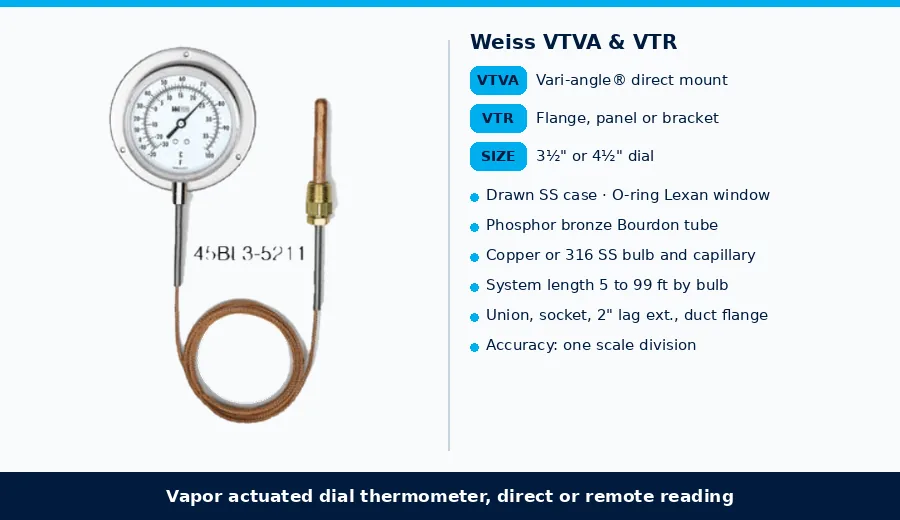
This note looks at the Weiss VTVA and VTR vapor actuated dial thermometers: the Vari-angle® direct-mount VTVA and the remote-reading VTR case styles. Figures come from the Series VTVA & VTR datasheet hosted on our product page and from the current Tetracon product pages. Where we give general engineering advice it is labelled as general. Nothing here goes beyond the manufacturer's published data. Tetracon (Pvt.) Ltd. is the sole authorized agent for Weiss Instruments in Pakistan.
Why a vapor actuated dial, and why remote reading?
- Read the temperature where people stand, not where the pipe runs. The VTR case styles put the dial on a back-flange surface mount, a semi-flush panel mount or an adjustable bracket, connected to the bulb by a capillary of up to 99 ft depending on the bulb (datasheet; general for typical locations).
- Or mount it directly and turn it to face the operator. The VTVA uses Weiss's Vari-angle® direct mount; the dimension drawing shows a rotatable friction lock and an axis of rotation between the case and the stem (datasheet).
- Purely mechanical. A vapor-filled thermal system drives a phosphor bronze Bourdon tube in the case, which moves a slotted adjustable pointer. There is nothing to power and nothing to configure on site (datasheet; general).
- A built-in averaging option for ducts. The X system is a 1/8" × 180" averaging bulb on an aluminium air-duct flange, for reading the average temperature across an AHU or duct section instead of one point (datasheet).
- Accuracy you can state simply. Weiss gives accuracy as one scale division throughout the range (datasheet).
How a vapor actuated thermometer works, and why range choice matters
The bulb is partly filled with a volatile liquid. As the process temperature rises, the vapor pressure in the sealed bulb, capillary and Bourdon tube rises, the tube uncoils and the pointer moves (general principle). The bulb and line assembly are copper or 316 stainless steel, the Bourdon tube is phosphor bronze, the case is drawn stainless steel with a snap-in O-ring gasketed clear Lexan window, and the dial is white coated aluminium with black markings (datasheet).
Vapor pressure does not rise linearly with temperature, so the dial is not linear either. Weiss puts it plainly on the standard-ranges page: vapor thermometers have progressive graduations and are best read within the upper two thirds of the range, so a range should be selected carefully; other ranges are available from the factory (datasheet). In practice, pick a range that puts your normal operating temperature in the upper two thirds of the dial, not at the bottom where the divisions are crowded (general).
Weiss VTVA and VTR at a glance
| Item | From the datasheet |
|---|---|
| Dial / case size | 3½" (code 35) or 4½" (code 45) |
| Case types | V Vari-angle® direct mount; B back flange, surface mount; R semi-flush, panel mount; Z adjustable bracket, remote mount |
| Case connection | A adjustable; B back; L lower |
| Case and window | Drawn stainless steel; snap-in O-ring gasketed clear Lexan window (code 3) |
| Dial / pointer / tube | White coated aluminium, black markings; slotted adjustable pointer; phosphor bronze Bourdon tube |
| Thermal system | Copper or 316 stainless steel bulb and line; plain or union bulb; capillary protection none, copper braid or interlock armor |
| System length | Up to 5, 10, 25, 50 or 99 ft depending on the bulb |
| Process fittings | Union or separable socket, 1/2" or 3/4" NPT; socket with 2" lag extension (No. 3 bulb only); air-duct flange (aluminium only); plain bulb |
| Fitting materials | Brass, 304 stainless steel, 316 stainless steel; aluminium (duct flange only) |
| Accuracy | One scale division throughout range |
| Ranges | Standard-ranges page of dual °C/°F and °F dials; catalogue example 40–240 °F; other ranges from the factory |
Reading a VTVA / VTR catalogue number
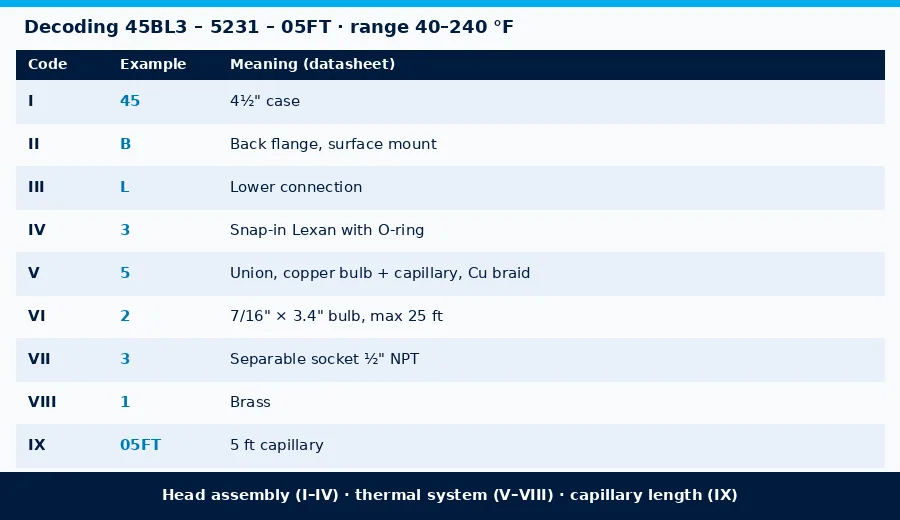
The order code has three blocks: the head assembly (codes I–IV), the thermal system (codes V–VIII) and the capillary length (code IX), followed by the range. The datasheet's worked example is 45BL3 – 5231 – 05FT, range 40–240 °F (datasheet). Decoded:
| Code | Example | Meaning (datasheet) |
|---|---|---|
| I Case size | 45 | 4½" case (35 = 3½") |
| II Case type | B | Back flange, surface mount (V Vari-angle direct, R semi-flush panel, Z adjustable bracket remote) |
| III Case connection | L | Lower connection (A adjustable, B back) |
| IV Window | 3 | Snap-in Lexan with O-ring |
| V Thermal system | 5 | Union bulb, copper bulb and capillary, copper braid protection |
| VI Bulb | 2 | 7/16" × 3.4" union bulb, system length up to 25 ft |
| VII Fitting | 3 | Separable socket, 1/2" NPT |
| VIII Fitting material | 1 | Brass |
| IX Length | 05FT | 5 ft capillary (two digits, then FT or IN) |
Choosing the thermal system and capillary protection
| Code V | Bulb type | Bulb | Capillary | Protection |
|---|---|---|---|---|
| 0 | Union | Copper (Vari-angle only) | – | – |
| 2 | Plain | Copper | Copper | Copper braid |
| 3 | Plain | 316 SS | 316 SS | None |
| 5 | Union | Copper | Copper | Copper braid |
| 7 | Union | 316 SS | Copper | Copper braid |
| 8 | Union | 316 SS | 316 SS | Interlock armor (at bulb end, 3½" long) |
| 9 | Union | 316 SS | 316 SS | None |
All systems have stainless steel spring capillary protection at the indicating head; systems 5–7 add a stainless spring at the bulb end, and a stainless jam nut is standard on systems 8–9 (datasheet). As general guidance: copper with copper braid suits clean HVAC water and air; choose a 316 SS bulb where the bulb sees a corrosive medium, and the armored system 8 where the capillary runs through a mechanically exposed area such as a walkway or cable tray (general).
Bulb size sets the maximum distance
| Code VI | Union bulb (systems 5–9) | Plain bulb (systems 2 and 3) | Max. system length |
|---|---|---|---|
| 1 | 7/16" × 2.5" | N/A | 10 ft |
| 2 | 7/16" × 3.4" | 3/8" × 3.4" | 25 ft |
| 3 | 7/16" × 5.4" | 3/8" × 4.9" | 50 ft |
| 4 | 7/16" × 7.4" | 3/8" × 7.9" | 99 ft |
| 5 | 7/16" × 9.4" | 3/8" × 9.4" | 99 ft |
| X | 1/8" × 180" averaging bulb | 10 ft | |
| 6 | N/A | 3/8" × 2.5" | 5 ft |
Work backwards from the run: measure the capillary route from the measuring point to where the dial will be read, add slack for bends, then pick the smallest bulb whose maximum system length covers it (general). A longer bulb also needs a pipe or vessel large enough to take the insertion length, so check that the pipe size fits the bulb before you settle on a 99 ft No. 4 or No. 5 system (general).
Process fittings: union, separable socket, lag extension or duct flange
- Union connection, 1/2" or 3/4" NPT (codes 1, 2). The bulb threads directly into the process connection (datasheet; general).
- Separable socket, 1/2" or 3/4" NPT (codes 3, 4). The socket stays in the pipe, so the bulb can be pulled for checking without draining the line (datasheet; general).
- Separable socket with a 2" lag extension (codes 5, 6; No. 3 bulb only). The extension keeps the connection clear of pipe insulation on chilled-water and hot-water lines (datasheet; general).
- Air-duct flange with union connection (code 7, aluminium only). For AHUs and ducts; pair it with the X averaging bulb for a duct-average reading (datasheet; general).
- Plain bulb, no fitting (code 9). For mounting in an existing well or a clamp arrangement (datasheet; general).
Fitting materials (code VIII) are brass, 304 stainless steel or 316 stainless steel, or aluminium for the duct flange only; code 0 means none (plain bulb) (datasheet).
Panel cut-outs and mounting dimensions
For the VTR semi-flush panel case, the datasheet gives a panel hole of 3-5/8" for the 3½" dial and 4-5/8" for the 4½" dial, with overall flange diameters (A) of 4-3/4" and 5-7/8" (datasheet). For the VTVA direct mount, case diameter (C) is 3-11/16" or 4-11/16" and case depth (E) is 1-1/4" for both sizes (datasheet). Cut panel holes from the datasheet drawing for the exact case ordered, not from a generic gauge template (general).
Where it fits in Pakistan
- Chiller plants and AHUs in hospitals, hotels, offices and data centres. Supply and return headers are often high or behind plant; a VTR on a bracket or panel lets the operator log readings at eye level. For a chilled-water range, choose a lower range from the standard-ranges page so normal operation sits in the upper two thirds of the dial (datasheet; general).
- Duct and AHU coil temperatures. The aluminium air-duct flange with the averaging bulb reads across the airstream rather than at one point (datasheet; general).
- Boiler rooms and hot-water calorifiers. Remote dials on a gauge board keep readings together for the shift log; use separable sockets so bulbs can be checked without draining (general).
- Tanks and process skids in textile, food and pharma utilities. Where the measuring point is on top of a tank or inside a skid frame, a remote dial avoids climbing to read it (general).
Related products and when to choose them
| Duty | Product | Key figure (datasheet / product page) |
|---|---|---|
| Dial thermometer, direct-mount or remote reading via capillary | Weiss VTVA / VTR | 3½" or 4½"; up to 99 ft system length; one scale division (datasheet) |
| Large-scale glass thermometer at the pipe or duct | Miljoco SX7 / SX9 | 7" or 9" scale; ±1 scale division; −40 to 550 °F across range codes (product page) |
| Combined pressure and temperature on hot-water service | Miljoco PB3008 | 3" dial; temperature ±1 scale division, pressure ±3-2-3 %; not for steam (product page) |
| Pressure on the same pipework | Weiss NF4UGY / LF4UGY | 4½"; ±0.5 %, ASME B40.1 Grade 2A; dry or liquid-filled (product page) |
| Recorded temperature trend for commissioning or troubleshooting | Lascar EL-USB-TC | J, K or T thermocouple; over 32,000 readings; 0 to 200 °C with the supplied K probe (product page) |
Choose the VTR when the dial must be read away from the measuring point, and the VTVA when it can sit on the pipe but must turn to face the operator. Choose a Miljoco SX7/SX9 when a large, linear glass scale at the point of measurement is preferred — our industrial thermometer selection note compares the two in more detail. Add a Weiss or Miljoco pressure gauge on the same header (see our pressure gauge selection note), and use a Lascar logger when you need a recorded trend rather than a local reading. The wider range is on the Process Instrumentation category page and the Weiss Instruments and Miljoco manufacturer pages.
What to send with an enquiry
- Direct mount (VTVA) or remote reading (VTR), and the case type: back flange, semi-flush panel or adjustable bracket.
- Dial size (3½" or 4½") and case connection (adjustable, back or lower).
- Normal operating temperature and the expected minimum and maximum, so the range puts normal operation in the upper two thirds of the dial.
- Capillary route length from the measuring point to the dial, and whether it passes exposed areas (armor).
- Process medium, pipe or duct size, insulation thickness and the connection you need: union, separable socket, lag extension or duct flange, and the material.
- Quantity, and any pressure gauges or loggers needed on the same points.
FAQ
What is the difference between the Weiss VTVA and the VTR?
The VTVA is the Vari-angle® direct-mount version: the dial sits on the stem at the measuring point and rotates to face the reader. The VTR covers the remote-reading case styles — back-flange surface mount, semi-flush panel mount and adjustable bracket mount — connected to the bulb by a capillary.
How far can the dial be from the measuring point?
It depends on the bulb: 5 ft with the No. 6 plain bulb, 10 ft with No. 1 or the X averaging bulb, 25 ft with No. 2, 50 ft with No. 3, and up to 99 ft with No. 4 or No. 5.
How accurate is a VTVA / VTR thermometer?
The datasheet gives accuracy as one scale division throughout the range. Because vapor thermometers have progressive graduations, Weiss advises reading them within the upper two thirds of the range, so choose a range that puts normal operation there.
Can I remove the bulb without draining the line?
Yes, if you order a separable socket (codes 3 to 6). The socket stays in the pipe and the bulb can be withdrawn. On insulated pipes, the 2-inch lag extension (codes 5 and 6, No. 3 bulb only) keeps the connection clear of the insulation.
Which range should I order?
The catalogue example uses 40–240 °F, and the datasheet's standard-ranges page shows a set of dual °C/°F and °F dials, with other ranges available from the factory. Send us the normal and maximum temperatures and we will propose a range that keeps normal operation in the upper two thirds of the dial.
Need a remote-reading or direct-mount dial thermometer for a chiller plant, AHU, boiler room or tank in Pakistan? Contact Tetracon with the mounting style, dial size, temperature range, capillary length and process connection. You can also browse the Weiss VTVA / VTR product page and the Weiss Instruments manufacturer page.