

Walk through any chiller plant, boiler house or process pipe rack in Pakistan and you will find local thermometers on almost every line: chilled-water supply and return headers in hospitals, hotels and shopping malls in Karachi, Lahore and Islamabad, hot-water and condensate circuits in textile, food and pharmaceutical plants, cooling-water and lube-oil lines in power stations, and air-handling-unit ducts in cleanroom and HVAC systems. They need no power, no batteries and no network, so they still give operators a reading during load-shedding, and they are the first cross-check when a BMS or DCS value looks wrong.
They are also often specified as an afterthought. Common results: a dial that sits at the bottom of a 40–240 °F scale on a chilled-water line, a thermometer buried under pipe insulation, a capillary crushed on a cable tray, a glass thermometer facing the wall, or a combined pressure/temperature gauge fitted on steam. This note explains the choices that avoid those problems and maps them to three real catalogue instruments from Weiss Instruments and Miljoco. Every specification below comes from the published product pages and manufacturer datasheets.
Three thermometer types in the catalogue
| Type | Catalogue example | How it works | Best for |
|---|---|---|---|
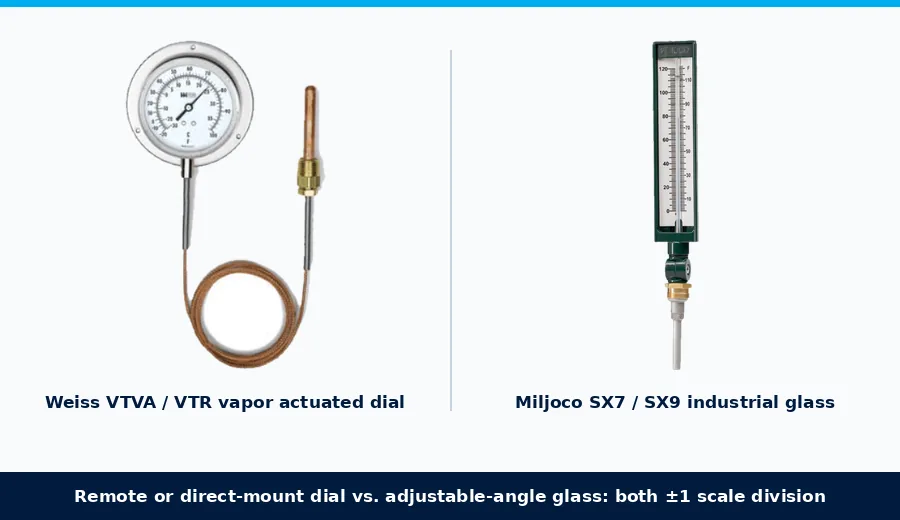
| Industrial liquid-in-glass | Miljoco SX7 / SX9 | Blue reading liquid (spirit fill) in a glass tube behind a magnifying lens, read against a V-shaped scale | Pipelines and air ducts where the reading point is at the pipe and a large, clear scale helps |
| Vapor actuated dial | Weiss VTVA / VTR | A vapor-filled bulb and capillary transmit a pressure change to a phosphor bronze Bourdon tube that drives the pointer | Direct-mount dials on pipes and tanks (VTVA) or remote reading on a panel or bracket away from the measuring point (VTR) |
| Combined pressure / temperature | Miljoco PB3008 / PB3008L | A Bourdon tube for pressure and a bimetal coil for temperature behind one 3" dial | Boilers and hot-water circuits where space and installation cost matter. Not suitable for steam. |
All three are mechanical, local indicators. The SX and VTVA/VTR read to ±1 scale division across their range; the PB3008 reads temperature to ±1 scale division and pressure to ±3-2-3% of span.
Choosing the range: the most common mistake
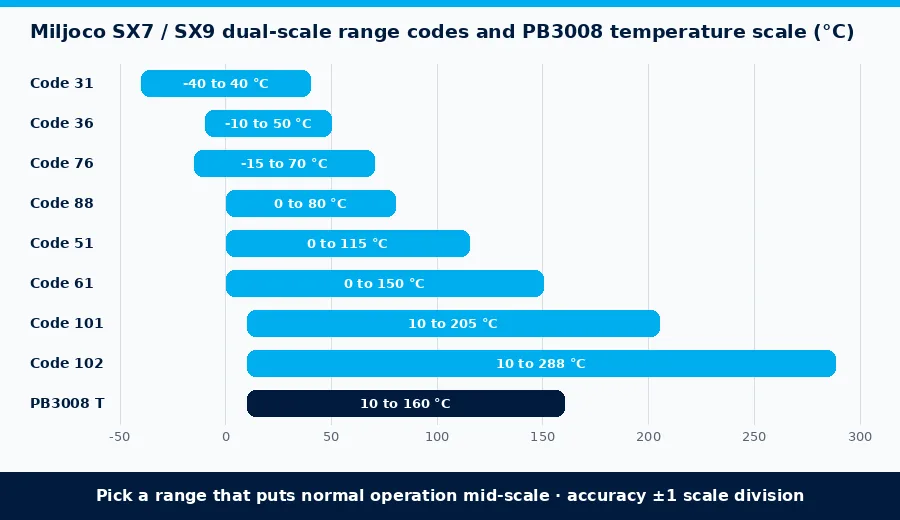
A thermometer is easiest to read, and most useful, when normal operation sits well inside the scale rather than at either end. That matters more for vapor actuated dials than for glass thermometers. Weiss states that vapor thermometers have progressive graduations and are best read within the upper two thirds of the range, so careful range selection is needed. The standard VTVA/VTR range is 40–240 °F (about 4–116 °C), and other ranges are available from the factory.
In practice:
- Chilled water (supply typically around 6–7 °C, return around 12 °C) sits in the bottom of a 40–240 °F vapor dial, exactly where the graduations are most compressed. Either ask for a lower vapor range when ordering a VTVA/VTR, or use a Miljoco SX with a low range: code 31 (−40 to 110 °F / −40 to 40 °C) or code 36 (0 to 120 °F / −10 to 50 °C), both with 1 °C divisions on the Celsius scale.
- Hot water and heating circuits suit the standard 40–240 °F vapor range, or an SX with code 88 (30 to 180 °F / 0 to 80 °C, 1 °C divisions) or code 51 (30 to 240 °F / 0 to 115 °C).
- Thermal oil, hot process lines and exhausts need the high SX ranges: code 101 (50 to 400 °F / 10 to 205 °C) or code 102 (50 to 550 °F / 10 to 288 °C). Above 300 °F (about 149 °C) the SX uses a glass lens instead of acrylic.
- Boiler and hot-water P/T points: the PB3008 combines 50 to 320 °F / 10 to 160 °C with a choice of 0–60, 0–75, 0–100 or 0–200 psi pressure scales (0–400, 0–500, 0–700 or 0–1400 kPa).
For Pakistani sites that work in Celsius, order a dual-scale SX range (codes 31, 36, 76, 88, 51, 61, 101 or 102) so both operators and imported equipment documentation are covered. The PB3008 dial already shows °F and °C, with red temperature and blue pressure markings.
Installation details that decide whether the reading is right
Thermowells and stems
The Miljoco SX stem is aluminium, tapered to fit standard industrial thermowells and packed with heat transfer paste for fast response. It comes as SX735 / SX935 (7" or 9" scale, 3½" stem) and SX760 / SX960 (7" or 9" scale, 6" stem), with brass, stainless steel and air-duct stems as options, and connects with a 1-1/4"-18 UNF brass coupling nut. Choose the stem length for the pipe size and the thermowell, so the sensing part of the stem sits in the flowing medium rather than in the pipe wall or insulation.
Separable sockets and insulated lines
For the Weiss VTVA/VTR, the process connection can be a union (1/2" or 3/4" NPT), a separable socket (1/2" or 3/4" NPT), a separable socket with a 2" lag extension (No. 3 bulb only), an aluminium air-duct flange, or a plain bulb. The separable socket lets you remove the bulb without draining the line. The lag extension is the detail most often missed on insulated chilled-water and hot-water pipes: it keeps the connection clear of the insulation so the thermometer can be serviced without cutting the lagging. Socket and fitting materials are brass, 304 stainless steel or 316 stainless steel.
Viewing angle
Mount the instrument where the operator actually reads it. The SX adjustable fitting gives 180° in the vertical plane and 360° in the horizontal plane, locked with a screw. The VTVA uses Weiss's Vari-angle® direct mount, which adjusts to the viewing position. Where the measuring point is out of reach (high on a header, inside an AHU or behind equipment), use a remote-reading VTR instead of a direct-mount dial.
Ambient conditions
The SX is rated for ambient temperatures of −40 to 60 °C (−40 to 140 °F) and the PB3008 for −40 to 120 °C (−40 to 250 °F). Rooftop chiller yards and sun-exposed pipe racks in Sindh and southern Punjab get very hot in summer, so shade glass thermometers or mount them on the shaded side of the pipe.
Remote reading with the Weiss VTR: bulb, capillary and case
The VTVA / VTR series comes in 3½" and 4½" dial sizes with a drawn stainless steel case and a snap-in, O-ring gasketed clear Lexan window. Five case styles are available: Vari-angle direct mount (VA), back flange lower mount (BL), back flange back mount (BB), semi-flush panel mount (RB) and adjustable bracket mount (ZL). The capillary length you can have depends on the bulb you choose:
| Bulb no. | Union bulb (systems 5–9) | Plain bulb (systems 2–3) | Maximum system length |
|---|---|---|---|
| 1 | 7/16" dia × 2.5" | n/a | 10 ft |
| 2 | 7/16" × 3.4" | 3/8" × 3.4" | 25 ft |
| 3 | 7/16" × 5.4" | 3/8" × 4.9" | 50 ft |
| 4 | 7/16" × 7.4" | 3/8" × 7.9" | 99 ft |
| 5 | 7/16" × 9.4" | 3/8" × 9.4" | 99 ft |
| 6 | n/a | 3/8" × 2.5" | 5 ft |
| X | 1/8" × 180" averaging bulb | 10 ft | |
Two points matter on Pakistani sites. First, the averaging bulb (1/8" × 180") is the right choice for large air-handling-unit ducts, where air temperature is stratified across the cross-section and a short bulb reads only one spot. Second, protect the capillary. Bulb and line come in copper or 316 stainless steel; protection options are copper braid or interlock armour (3½" long at the bulb end), and every system has a stainless steel spring at the indicating head. Use 316 stainless steel and armour where the capillary runs through plant areas, along cable trays or near moving equipment, and route it without sharp bends or crushing points.
Reading a Weiss catalogue number is straightforward. In the datasheet example 45BL3-5231-05FT, 45 is the 4½" case, B the back flange surface mount, L the lower connection, 3 the snap-in Lexan window, 5 a union system with copper bulb and copper capillary with copper braid, 2 the No. 2 bulb, 3 a 1/2" NPT separable socket, 1 brass, and 05FT a 5 ft system length.
Combined pressure/temperature gauges: where the PB3008 fits and where it does not
The Miljoco PB3008 (back connection) and PB3008L (bottom connection) are dual indicating pressure/temperature gauges, often called tridicators. They combine a pressure gauge and a thermometer in one instrument, which saves a tapping and an instrument on boilers and other hot-water applications where space and installation cost count. The case and ring are black drawn steel, the lens is glass, the movement is brass and the Bourdon tube is phosphor bronze. Connections are 1/4" NPT or 1/2" NPT, and a 1/4" NPT version with extension is listed.
The datasheet carries a clear warning: not suitable for steam service. On steam headers use a separate pressure gauge with a coil syphon (see our pressure gauge selection note) and a separate thermometer in a thermowell.
Applications across Pakistan industry
| Sector and point | What matters | Suggested catalogue choice |
|---|---|---|
| Chiller plants (hospitals, hotels, malls, offices) | Low temperatures, insulated pipes, readability at the header | Miljoco SX with range code 31 or 36, or a Weiss VTVA with a low range and a lag-extension socket |
| AHUs and ducts (pharma, cleanrooms, commercial HVAC) | Stratified air, reading outside the unit | Weiss VTR with averaging bulb and panel or bracket case; SX with air-duct stem |
| Boiler houses (textile, sugar, food, captive power) | Hot water vs steam service | PB3008 on hot-water boilers and circuits only; separate gauge and thermometer on steam |
| Process piping and tanks (chemicals, fertilizer, refineries) | Material, remote location, mechanical protection | Weiss VTVA/VTR with 316 SS bulb, line and socket, armoured capillary; SX high-range codes on hot lines |
| Cooling water and lube oil (power plants, compressors) | Quick visual cross-check of DCS values | SX or VTVA direct mount at the exchanger inlet and outlet |
Where you need a recorded trend rather than a spot reading, for example to prove a heat exchanger problem or check a suspicious DCS value over a shift, a Lascar EL-USB-TC thermocouple data logger can sit alongside the local thermometer. It accepts J, K or T type thermocouples, stores over 32,000 readings, logs from every second to every 12 hours, and ships with a 1.5 m K-type probe covering 0 to 200 °C.
Specification checklist for your enquiry
- Medium (water, glycol, oil, air, process fluid) and pipe or duct size
- Normal and maximum temperature, and the pressure if you want a combined P/T gauge
- Steam or not (rules out the PB3008 on steam)
- Insulation thickness, so a lag extension or longer stem can be specified
- Direct mount or remote reading, and the distance from bulb to dial
- Viewing position and preferred case (direct, back flange, panel, bracket)
- Connection size and material: brass, 304 SS or 316 SS; °C, °F or dual scale
FAQ
Should I choose a glass thermometer or a dial thermometer?
Choose an industrial glass thermometer such as the Miljoco SX7/SX9 when the reading point is at the pipe or duct and you want a large, clear scale with ±1 scale division accuracy. Choose a vapor actuated dial such as the Weiss VTVA for a compact direct-mount dial, or the Weiss VTR when the dial must be read away from the measuring point via a capillary.
Why should a vapor actuated thermometer be read in the upper two thirds of its range?
Vapor actuated thermometers have progressive graduations, so the scale is compressed at the low end. Weiss advises that they are best read within the upper two thirds of the range, so pick a range that puts normal operation there. On chilled water this usually means a lower range than the standard 40–240 °F, or a glass thermometer with a low range.
Can I use the Miljoco PB3008 pressure/temperature gauge on steam?
No. The Miljoco datasheet states that the PB3008 and PB3008L are not suitable for steam service. Use them on boilers and hot-water applications, and fit a separate pressure gauge with a syphon and a separate thermometer on steam lines.
How far can a Weiss VTR remote-reading thermometer be from the measuring point?
The maximum system length depends on the bulb: 10 ft with the No. 1 bulb, 25 ft with No. 2, 50 ft with No. 3, and up to 99 ft with the No. 4 or No. 5 bulb. The 1/8" × 180" averaging bulb allows up to 10 ft.
Which Miljoco SX range should I order for chilled water?
Range code 31 (−40 to 110 °F / −40 to 40 °C) or code 36 (0 to 120 °F / −10 to 50 °C). Both are dual-scale with 1 °C divisions on the Celsius scale, which keeps typical chilled-water temperatures well inside the scale.
Key takeaways
Pick the range first: keep normal operation well inside the scale, and in the upper two thirds for vapor actuated dials. Use a separable socket with a lag extension on insulated lines, an averaging bulb in large ducts, 316 stainless steel and armoured capillary in plant areas, and never put a combined P/T gauge on steam. In catalogue terms: the Miljoco SX7/SX9 for clear local readings on pipes and ducts, the Weiss VTVA for direct-mount dials and the VTR for remote reading up to 99 ft, and the Miljoco PB3008 for compact pressure-plus-temperature indication on hot-water boilers and circuits.
How Tetracon helps
Tetracon supplies process instrumentation to Pakistan's HVAC, power, oil and gas, fertilizer, chemical, pharmaceutical, textile and food sectors, including Weiss Instruments and Miljoco thermometers and gauges. Send us the medium, normal and maximum temperature, pipe size, insulation, mounting and any remote-reading distance, and we will propose the range, stem or bulb, connection and case. Use the contact page or see our services. Start with the catalogue pages for the Weiss VTVA / VTR, Miljoco SX7 / SX9 and Miljoco PB3008, browse the process instrumentation category, or see all Weiss Instruments and Miljoco products. Free technical guides are collected under Guides.