

At percent and high-ppm levels, oxygen is a routine measurement. Below 1 ppm it becomes a different job. Nitrogen and argon for electronics and specialist metal work, hydrogen for furnaces and labs, glovebox and isolator atmospheres, and the gas lines feeding them are often specified in parts per billion of oxygen. At those levels the analyzer, the sample line and the way the instrument is handled between measurements all affect the reading. A leaking fitting or a few seconds of air exposure can push the number up by orders of magnitude.
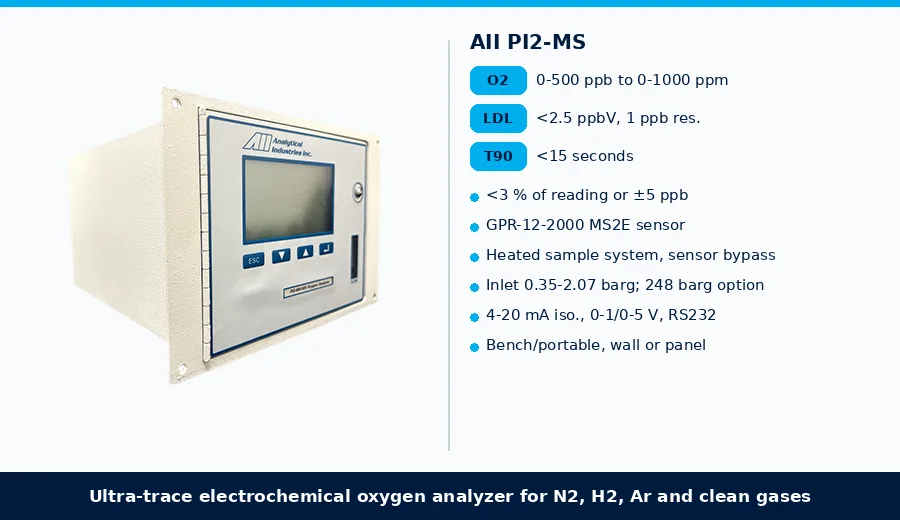
This note looks at the AII PI2-MS from Analytical Industries Inc. (AII), an ultra-trace electrochemical oxygen analyzer with ppb and low-ppm ranges in bench/portable, wall and panel versions. Figures come from the PI2-MS datasheet (document AII-DS-3005-01 02/2025, the copy hosted on our product page) and the current Tetracon product pages. Where we give general engineering advice, it is labelled as general. No prices are given; ranges, mounting and the high-pressure option should be confirmed at quotation.
Why ppb oxygen needs a dedicated analyzer
- The specification is far below what general trace analyzers resolve. A high-purity nitrogen or argon specification may call for oxygen in the tens or hundreds of ppb. The PI2-MS has a lowest range of 0-500 ppb, 1 ppb output resolution and a lower detection limit below 2.5 ppbV, according to the datasheet.
- Air exposure is the main enemy. Any trace oxygen sensor that sees air needs time to purge back down. The datasheet's recovery table shows that after 30 seconds of air the PI2-MS returns to 1 ppm in 45 minutes of nitrogen purge, and after 2 minutes at 9 ppm it returns to 10 ppb in 10 minutes. This is why the sensor bypass and good sampling practice matter (general).
- The sample system is part of the measurement. Tube material, fitting quality, dead volume and flow rate all affect a ppb reading. The PI2-MS uses a heated sample system and sensor housing with temperature compensation for stable readings (datasheet).
How the PI2-MS works
The analyzer uses an AII GPR-12-2000 MS2E electrochemical oxygen sensor in a heated sample system and sensor housing. Sample gas flows at 1-2 SCFH (0.5-1 LPM) through 1/4" compression fittings and exits to an atmospheric vent. The datasheet gives an inlet pressure of 0.35-2.07 barg (5-30 psig), or up to 248 barg (3600 psig) with the high-pressure regulation option. A sensor bypass lets the sample flow around the sensor, which protects it during upsets and line purging and gives fast recovery.
Six ranges are available: 0-500 and 0-1000 ppb, and 0-1, 0-10, 0-100 and 0-1000 ppm. The reading appears on an LCD and is available as an isolated 4-20 mA output plus 0-1 V and 0-5 V, over RS232, and through a 1-5 V DC range-ID signal. Two user-adjustable form C relays, non-latching, provide alarms. The datasheet lists three housings: bench/portable, wall and panel.
AII PI2-MS at a glance
| Item | PI2-MS datasheet (AII-DS-3005-01 02/2025) |
|---|---|
| Sensor | GPR-12-2000 MS2E electrochemical oxygen sensor |
| Ranges | 0-500, 0-1000 ppb; 0-1, 0-10, 0-100, 0-1000 ppm |
| Accuracy | <3 % of reading or ±5 ppb, whichever is greater (at constant conditions, once thermal stability is achieved) |
| Resolution / LDL | 1 ppb output resolution; lower detection limit <2.5 ppbV |
| Response time | T90 <15 seconds |
| Recovery (N2 purge) | 9 ppm for 2 min, back to 10 ppb in 10 min; air for 30 s, back to 1 ppm in 45 min |
| Sample | 1-2 SCFH (0.5-1 LPM); sensor pressure range 700-1400 mbar (10-20 psi) |
| Inlet pressure | 0.35-2.07 barg (5-30 psig) with atmospheric vent; max 248 barg (3600 psig) with high-pressure regulation option |
| Compensation | Temperature; heated sample system and sensor housing |
| Sensor life / shelf life | Up to 18 months (application dependent) / 6 months |
| Calibration interval | Monthly recommended (application dependent) |
| Outputs | 4-20 mA isolated, 0-1 V and 0-5 V; range ID 1-5 V DC; RS232 |
| Alarms | 2 user-adjustable form C relay contacts, non-latching |
| Power | 100-240 V AC; 120 W maximum |
| Operating temperature | 0 to +45 °C |
| Mechanical | 1/4" compression gas connections; painted sheet metal; bench/portable, wall or panel mount |
Where it fits
- Gas generation and purity verification. The datasheet lists gas generation purity and purity verification of N2, H2 and Ar. Typical points are the outlet of a nitrogen generator or purifier, a cylinder filling manifold and the point of use (general).
- Semiconductor and electronics. Listed in the datasheet as process monitoring in the semiconductor and electronics industries, for example purge and carrier gases and inert atmospheres in assembly processes (general).
- Isolators and gloveboxes. Also listed in the datasheet. Inert-atmosphere gloveboxes for battery materials, chemistry and research often specify oxygen in the sub-ppm range (general).
- Specialist metal processing. Listed in the datasheet. Examples include protective-gas heat treatment, brazing and powder handling, where trace oxygen affects surface quality (general).
- Field service and line testing. The datasheet names field service gas line testing for the bench unit, for example when commissioning a new high-purity gas line or checking it after maintenance (general).
Installation and sampling notes
- Keep the sample line tight and short. Use clean stainless steel tube and leak-tight 1/4" compression fittings, and keep dead legs to a minimum. At ppb levels, oxygen diffusing in through a poor joint can be larger than the oxygen in the gas (general).
- Use the bypass when connecting and disconnecting. Route the sample around the sensor while lines are opened or purged so the sensor does not see air. Then switch to the sensor once the line is flushed (general). Plan for the recovery times in the datasheet after any air exposure.
- Respect the pressure limits. The standard inlet is 0.35-2.07 barg with an atmospheric vent. Higher line pressures up to 248 barg need the high-pressure regulation option, which should be specified when ordering.
- Control flow. Keep the flow inside the 1-2 SCFH (0.5-1 LPM) window, and keep the vent free of back-pressure (general).
- Ambient and calibration. The operating temperature is 0 to +45 °C, so in Pakistan's summer the wall or panel unit belongs in a conditioned room or shelter, not an outdoor enclosure (general). Monthly calibration is recommended by the datasheet; agree the span and zero gas arrangement with us at quotation.
- Sensor stock. Sensor life is up to 18 months depending on the application, and shelf life is 6 months, so order spare sensors close to when they will be fitted (general).
Other trace oxygen options from Tetracon's principals
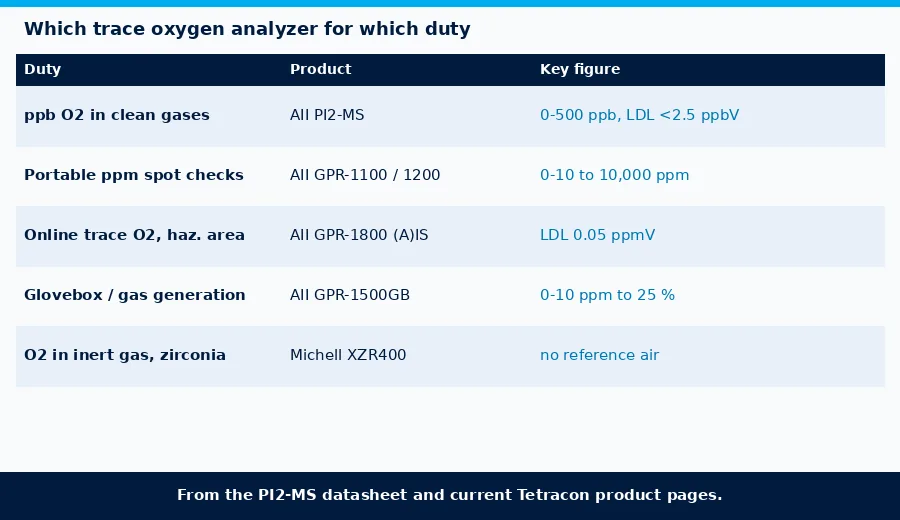
| Duty | Product | From the datasheet / product page |
|---|---|---|
| ppb and low-ppm O2 in clean gases, bench or panel | AII PI2-MS | 0-500 ppb to 0-1000 ppm, LDL <2.5 ppbV, T90 <15 s, heated sample system, sensor bypass |
| Portable spot checks of trace ppm O2 | AII GPR-1100 / GPR-1200 | Four ranges from 0-10 ppm to 0-10,000 ppm, general purpose or ATEX / IECEx / cMETus / UKEx, integral data logging |
| Online trace O2 in hazardous areas | AII GPR-1800 (A)IS | 0-10 ppmV to 0-1 %, LDL 0.05 ppmV, loop-powered IS or line-powered AIS with Modbus and alarms |
| Glovebox and gas generation transmitters | AII GPR-1500GB / GPR-2500GB | 0-10 ppm to 0-25 %, 2-wire 4-20 mA, KF-40 flange or flow-through base, IIC rating |
| O2 impurity in inert gases with zirconia | Michell XZR400 | Zirconium oxide, no reference air, 4-20 mA, RS485 Modbus RTU / RS232 |
Typical uses in Pakistan
- Industrial and specialty gas producers checking high-purity nitrogen, argon and hydrogen before filling and dispatch.
- Nitrogen generator and purifier suppliers proving outlet purity at commissioning and service.
- Electronics, PCB and component assembly plants using inert gas atmospheres.
- University, research and pharmaceutical laboratories running gloveboxes and isolators.
- Heat-treatment, brazing and specialist metal works using protective gas.
These are general application areas based on the datasheet, our product page and our experience of the sector; they are not customer references.
What to send with an enquiry
- The background gas (nitrogen, argon, hydrogen, helium or other) and any other components in the stream.
- The oxygen specification you need to prove, and the range you expect to run in normally.
- Line pressure at the sample point, and whether the high-pressure regulation option is needed.
- Mounting: bench/portable for field and lab use, or wall or panel for a fixed point.
- Required outputs (4-20 mA, voltage, RS232) and alarm set-points for the PLC, DCS or local alarm.
FAQ
What is the AII PI2-MS?
An ultra-trace oxygen analyzer from Analytical Industries Inc. (AII) for oxygen in gases at ppb and low ppm levels, using a GPR-12-2000 MS2E electrochemical sensor in a heated sample system, available as a bench/portable, wall or panel unit.
What ranges and accuracy does it have?
Ranges are 0-500 and 0-1000 ppb and 0-1, 0-10, 0-100 and 0-1000 ppm. Accuracy is <3 % of reading or ±5 ppb, whichever is greater, at constant conditions once thermal stability is achieved. The lower detection limit is <2.5 ppbV and output resolution is 1 ppb.
How fast is it?
The datasheet gives a T90 response time of under 15 seconds. After air exposure for 30 seconds, it recovers to 1 ppm in 45 minutes of nitrogen purge.
What outputs does it provide?
An isolated 4-20 mA output, 0-1 V and 0-5 V outputs, a 1-5 V DC range-ID signal, RS232 communication and two user-adjustable form C alarm relays.
Can it sample high-pressure gas lines?
The standard inlet pressure is 0.35-2.07 barg (5-30 psig) with an atmospheric vent. With the high-pressure regulation option it accepts up to 248 barg (3600 psig).
How often does it need calibration?
The datasheet recommends monthly calibration, depending on the application. Sensor life is up to 18 months, also application dependent.
Next steps
Tetracon (Pvt.) Ltd. is the sole authorized agent for Analytical Industries Inc. in Pakistan and supplies AII oxygen analyzers with local technical support. Send us your background gas, oxygen specification, line pressure and mounting needs, and we will propose the right PI2-MS configuration. Use the contact page or see our services. Start with the PI2-MS, compare the GPR-1100 / GPR-1200, GPR-1800 (A)IS, GPR-1500GB / GPR-2500GB and Michell XZR400, browse oxygen analysis, or see all Analytical Industries products and the full product catalogue. Related notes: portable and process trace oxygen analysis, trace oxygen in inert gases with the XZR400 and ppb moisture in ultra-high-purity gases. Free technical guides are collected under Guides.