

Humidity and temperature are not “comfort” readings in a pharmaceutical plant. In Grade A–D cleanrooms, packing halls, cold rooms, and stability warehouses across Pakistan, RH and temperature decide whether a batch stays within validated limits, whether a deviation becomes a CAPA, and whether an audit finds continuous evidence or a gap. Spot checks with a handheld probe help—but they do not replace a designed monitoring programme with alarms, logs, and named owners.
This technical note is for QA, validation, facility, and engineering teams specifying or operating humidity and temperature monitoring for pharma cleanrooms and storage. It maps typical duties to catalogue instruments from Rotronic—notably the wall-mount DT722 humidity & temperature transmitter, the intrinsically safe HygroFlex5-EX, and the HC2A-AW water-activity head—plus secondary logging with Lascar EL-SIE-2+ and Wi-Fi EL-IOT-SP-TH+. For probe/transmitter verification programmes, see also field calibration of dew-point hygrometers (calibration is supporting discipline here, not the focus).
Why RH and temperature matter in Pakistani pharma facilities
Pakistan’s climate—hot summers, monsoon humidity, and wide day–night swings—stresses HVAC and storage envelopes. Even “controlled” rooms drift when filters load, doors stay open, or backup chillers lag. Continuous RH/T data supports:
- Cleanroom classification & process control — Validated temperature and humidity ranges protect sterile and non-sterile operations, coating, compression, and packaging.
- Warehouse & cold-chain storage — Excursions on raw materials, finished goods, and cold rooms create quality and regulatory risk long before a quarterly audit.
- Stability & retention samples — Chambers and rooms need trendable climate data, not only end-of-day clipboard readings.
- Water activity of hygroscopic products — Equilibrium humidity (aw) links packaging and storage decisions to moisture-driven degradation.
- Audit evidence — Inspectors and customers ask for continuous records, alarm history, and calibration status—not “we check it sometimes.”
A handheld RH meter proves a point in time. A transmitter-plus-logger programme proves the room stayed inside the validated envelope—or shows exactly when it did not.
Typical monitoring duties in pharma cleanrooms and storage
| Duty | What you need | Usual pattern |
|---|---|---|
| Cleanroom / HVAC zone RH & T | Continuous wall or duct RH/T with alarm outputs | Fixed transmitters (e.g. DT722 class) into BMS/SCADA or local logger; defined setpoints and response SOPs |
| Hazardous or solvent areas | Intrinsically safe RH/T | ATEX/IECEx transmitter (e.g. HygroFlex5-EX) with certified probe—do not stretch safe-area hardware into Ex zones |
| Warehouse / packing / cold room | Continuous RH/T + excursion alerts | Transmitters at representative points; secondary display loggers for local visibility |
| Stability / mapping support | High-accuracy logging with exportable records | Mapped sensor layout; USB/Wi-Fi loggers (EL-SIE-2+ / EL-IOT-SP-TH+ class) as complementary evidence |
| Product / packaging moisture risk | Water activity (aw) | Dedicated aw head (HC2A-AW class) on samples—not a room RH probe pressed into a bag |
| Probe / transmitter verification | Traceable RH/T checks | Scheduled verification against a controlled generator or reference; see calibration article for HygroGen2-class options |
Write the duty first: continuous cleanroom proof, Ex-area climate, warehouse alarms, stability logging, or aw on product. Buying “a humidity meter” without that sentence is how spare drawers fill with the wrong accuracy class.
Fixed RH/T transmitters for cleanrooms and HVAC
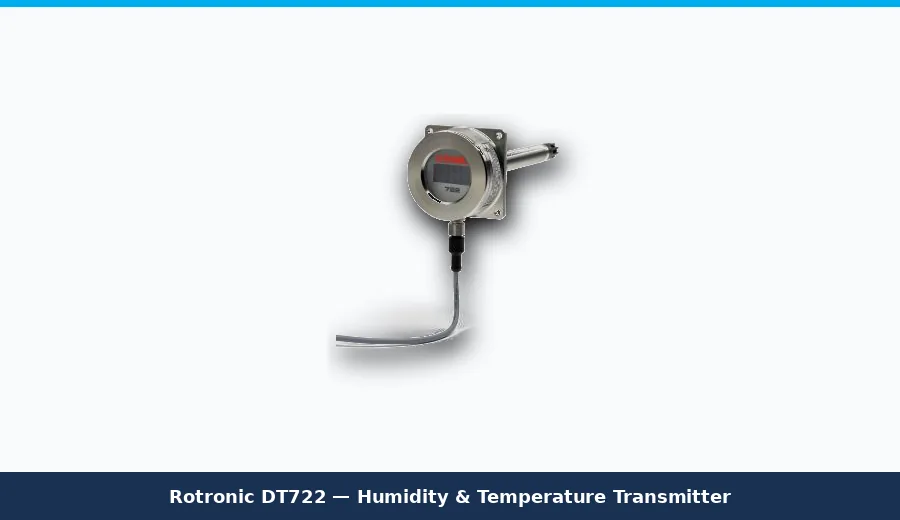
Wall- and duct-style transmitters such as the DT722 measure humidity and temperature (with computed dew point and related psychrometric values on many Rotronic platforms) and output selected values as analog or digital signals. They suit continuous cleanroom and HVAC zone monitoring where the BMS, SCADA, or a dedicated environmental system needs live RH/T—not a weekly walk-around.
Specify range, accuracy class, display needs, probe/filter type for the room grade, and outputs (4–20 mA, Modbus/Ethernet options where used) with the validation protocol—not after installation. Place sensors where they represent the critical volume: avoid dead corners, direct HVAC blast, and doors that create false excursions.
Hazardous-area RH/T: HygroFlex5-EX
Solvent handling, certain API steps, and classified production areas may require intrinsically safe humidity and temperature measurement. The HygroFlex5-EX is a two-channel ATEX/IECEx humidity and temperature transmitter with an intrinsically safe interchangeable stainless-steel probe. Use Ex-rated hardware when the area classification demands it; do not “make do” with a safe-area wall transmitter and hope the auditor agrees.
Water activity for storage and stability decisions
Room RH is not the same as product water activity. For hygroscopic powders, granules, and packaging studies, a dedicated head such as the HC2A-AW measures equilibrium relative humidity above a sample and reports aw. That supports packaging selection, storage-condition justification, and investigations where moisture—not just room climate—drives assay or microbial risk. Keep aw as a lab/QA method alongside room transmitters; one does not replace the other.
Secondary logging: Lascar EL-SIE-2+ and EL-IOT-SP-TH+
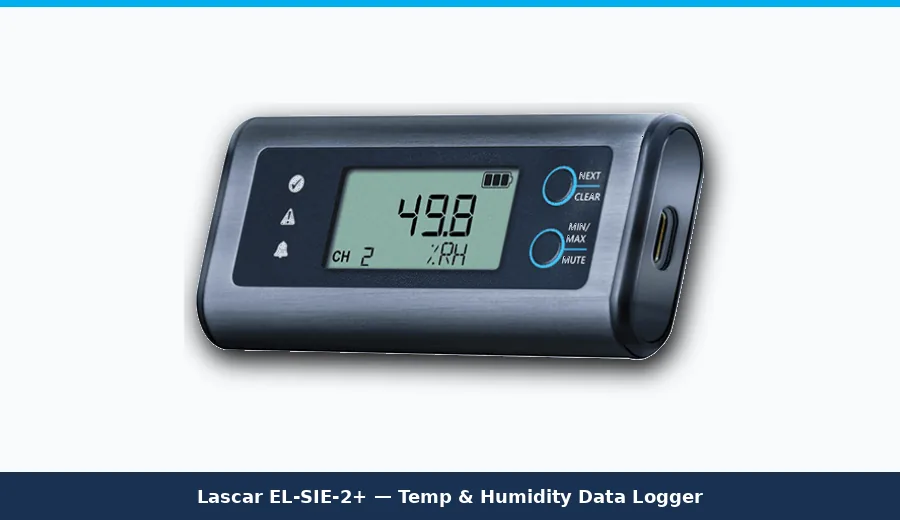
Even with BMS-connected transmitters, many sites want local, exportable logs for mapping campaigns, temporary rooms, or backup evidence when the network is down. The EL-SIE-2+ provides high-accuracy temperature and humidity logging with an on-board display and browser-based configuration (no heavy software install). The EL-IOT-SP-TH+ adds Wi-Fi sync to EasyLog Cloud with a hot-swappable smart probe—useful when remote viewing and automatic upload matter for multi-site or warehouse programmes.
Treat loggers as complementary evidence and mapping tools, not as a substitute for fixed transmitters on critical cleanroom zones that need live alarms into the facility system.
Practical selection tips for Pakistani pharma sites
- Start from the validated envelope — Document RH and temperature ranges, alarm limits, and response times per room grade and storage class.
- Match hardware to area classification — Safe-area DT722-class transmitters for most HVAC/cleanroom walls; HygroFlex5-EX where Ex rating is required.
- Design placement and redundancy — Representative points, spare channels for mapping, and clear ownership when an alarm fires at 02:00.
- Separate room climate from product aw — Use HC2A-AW-class methods for sample moisture risk; do not infer aw from a wall RH reading alone.
- Plan secondary logging deliberately — EL-SIE-2+ / EL-IOT-SP-TH+ for mapping, temporary duties, and audit-friendly exports alongside BMS historians.
- Schedule verification — Probes and transmitters need periodic checks against a reference; keep as-found/as-left records with the quality system (briefly cross-link your calibration programme—do not confuse it with continuous monitoring).
- Train named owners — One custodian for fixed transmitters and one for portable/logger fleets beats a shared drawer of “maybe calibrated” sensors.
Building a sensible RH/T programme
- Inventory every cleanroom, packing hall, warehouse, cold room, and stability space with required range, criticality, and area classification.
- Put DT722-class continuous transmitters on zones where validated climate and live alarms matter most.
- Put HygroFlex5-EX-class monitoring on Ex-rated duties that need certified RH/T.
- Keep HC2A-AW-class water-activity capability for product and packaging decisions.
- Use Lascar display/Wi-Fi loggers for mapping, temporary coverage, and complementary records—with written download and review SOPs.
- Tie alarm response, deviation handling, and calibration status into the quality management system.
How Tetracon supports humidity and temperature choices
Tetracon supplies Rotronic humidity and temperature instruments alongside Lascar environmental data loggers for pharmaceutical and industrial applications in Pakistan. Application support through the contact page and services team can help match fixed transmitters, Ex-rated options, water-activity methods, and secondary logging to your validated envelopes. Start with catalogue pages for DT722, HygroFlex5-EX, HC2A-AW, EL-SIE-2+, and EL-IOT-SP-TH+, or browse Rotronic and Lascar Electronics on the site.
Key takeaways
Humidity and temperature monitoring for Pakistani pharma cleanrooms and storage is a programme, not a single handheld. Use continuous RH/T transmitters (DT722 class) for validated cleanroom and HVAC zones; use intrinsically safe HygroFlex5-EX where area classification demands it; use HC2A-AW-class water activity for product moisture decisions; keep Lascar EL-SIE-2+ / EL-IOT-SP-TH+ loggers as complementary mapping and audit-friendly evidence. Sites that write the duty, placement, alarm response, and verification plan before the PO spend less time explaining climate excursions—and more time protecting product quality.