

Hydrogen sulfide and total sulfur are not “nice to know” numbers on Pakistani gas networks and refineries. They decide whether sales gas clears a contract, whether an amine unit is overloaded, whether a Claus plant stays in air-demand control, and whether people and metallurgy stay safe. A single occasional grab sample is how plants discover sulfur problems as odor complaints, catalyst damage, failed custody disputes, or unplanned shutdowns.
This technical note is for gas-plant, pipeline, refining, and HSE engineers specifying or operating H2S and total-sulfur monitoring. It maps typical duties to catalogue instruments from Galvanic Applied Sciences—notably the tape-based ProTech903, process GC options such as AccuChrome GC5, and the Brimstone sulfur-recovery analyzer—plus practical selection tips for Pakistani plants. See also the broader manufacturers hub and portable GPR-7500 H2S / total sulfur kit where field verification matters.
Why H2S and total sulfur matter on Pakistan gas and refining assets
Sour and mildly sour streams still move through transmission, distribution, and processing assets across Pakistan. Even “sweet” sales gas has contractual sulfur ceilings. Continuous or well-scheduled sulfur data supports:
- Sales-gas and custody specs — Contractual H2S and total-sulfur limits are commercial evidence, not brochure claims.
- Pipeline integrity & odor — Elevated H2S accelerates corrosion risk and drives public/community odor events long before a lab result returns.
- Amine / sweetening performance — Inlet and treated-gas sulfur trends show whether the amine unit is keeping pace with feed changes.
- Sulfur recovery (Claus / SRU) — Tail-gas H2S/SO2 (and related species) drive air-demand control, pit safety, and emissions compliance.
- People safety — Personal and area H2S detection remains mandatory for entry and plant rooms; it does not replace process sulfur analyzers on the gas train.
H2S alone is not always enough—total sulfur (mercaptans and other species converted or measured as sulfur) often sits in the contract, and amine units care about what the plant actually rejects or polishes.
Typical monitoring duties on Pakistani plants
| Duty | What you need | Usual pattern |
|---|---|---|
| Pipeline / sales-gas quality | Low-level H2S; often total sulfur | Continuous tape or GC at key stations; portable verification for disputes and bypass events |
| Amine unit inlet / treated gas | H2S (and related sulfur) trends | Online analyzer on critical streams; sample conditioning matched to wet, amine-laden gas |
| Sulfur recovery (SRU) | H2S, SO2, COS, CS2 / air demand | Dedicated SRU analyzer (e.g. Brimstone class) close-coupled to process |
| Field troubleshooting & custody checks | Portable H2S / total sulfur | Intrinsically safe portable (e.g. GPR-7500 class) with written purge and settle procedure |
| Personal / area HSE | Toxic H2S alarms for people | Separate fixed + portable HSE programme—complement, do not replace process analyzers |
Write the duty first: continuous contractual proof, SRU control, or portable verification. Buying “an H2S meter” without that sentence is how spare cabinets fill up with the wrong technology.
Technology choices: tape, TDLAS, and GC
Three families dominate process sulfur decisions. None is universally “best”—each wins a different duty.
Lead-acetate (colorimetric) tape
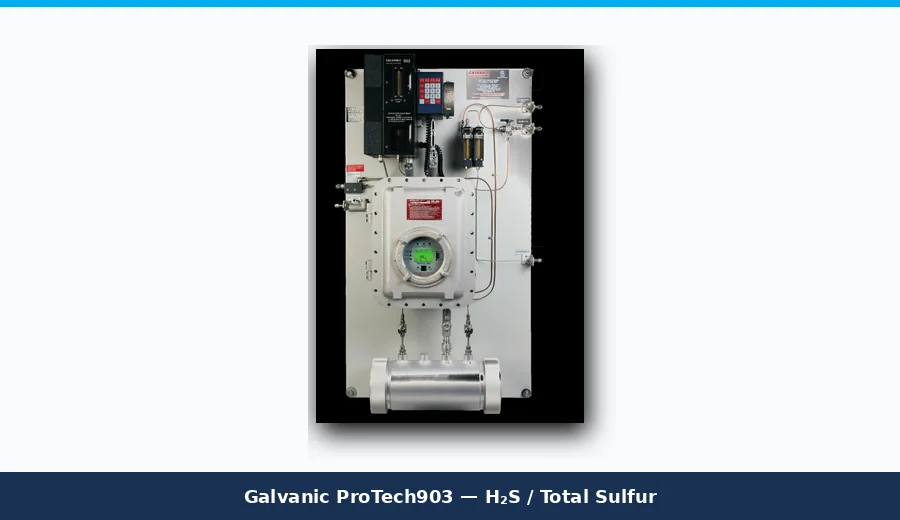
Paper-tape analyzers such as the ProTech903 (and related ProTech 1000 Z2 class) measure H2S—and with conversion options, total sulfur—via a reagent-impregnated tape and optical stain reading. They excel at low ppm / ppb sales-gas and pipeline duties where interference-free H2S response and long tape life matter. Specify ranges, total-sulfur furnace options, multi-stream needs, and hazardous-area certification with the sample system—not after the PO.
TDLAS (tunable diode laser)
Laser absorption analyzers offer fast, low-consumable measurement of selected species (depending on platform and line selection). On natural-gas trains, TDLAS is widely used for moisture and other target gases; for multi-component sulfur programmes, confirm the exact species, range, and background-gas matrix with the OEM datasheet before treating laser as a drop-in for tape or GC. Pair laser moisture duties (where specified) with a dedicated sulfur analyzer rather than assuming one laser box answers every gas-quality question.
Process gas chromatography
Process GCs such as AccuChrome GC5 resolve multiple components—including sulfur analysis configurations—on a field-ready chromatographic platform. Choose GC when you need speciation, BTU/quality packages alongside sulfur, or contractual multi-component proof that a single-species H2S channel cannot provide. Budget carrier gas, maintenance skill, and cycle time into the business case.
SRU specialists
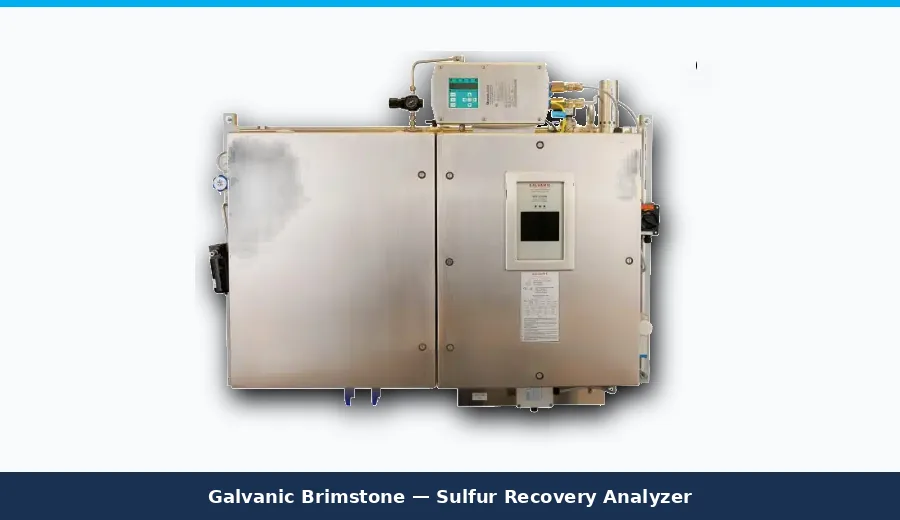
Claus and related sulfur-recovery units need purpose-built analyzers. The Brimstone family targets acid-gas, tail-gas, sulfur-pit, and related duties with simultaneous H2S/SO2/COS/CS2 measurement and air-demand calculation. Do not stretch a sales-gas tape analyzer into Claus control—or an SRU UV analyzer into a pipeline custody H2S role.
Practical selection tips for Pakistani plants
- Start from the contract and the P&ID — H2S only vs total sulfur; continuous vs survey; pipeline vs amine vs SRU.
- Match technology to range and matrix — Low-level sales gas often favors tape; multi-component quality favors GC; Claus control favors SRU analyzers.
- Spec the sample system with the analyzer — Moisture, liquids, amine carry-over, and sulfur vapor plugging kill more projects than the sensor head.
- Separate process sulfur from personal HSE — Bump-tested personal detectors protect people; they do not prove sales-gas sulfur to an offtaker.
- Plan consumables and verification — Tape life, calibration gases, and portable cross-checks (e.g. GPR-7500 class) belong in OPEX, not as afterthoughts.
- Document as-found / as-left — Custody and HSE audits need records; stickers without logs will not settle a dispute.
- Train named owners — One custodian for online sulfur analyzers and one for the portable fleet beats a shared cabinet of “maybe calibrated” kits.
Building a sensible sulfur programme
- Inventory every sales-gas, pipeline station, amine, and SRU sample point with required species, range, and criticality.
- Put ProTech903–class continuous tape (or GC where speciation is required) on streams where contractual or integrity consequence is high.
- Put Brimstone–class monitoring on SRU duties that need air-demand and multi-species control.
- Keep portable H2S / total-sulfur kits for bypass events, commissioning, and dispute resolution—with written purge and settle procedures.
- Keep area/personal H2S detection as a parallel HSE programme with its own bump-test logs.
How Tetracon supports H2S and total-sulfur choices
Tetracon supplies Galvanic Applied Sciences sulfur and gas-analysis instruments alongside complementary portable H2S analyzers and gas-detection products. Application support through the contact page and services team can help match tape vs GC vs SRU duty, sample systems, and hazardous-area needs. Start with catalogue pages for ProTech903, AccuChrome GC5, Brimstone, and GPR-7500, or browse Galvanic Applied Sciences on the site.
Key takeaways
H2S and total-sulfur monitoring on Pakistani natural-gas and refining assets is a programme, not a single catalogue click. Use lead-acetate tape (ProTech903 class) for sensitive continuous pipeline and sales-gas sulfur; use process GC when speciation and multi-component quality matter; use dedicated SRU analyzers (Brimstone class) for Claus air-demand and pit/tail-gas duties; keep portable kits and personal HSE detection as separate, documented layers. Sites that write the duty, sample system, and verification plan before the PO spend less time arguing about “bad sulfur numbers” and more time protecting contracts, metallurgy, and people.