

Natural gas rarely arrives at a sales meter or process plant as a perfectly dry, single-phase fluid. Even when the bulk stream looks “gas-only,” heavier hydrocarbons and water vapour can condense when pressure drops, temperature falls, or composition shifts. For Pakistan’s transmission and distribution networks—and for the power, fertilizer, and industrial users that take gas off those lines—hydrocarbon dew point (HCDP) and water dew point are among the most important gas-quality parameters after calorific value and contaminants such as H₂S.
This article explains both dew points in practical plant language, why they matter on Pakistani systems, how they are measured, and how engineering teams typically choose online versus spot-check methods.
What “dew point” means in a gas pipeline
Dew point is the temperature at which a vapour begins to form liquid at a given pressure and composition. In natural gas there are two distinct condensation risks:
- Water dew point — the temperature at which water vapour starts to form liquid water (or ice/hydrate-related issues under the right conditions).
- Hydrocarbon dew point — the temperature at which the heaviest hydrocarbon components begin to form liquid condensate (NGL-like droplets).
They are not interchangeable. A gas can meet a water-dew-point contract and still drop hydrocarbon liquid in a cold section of pipe. The reverse is also possible after glycol dehydration: water may be under control while C₆+ content remains high enough to cause hydrocarbon condensation during pressure let-down.
The phase behaviour is often described with a pressure–temperature envelope. The cricondentherm is the highest temperature on that envelope at which hydrocarbon liquid can still form. Operating and contractual practice typically aims to keep pipeline conditions safely above the dew-point curve—or to limit potential liquid dropout to levels that do not affect capacity, metering, or equipment.
Why dew point is a live issue in Pakistan
Pakistan’s gas system combines long transmission distances, seasonal ambient extremes, multiple producers and importers, and industrial customers that take gas at high pressure and then let it down. Under the Pakistan Gas Network Code and OGRA-related transmission practice, gas entering the system is expected to meet specification quality. Even when a numeric HCDP limit is not the public talking point, operators still care about:
- Hydrate and freeze risk at pressure-reduction stations, regulators, and orifice meters when water dew point is high.
- Liquid dropout in filters, knock-out pots, compressor suction scrubbers, and turbine fuel-gas trains when HCDP is high.
- Custody-transfer disputes when measured energy, flow, or quality drifts because liquid is collecting in measuring sections.
- Corrosion and fouling when free water combines with CO₂, H₂S, or oxygen ingress.
- Turbine and burner reliability for power plants and large industrial burners that assume dry, single-phase fuel gas.
Winter ambient temperatures in northern and central Pakistan, plus Joule–Thomson cooling at pressure reduction, make dew-point control more than a laboratory topic. A stream that looks dry at a warm processing plant outlet can still condense downstream.
Water dew point: what goes wrong when it is too high
Free water in a gas line is rarely “just moisture.” Typical consequences include:
- Hydrate formation in high-pressure, low-temperature sections—especially around valves and fittings where velocity and JT cooling combine.
- Ice or solid deposits on regulators and control valves during cold mornings.
- Corrosion under wet deposits, accelerated by acid gases.
- Metering bias if liquid films or droplets interfere with ultrasonic paths, orifice plates, or turbine meters.
- Filter and coalescer overload at city gate stations and industrial PRS skids.
Contractual water dew points are often expressed as a temperature at a reference pressure (for example, a dew point at pipeline operating pressure) or converted to a moisture content such as mg/Nm³ or lb/MMscf. Engineers should always confirm whether a quoted number is at process pressure or at atmospheric/standard pressure—mixing the two is a common source of false comfort.
Hydrocarbon dew point: the quieter liquid problem
Hydrocarbon liquids form when heavier ends (C₆ and above, plus aromatic components in some streams) reach saturation. Triggers include:
- Reduced NGL extraction at processing plants when economics favour leaving liquids in the gas.
- Stream blending that raises C₆+ without anyone updating the dew-point model.
- Biomethane or imported gas with a different heavy-end profile.
- Temperature drops along uninsulated lines or at large pressure cuts.
Even small liquid volumes can:
- Collect in low points and surge into compressors.
- Coat ultrasonic meter transducers.
- Contaminate fuel-gas filters and heater tubes.
- Cause intermittent “wet gas” behaviour that operators misdiagnose as water.
Industry research (including GPA-related work on practical HCDP specifications) has long shown that calculation from a C₆+ lumped GC analysis can under- or over-predict dew point depending on how the heavy fraction is split. Direct measurement remains the reference method when contracts or plant integrity depend on the number.
How plants measure dew point today
1) Direct chilled-mirror hydrocarbon dew-point analyzers
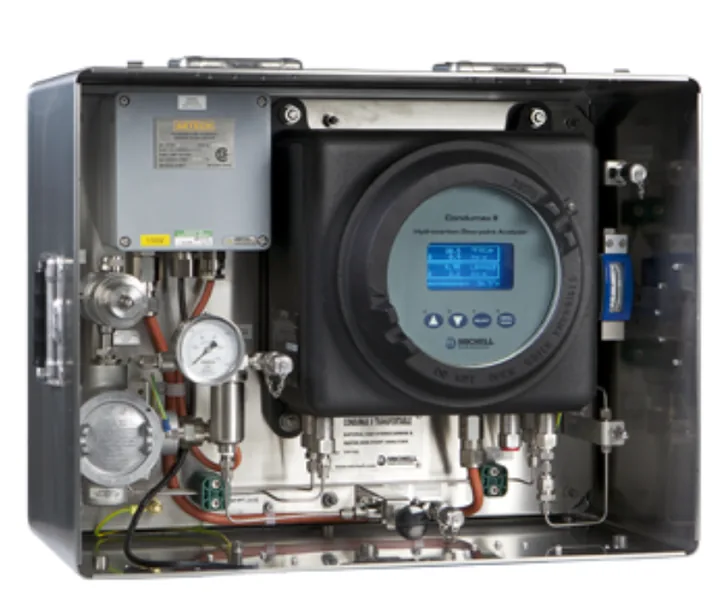
For HCDP, the industry reference approach is direct condensation detection on a cooled surface—historically the Bureau of Mines chilled-mirror method, now automated in online analyzers. Michell’s Condumax II hydrocarbon dew-point analyzer uses a patented “Dark Spot” optical method to detect the onset of hydrocarbon condensate objectively, with optional simultaneous water dew-point sensing via a ceramic moisture sensor. That combination is especially useful at custody-transfer or entry points where both parameters are contractual.
For survey work, turnaround verification, or stations without a permanent analyzer house, a Condumax II Transportable package allows the same measurement principle to be moved between sites.
2) Optical TDLAS for moisture in natural gas
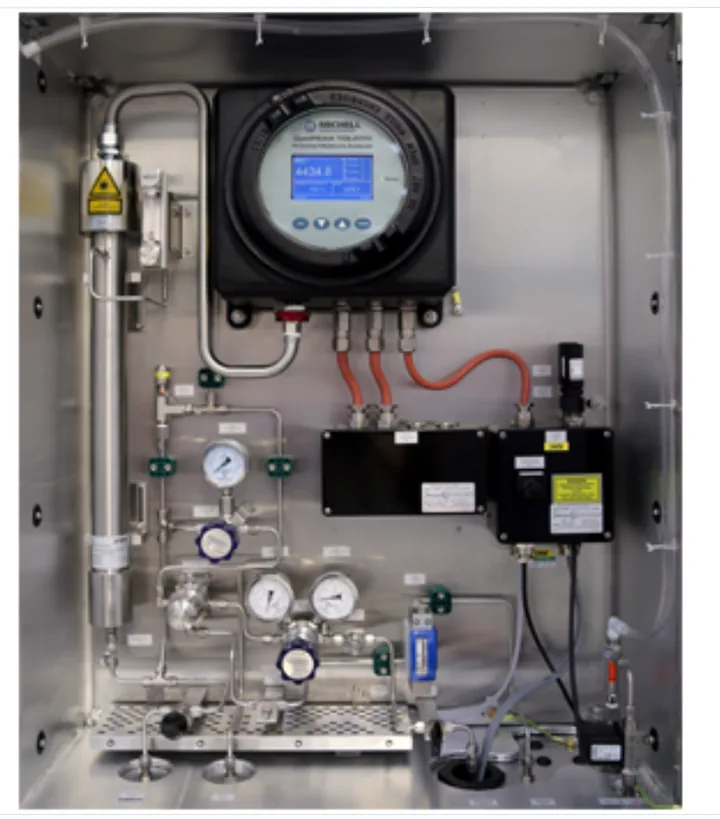
Where the priority is trace water in variable-composition natural gas—including blended or sour streams—tuneable diode laser absorption spectroscopy (TDLAS) is widely used. The OptiPEAK TDL600 measures moisture online with a non-contact optical path, designed for changing methane backgrounds and low ppmV detection. It answers a different question from Condumax: TDLAS is about water (or specific absorbing species), not hydrocarbon dew point.
3) Process moisture transmitters and sampling systems
Ceramic metal-oxide and related capacitive sensors remain common for continuous water dew-point trending on dryer outlets, fuel-gas skids, and instrument-air interfaces that share plant utilities. Their success depends heavily on sample conditioning: filtration, pressure regulation, flow control, and heat tracing so that the sensor sees a representative dry gas—not condensed liquid or ambient wet air.
4) GC + equation of state (EOS) calculation
Extended chromatography with a validated EOS (Peng–Robinson, SRK, etc.) can estimate HCDP when heavy ends are well characterised (ideally beyond C₆+ lumping). Calculated dew point is valuable for modelling and screening, but it is only as good as the heavy-fraction characterisation. Many transmission operators therefore use GC for composition/BTU and keep a direct HCDP analyzer for contractual dew point.
Practical selection guidance for Pakistani sites
Use the table below as a starting point—not a substitute for a site HAZOP or manufacturer datasheet review.
| Need | Prefer | Watch-outs |
|---|---|---|
| Contractual HCDP at entry/exit | Online chilled-mirror HCDP (e.g. Condumax II) | Needs clean sample system; verify hazardous-area certs |
| Water moisture in sales gas, variable composition | TDLAS moisture analyzer | Confirms water, not hydrocarbon liquids |
| Fuel-gas train protection at a power plant | Water dew-point transmitter + liquid knock-out design | Don’t ignore HCDP if gas is rich |
| Multi-site verification / troubleshooting | Transportable HCDP / portable hygrometer | Sampling technique dominates accuracy |
| Model-based studies | Extended GC + EOS | C₆+ split assumptions can skew HCDP |
Questions worth answering before purchase:
- Is the contractual parameter water dew point, HCDP, both, or a liquid content limit?
- What is the maximum pressure and the expected composition range (including H₂S, CO₂, H₂ blending if relevant)?
- Do you need continuous 4–20 mA / Modbus into SCADA, or periodic verification?
- Who will maintain the sample system—filters, regulators, heat tracing, calibration gas?
- Is the installation classified (Zone/Div) and do you need Ex d / Ex i hardware?
Sampling and installation mistakes that create false readings
Most “analyzer problems” on gas plants are sampling problems:
- Wet legs and unheated tubing that condense before the sensor.
- Over-long sample lines that lag real process changes by minutes or hours.
- Oil and glycol carry-over coating mirrors or sensors.
- Incorrect pressure reduction without accounting for JT cooling.
- Ambient air leaks on the low-pressure side that make a dry gas look wet.
- Calibration neglected after seasonal extremes or filter changes.
A good rule: design the sample system with the same seriousness as the analyzer. For Pakistan outdoor skids, sun shields, monsoon ingress protection, and winter heat tracing are not optional extras.
How Tetracon fits without turning this into a sales pitch
Selecting and supporting dew-point analyzers in Pakistan requires both OEM knowledge and local commissioning capability. Tetracon (Pvt.) Ltd. is the sole authorized agent in Pakistan for Michell Instruments and provides application support across Oil & Gas and Power. Plant teams evaluating online HCDP, TDLAS moisture, or transportable verification kits can review product options in the catalogue and discuss installation through Tetracon’s services and contact channels in Islamabad.
Checklist for process, HSE, and procurement
- Confirm whether the risk is water, hydrocarbons, or both.
- Align measurement location with the contract point (entry, SMS, industrial PRS, fuel-gas skid).
- Prefer direct HCDP measurement where liquid dropout has caused trips or disputes.
- Prefer TDLAS or equivalent for low-level water in variable gas compositions.
- Budget sample-system spares and calibration—not only the analyzer head.
- Document alarm setpoints in engineering units everyone understands (°C dew point at stated pressure, or ppmV/mg/Nm³).
Key takeaways
Hydrocarbon and water dew point are separate physical risks that both threaten Pakistani gas pipelines, city gate stations, and industrial fuel-gas systems. Water drives hydrates, corrosion, and freeze-ups; heavy hydrocarbons drive liquid dropout, metering trouble, and equipment fouling. Direct chilled-mirror HCDP analyzers, TDLAS moisture analyzers, and well-designed sample systems remain the practical toolkit. Calculated dew points help, but they do not replace measurement where integrity and custody transfer are on the line.