

“How dry is this gas?” sounds like a single measurement problem. In process plants it is several different problems sharing one word—moisture. Instrument air at −40 °C dew point, natural-gas sales moisture in the low ppmV range, ultra-dry blanket gas for metallurgy, and laboratory reference humidity each push sensor physics in different directions.
This article compares the technologies Pakistani process, analyzer, and reliability engineers most often evaluate: ceramic (metal-oxide) impedance sensors, chilled-mirror hygrometers, quartz crystal microbalance (QCM) analyzers, and tuneable diode laser (TDL/TDLAS) systems. The goal is selection clarity—not a claim that one principle wins every bid.
Start with the process question, not the brochure
Before comparing technologies, write down:
- Analyte range — % RH, frost point −20 °C, −80 °C, or 0.1 ppmV?
- Background gas — air, N₂, H₂, natural gas, CO₂, sour gas, refrigerant?
- Variability — steady composition or blending/biomethane swing?
- Speed — dryer control loop vs custody-transfer average?
- Hazardous area — Ex i, Ex d, purge?
- Maintenance reality — who will change filters and run calibrations after year two?
Technology choice falls out of those answers more reliably than from brand preference.
Ceramic / metal-oxide dew-point transmitters
Ceramic moisture sensors change electrical impedance as water molecules equilibrate in a porous hygroscopic layer. Modern industrial transmitters package that sensor with temperature measurement, rugged housings, and loop-powered or digital outputs.
Typical fit
- Compressed-air and dryer outlets
- Glove boxes and nitrogen generators (with correct range)
- Many process gas dryer packages
- Hazardous-area points using I.S. or explosion-proof housings such as the Easidew PRO XP or Easidew PRO I.S. family
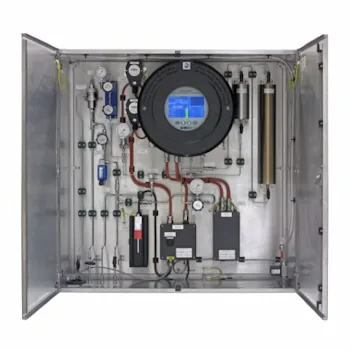
- Multi-channel process monitoring via systems like Promet EExd where several streams need continuous dew-point trending
Strengths
- Compact, relatively low cost of ownership for continuous duty
- Fast enough for most dryer control and alarm duties
- Wide installed base and familiar 4–20 mA integration
- Options for very low dew points when correctly specified and sampled
Limitations
- Contaminants (glycols, oils, compressor varnish, amines) can shift calibration
- Needs disciplined sampling; liquid water on the sensor is abusive
- Periodic calibration against a higher-order reference is good practice
- Extreme trace levels and rapidly changing natural-gas backgrounds may favour optical or QCM methods
Ceramic sensors are the default workhorse when the plant needs reliable dew-point trending without laboratory complexity.
Chilled-mirror hygrometers
A chilled-mirror system cools a mirror until condensate forms, detects that onset optically, and reports the mirror temperature as dew/frost point. It is a fundamental measurement: the reading is tied to phase change, not to a secondary material property.
Typical fit
- Calibration laboratories and transfer standards
- High-accuracy plant labs
- Validation of other moisture transmitters
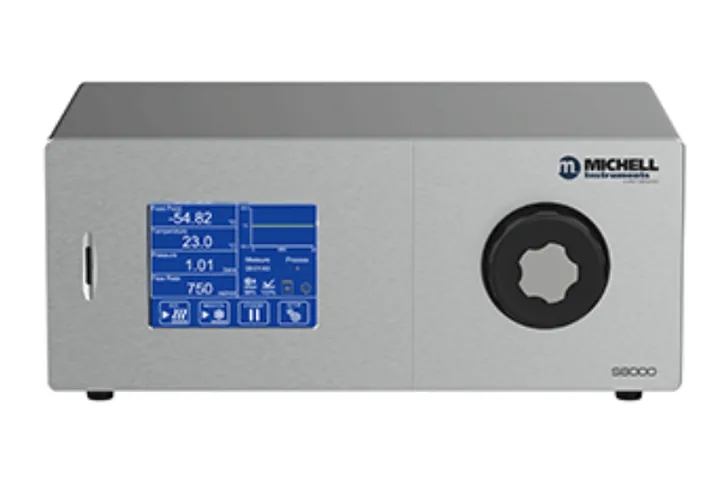
- Precision process applications where fundamental traceability justifies size and cost—see for example Michell’s S8000 precision chilled-mirror class instruments
Strengths
- Fundamental dew/frost-point determination
- Excellent for reference and audit work
- Broad measurement capability with the right mirror and optics design
Limitations
- Higher capital cost and more complex packaging for field Ex duty (though field models exist)
- Mirror contamination control matters
- Generally larger footprint than a simple transmitter
- Overkill for many ordinary dryer-monitoring points
If your QA policy says “calibrate plant transmitters against a chilled mirror,” believe that policy—and budget cleanliness and operator skill.
Quartz crystal microbalance (QCM) process moisture analyzers
QCM analyzers infer moisture from the frequency shift of a quartz crystal as water mass adsorbs and desorbs. Advanced process units add automatic verification against an internal moisture generator.
Typical fit
- Natural-gas transmission and custody-oriented moisture measurement
- Process gases where fast, sensitive ppmV performance is required
- Applications addressed by analyzers such as the QMA601 and related QMA401 low-range variants
Strengths
- High sensitivity and fast response in the trace range
- Designed as a process analyzer (alarms, communications, sample integrity features)
- Automatic calibration/verification features on advanced models reduce drift anxiety
Limitations
- Higher complexity than a two-wire dew-point transmitter
- Sample system design remains critical
- Not automatically the right answer for simple instrument-air dryer loops
Choose QCM when the moisture number has process or commercial weight and you want analyzer-class performance rather than a field transmitter.
TDL / TDLAS moisture analyzers
Tuneable diode laser absorption spectroscopy measures moisture by optical absorption at characteristic wavelengths. Non-contact measurement inside a sample cell reduces some chemical contamination mechanisms that plague surface sensors.
Typical fit
- Moisture in natural gas and biomethane with variable methane/background composition
- Sour-gas service where optical immunity is valued
- Online sales-gas or pipeline moisture where low ppmV detection matters—e.g. OptiPEAK TDL600
Strengths
- Specific to the absorbing species (water) when correctly designed
- Strong performance with changing gas backgrounds (D-MET style compensation on advanced units)
- Minimal sensor “wet-up / dry-down” behaviour compared with impedance sensors
- Low routine maintenance relative to many extractive chemical sensors
Limitations
- Measures water (or configured species)—not hydrocarbon dew point
- Optical windows and sample conditioning still need care
- Capital cost sits at analyzer class, not transmitter class
- Engineers sometimes buy TDL when a ceramic transmitter would have solved a simple dryer problem
TDL is not a universal upgrade; it is the right tool when composition variability and trace water in hydrocarbons dominate the risk.
Side-by-side comparison
| Criterion | Ceramic impedance | Chilled mirror | QCM | TDLAS |
|---|---|---|---|---|
| Principle | Surface impedance | Condensation temperature | Mass on crystal | Optical absorption |
| Best role | Continuous plant dew point | Reference / high accuracy | Trace process moisture | NG moisture, variable backgrounds |
| Speed | Good | Moderate | Very good | Excellent optical response |
| Contamination sensitivity | Medium–high | Mirror fouling risk | Sample dependent | Windows / optics |
| Typical ownership | Transmitter | Lab / precision field | Process analyzer | Process analyzer |
| Hydrocarbon dew point? | No | HCDP needs dedicated HCDP dark-spot/BOM methods | No | No (water) |
Note: hydrocarbon dew point uses related but distinct chilled-mirror methods (e.g. Condumax-style Dark Spot detection). Do not assume a water chilled-mirror or TDLAS replaces HCDP measurement.
Sample systems: the silent majority of moisture errors
Regardless of sensor physics:
- Keep sample lines short, clean, and compatible (stainless, electropolished where justified).
- Control flow and pressure; account for JT cooling on regulators.
- Filter particulates and liquids upstream—never use the sensor as a filter.
- Heat-trace outdoor lines in Pakistani winters on high-pressure gas skids.
- Avoid dead legs that store wet gas and slowly bleed into readings.
- After maintenance, purge thoroughly before trusting the first “dry” number.
A premium TDLAS with a wet, leaking poly tube will lose to a basic ceramic transmitter on a correct sample panel every time.
Application snapshots for Pakistan industry
Power plant instrument air — ceramic transmitter online + portable spot checks. Escalate to chilled-mirror only for calibration audits.
Gas transmission entry/exit moisture — TDLAS or QCM-class analyzers depending on composition variability and company standard; keep HCDP as a separate discussion.
Fertilizer / hydrogen-rich streams — confirm material compatibility, certifications, and whether the sensor principle remains valid in H₂ backgrounds.
Pharma clean utilities — map dew-point targets to ISO 8573 classes; ceramic online monitoring with documented calibration usually leads.
Metallurgical / additive manufacturing N₂ — ppm-level O₂ and moisture often travel together in specs; select analyzers rated for the range, not general RH transmitters.
Review options under Michell Instruments, Pakistan’s authorized line through Tetracon, when comparing these principles on a living datasheet rather than a generic white paper.
A simple selection flow
- If you need a transfer standard → chilled mirror.
- If you need simple continuous dew point on air/N₂ dryers → ceramic transmitter.
- If you need trace moisture with analyzer diagnostics on process gas → QCM.
- If you need water in variable natural gas → TDLAS.
- If you need hydrocarbon dew point → dedicated HCDP analyzer (not the tools above).
When two technologies both fit, prefer the one your technicians can maintain with the spare parts and calibration path you will actually fund.
Key takeaways
Ceramic, chilled-mirror, QCM, and TDLAS moisture technologies solve overlapping but distinct problems. Ceramic transmitters dominate everyday dew-point control; chilled mirrors anchor accuracy; QCM serves fast trace process moisture; TDLAS excels at water in changing natural-gas backgrounds. Match principle to range, background gas, and maintenance reality—and invest as much engineering in the sample system as in the analyzer head.
For plant teams updating moisture measurement standards across multiple units, document the decision matrix once, then reuse it at each FEED or brownfield upgrade so every project does not re-argue physics from scratch.