

Binary gas mixtures show up across Pakistani industry: hydrogen purity on electrolysers and turbine coolant loops, air-in-argon checks for double glazing and air-separation plants, CO2 in methane for biomethane quality, helium recovery, syngas and fuel-cell research. Where the background gas is fixed and the target spans percent-level ranges, a thermal-conductivity analyzer is often the simplest continuous measurement — provided the sensor stays stable and the enclosure matches the area classification.
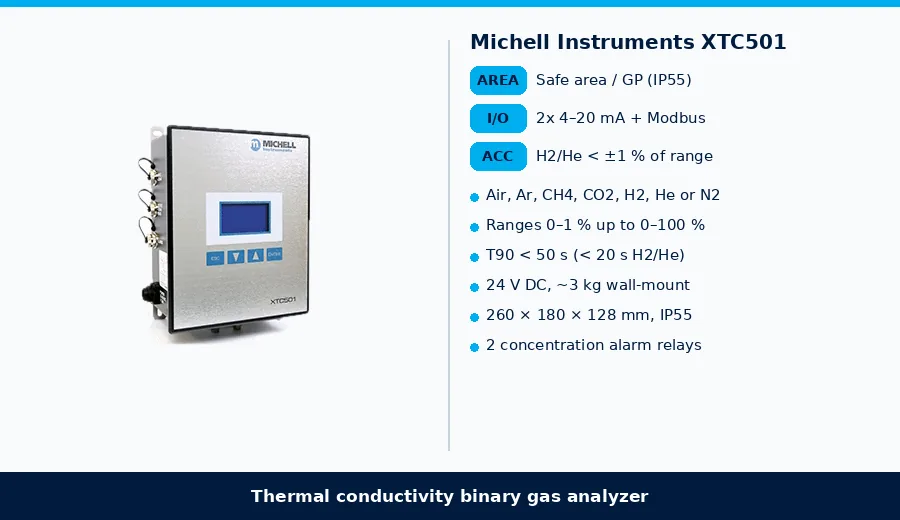
This note looks at the Michell Instruments XTC501 thermal conductivity binary gas analyzer, the lightweight IP55 safe-area model in the XTC Series. Figures come from the Michell XTC Series datasheet (Issue XTC Series_97440_V6.10_EN_0624) hosted on our product page and from the current Tetracon product pages. Where we give general engineering advice it is labelled as general. No performance claim here goes beyond the manufacturer's published data. Tetracon (Pvt.) Ltd. is the sole authorized agent for Michell Instruments Ltd. in Pakistan.
Why a thermal-conductivity binary gas analyzer?
- Percent-level binary mixes need a dedicated principle. Trace O2 or moisture analyzers do not answer "how much H2 is in this N2 background" or "how much air is left in argon". Thermal conductivity uses the unique heat-transfer property of each gas to report the target concentration in a single background or a fixed-proportion background mix (datasheet).
- Non-depleting sensor, low maintenance. The XTC cell has no moving parts and is not a consumable electrochemical cell, so vibration and remote mounting are less of a problem and calibration intervals can be longer (datasheet).
- Safe-area footprint when Ex is not required. Many QC cabinets, electrolyser skids in safe areas, indoor air-separation sample points and laboratory fuel-cell rigs do not need an Ex d analyzer. The XTC501 puts the same measurement chain in a lightweight IP55 wall-mount case (datasheet; product page).
- Sister to the XTC601 family. Where the point is hazardous or needs a heavy IP66 / Ex d housing, see the Michell XTC601 and our note on hydrogen purity for hydrogen-cooled generators (XTC601 HCG). The XTC501 is the safe-area sibling (datasheet).
How the XTC501 works
All gases have a unique thermal conductivity. The XTC analyzer uses that difference to measure a target gas in a binary or pseudo-binary mixture. Matched thermistors sit in a Wheatstone bridge: one in the sample cell, one in a sealed reference chamber. The assembly is temperature-controlled so the cell runs isothermally — on the XTC501 the sample cell is held at +50 °C — which gives a stable platform for the reading (datasheet).
The analyzer is calibrated in the background gas of the process. Measured gases listed on the datasheet are air, argon, methane, carbon dioxide, hydrogen, helium or nitrogen. Sample must be non-condensing with particles smaller than 3 μm. General-purpose sample flow is 100 to 500 ml/min; sample pressure should be a fixed 0.75 to 1.5 bar absolute and the unit must be calibrated at that same pressure. Maximum safe pressure is 1 barg (datasheet).
Outputs as standard are two 4–20 mA loops and Modbus RTU over RS485, plus two concentration alarm relays. Power is 24 V DC, 1.0 A max. Warm-up is under 25 minutes at 20 °C ambient, with about 5 minutes to stabilize. The XTC501 enclosure is IP55, about 3 kg, 260 × 180 × 128 mm, with 1/8" Swagelok gas connections and a Viton O-ring. Ambient operating range is +5 to +50 °C (datasheet).
Two packaging styles are published for the XTC501: a GP1 light-industrial wall-mount with external connectors accessible without opening the case, and a GP2 base model without an integrated display for sites that already have a local control system (optional remote display for set-up, diagnostics and calibration). Application software can show concentration, alarms and graphs and supports remote parameter changes and remote calibration (datasheet).
XTC501 at a glance
| Item | From the datasheet (XTC Series V6.10) |
|---|---|
| Area rating | Safe / general-purpose (GP); XTC501 has no Ex / SIL2 rating (those are XTC601 options) |
| Technology | Thermal conductivity (matched thermistors, temperature-controlled cell) |
| Measured gases | Air, Ar, CH4, CO2, H2, He or N2 in a calibrated background |
| Ranges | Selectable 0–1 % up to 0–100 %; 50–100 % up to 98–100 % (see order codes) |
| Accuracy (intrinsic error) | < ±1 % of range or ±0.05 % H2/He (whichever greater); < ±2 % of range for other mixtures |
| Response (T90) | < 50 s for most combinations; < 20 s for H2 or He |
| Repeatability / linearity | ±0.2 % of range / ±1 % of range |
| Stability | Zero and range ±0.5 % of range per month |
| Outputs | 2 × 4–20 mA; Modbus RTU RS485; 2 concentration alarm relays |
| Power | 24 V DC, 1.0 A max |
| Enclosure | IP55 wall-mount; ~3 kg; 260 × 180 × 128 mm; 1/8" Swagelok |
| Ambient / cell | +5 to +50 °C ambient; sample cell +50 °C |
| Sample | Non-condensing, <3 μm particles; 100–500 ml/min; fixed 0.75–1.5 bar A |
Where it fits in Pakistan
- Hydrogen generation and purity. Electrolyser product gas and H2-in-N2 or air-in-H2 checks on safe-area skids (datasheet applications: hydrogen generation by electrolysis; H2 purity examples).
- Air separation and industrial gases. Product-quality binary checks such as air in argon for double glazing, or other ASU purity duties listed on the datasheet (datasheet).
- Biomethane / biogas upgrading. CO2 in methane as a binary (or pseudo-binary) quality check alongside dedicated biomethane analyzers — see also QED BIOMETHANE 3000 for CH4/O2 fixed analysis (datasheet application; general).
- Helium recovery and fuel-cell research. Helium-in-background and lab-scale binary mixes where a compact IP55 wall unit is enough (datasheet).
- Syngas and process QC cabinets. Indoor safe-area sample points that need 4–20 mA and Modbus into a PLC or DCS without an Ex d housing (datasheet; general).
- Not for hydrogen-cooled generator Ex loops. Turbine coolant H2 purity in classified areas belongs on the XTC601 / XTC601 HCG path — see the HCG note (datasheet; existing blog).
Practical notes for a clean installation
- Confirm binary (or fixed-proportion) chemistry. Thermal conductivity assumes a known background. If a third component varies, the reading can shift — either fix the background proportions or choose a different analyzer technology (datasheet principle; general).
- Match sample pressure at calibration. The datasheet requires a fixed sample pressure of 0.75 to 1.5 bar absolute and calibration at that same pressure. Design the sample system (regulator / bypass) so the analyzer always sees that pressure (datasheet).
- Keep the sample clean and dry. Non-condensing gas, particles under 3 μm. Use a filter and, where condensate is possible, a knockout or heated line so liquid never reaches the cell (datasheet; general for Pakistani outdoor sample points feeding an indoor analyzer).
- Flow inside 100–500 ml/min. Sample-flow effect is published as under 1 % of range within that window (calibrated at 300 ml/min). Fit a rotameter or mass-flow indication on the bypass (datasheet).
- Use both mA and Modbus where useful. One 4–20 mA for the DCS faceplate, the second for a recorder or PLC, and Modbus RTU for richer diagnostics and remote calibration via the application software (datasheet).
- Choose GP1 vs GP2 deliberately. GP1 suits a local wall readout; GP2 suits a cabinet with an existing HMI and optional remote display for periodic service (datasheet).
- Step up to XTC601 when the area is hazardous. XTC501 has no ATEX/IECEx/cQPSus rating. For Ex d / SIL2-capable binary gas duty, specify XTC601 (datasheet).
Related Michell analyzers and when to choose them
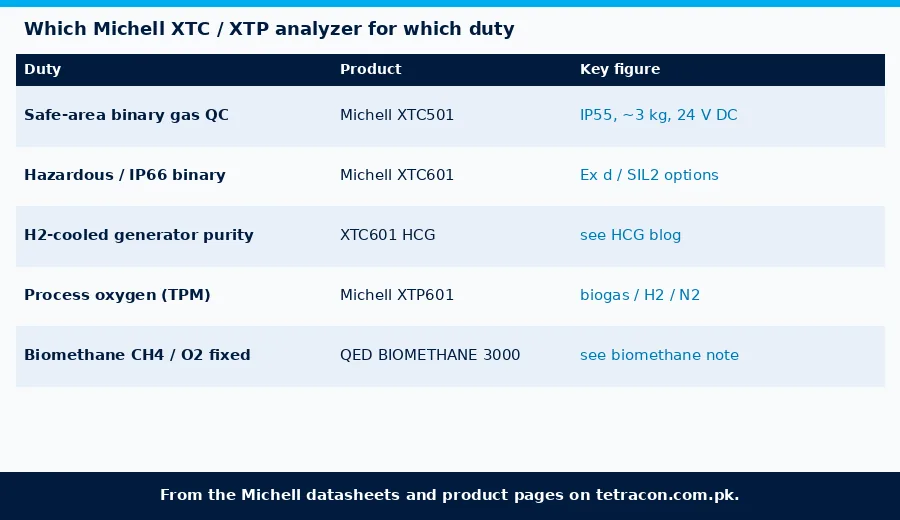
| Duty | Product | From the datasheet / product page |
|---|---|---|
| Safe-area binary gas (H2, He, CO2/CH4, air/Ar…) | Michell XTC501 | Thermal conductivity; IP55; ~3 kg; 2 × 4–20 mA + Modbus; GP only |
| Hazardous-area / heavy IP66 binary gas | Michell XTC601 | Same TC principle; IP66; Ex d options; SIL2-capable option; touch HMI |
| Hydrogen-cooled generator purity | Michell XTC601 HCG | HCG package; see HCG blog |
| Process oxygen (thermo-paramagnetic) | Michell XTP601 | O2 in biogas, H2, N2; see XTP601 blog |
As a rule of thumb, choose the XTC501 when you need percent-level binary gas measurement in a safe area with a compact IP55 wall unit; step to XTC601 when the area is classified or you need the heavier IP66 / Ex d / SIL2 path; and use XTP601 when the measurand is oxygen rather than a binary thermal-conductivity pair (datasheets; general).
What to send with an enquiry
- The target gas and background gas (for example H2 in N2, air in Ar, CO2 in CH4) and the range you need (0–1 %, 0–100 %, 98–100 %, etc.).
- Whether the install point is confirmed safe (non-Ex) or classified — and any zoning drawing.
- Sample pressure, temperature, flow availability, and whether condensate or particulates are present.
- Preferred outputs: which 4–20 mA signals, whether Modbus RTU is required, and alarm-relay actions.
- GP1 (local connections / display path) vs GP2 (no integrated display), and whether a remote display or application-software licence is needed.
- How many points, and whether sister XTC601 / XTP601 analyzers are also required on the same project.
FAQ
Is the XTC501 suitable for hazardous (Ex) areas?
No. The XTC501 is a safe / general-purpose IP55 analyzer. Hazardous-area binary gas duty belongs on the XTC601 with the appropriate Ex certification. SIL2-capable options are also published for the XTC601, not the XTC501.
Which gases can it measure?
The datasheet lists air, argon, methane, carbon dioxide, hydrogen, helium or nitrogen as measured gases, with the analyzer calibrated in the background gas of the process. Ranges are selectable from 0–1 % up to 0–100 %, and from 50–100 % up to 98–100 %.
How accurate is it on hydrogen or helium?
Intrinsic error is published as better than ±1 % of range or ±0.05 % H2 or He, whichever is greater. For other gas mixtures the figure is better than ±2 % of range. T90 for H2 or He is under 20 seconds.
What outputs and power does it need?
Two 4–20 mA outputs and Modbus RTU over RS485 are standard, plus two concentration alarm relays. Power is 24 V DC at up to 1.0 A.
When should I choose XTC601 or XTP601 instead?
Choose XTC601 for hazardous-area, IP66 or SIL2-capable binary gas installations (including hydrogen-cooled generator packages). Choose XTP601 when you need thermo-paramagnetic oxygen measurement rather than a thermal-conductivity binary pair.
Need help selecting a Michell binary gas or oxygen analyzer for a Pakistani plant, ASU, electrolyser or biomethane project? Contact Tetracon with the target/background gases, range, area classification and sample conditions — or browse the XTC501 product page and the Michell Instruments manufacturer page.