

Many large steam-turbine and gas-turbine generators in Pakistan’s power fleet — RLNG combined-cycle blocks, imported-coal and Thar-lignite units, older furnace-oil and gas-fired steam plants, and the bigger captive sets at refineries, fertilizer and process complexes — are cooled with hydrogen. Hydrogen draws heat away from the stator and rotor windings far better than air, and its very low density cuts windage losses. But the coolant only does that job while it stays pure and dry. Air leaking in through shaft seals lowers purity and raises losses; moisture carried in with make-up gas or seal oil attacks insulation; and every outage needs a controlled hydrogen → CO₂ → air purge (and back again) without ever passing through a flammable mixture.
This note is for power-plant electrical, instrumentation and operations teams who specify or replace the gas analysis on a hydrogen-cooled generator. It maps the duty to three Michell catalogue models listed on this site: the purpose-configured XTC601 HCG Hydrogen-Cooled Generator Analyzer, the general XTC601 Binary Gas Analyzer for other hydrogen and binary-gas duties, and the flameproof Easidew PRO XP Explosion Proof Moisture Transmitter for hydrogen dew point. It is deliberately distinct from the site’s SF₆ and compressed-air portable dew-point note (switchgear, not generators) and the oxygen analyzers for process safety note.
Why hydrogen purity is a megawatt number, not just a safety number
Hydrogen is used as a generator coolant for two properties: very high thermal conductivity (it pulls heat out of the windings) and very low density and viscosity (it reduces the wind resistance on the spinning rotor). Both advantages fade as air leaks in. Michell’s published application example puts a figure on it: if a 900 MW generator’s hydrogen purity falls from 99% to 96%, losses increase by about 670 kW — roughly the demand of a thousand households — from extra windage and poorer cooling. On units dispatched at high load factor, that is a continuous, measurable cost long before purity becomes a safety issue.
The safety side is just as concrete. Hydrogen is flammable in air from about 4% to 75%, so a generator can never be opened by simply venting hydrogen and letting air in. Plants purge with carbon dioxide first, then purge the CO₂ out with air before seals are broken — and reverse the sequence after maintenance. Each step has to be measured, not timed.
Write the three duties down separately before you buy “a hydrogen analyzer”: (1) running purity — air-in-H₂ during normal operation; (2) purge monitoring — H₂ in CO₂ and CO₂ in air during outages; (3) coolant dryness — dew point of the hydrogen in the casing or dryer outlet. One instrument family covers 1 and 2; dew point is a separate sensor.
The three measurement phases of a hydrogen-cooled generator
| Phase | When | Binary mixture | XTC601 HCG range / resolution | T90 · recommended calibration |
|---|---|---|---|---|
| Phase 1 | Normal running | H₂ in air (purity / air in-leakage) | 80–100% or 90–100% H₂ · 0.01% | <20 s · monthly |
| Phase 2 | Purging H₂ out with CO₂ (and CO₂ out with H₂ on return) | H₂ in CO₂ | 0–100% · 0.1% | <20 s · prior to use |
| Phase 3 | Purging CO₂ with air before maintenance (and air with CO₂ after) | CO₂ in air | 0–100% · 1% | <50 s · annually |
The outage sequence runs Phase 1 → 2 → 3 for shutdown (H₂ replaced by CO₂, then CO₂ by air so people can work safely — CO₂ is an asphyxiant), and Phase 3 → 2 → 1 for return to service. Because thermal conductivity measures a binary mixture against a known background gas, the analyzer must know which phase it is in — which is exactly what the HCG configuration is built around.
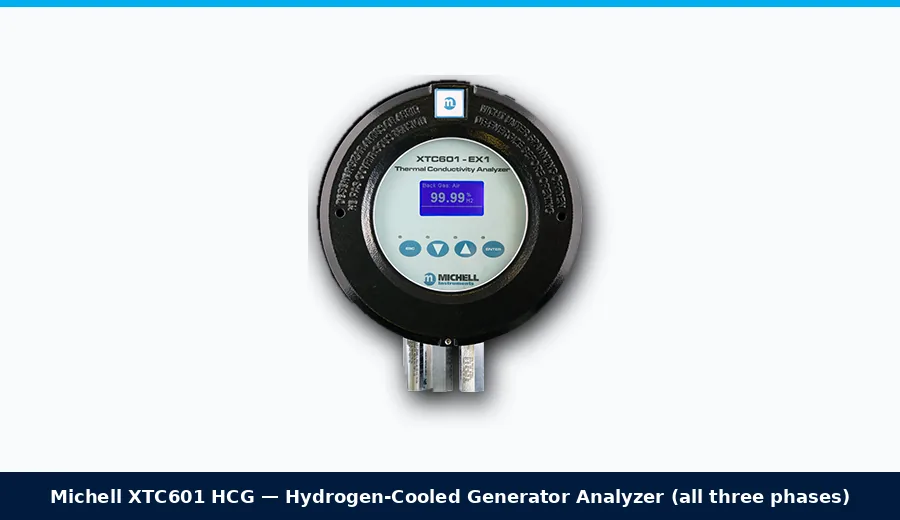
When the XTC601 HCG fits — the dedicated generator analyzer
The Michell XTC601 HCG is an XTC601 thermal-conductivity binary gas analyzer configured specifically for hydrogen-cooled generators. Matched thermistors sit in a Wheatstone bridge — one in the sample cell, one in a sealed or flowing reference chamber — and the whole assembly is held at +50 °C for an isothermal, stable measurement. The sensor is non-depleting with no moving parts, so there are no cells to replace.
- All three phases in one unit — H₂ in air (80–100% or 90–100%), H₂ in CO₂ (0–100%) and CO₂ in air (0–100%), with repeatability ±0.2% of range and linearity ±1% of range.
- Three ways to select the phase — locally on the HMI, over Modbus RTU (RS485), or from a 4–20 mA input driven by the plant’s purge-control logic, so the measurement changes with the maintenance schedule instead of relying on someone remembering.
- Outputs built for the DCS — mA 1 = concentration, mA 2 = phase indication, plus two SPCO concentration relays (250 V, 5 A max) for low-purity or purge-complete alarms.
- External sensor input — a second 4–20 mA input can display another signal, such as a dew-point transmitter or temperature probe, on the analyzer screen — useful for showing coolant dryness beside purity at the generator.
- Hazardous-area build — ATEX / IECEx Ex db IIB+H₂ T6 Gb (and Ex tb IIIC T85 °C Db), cQPSus Class I Division 1 Groups B, C, D, TR CU Ex; IP66 / NEMA 4; 234 × 234 × 172 mm, 9.7 kg. Calibration or adjustment through the glass on the touch-screen, without a hot-work permit.
- Sample requirements to design for — non-condensing gas with particles <3 µm, 270–330 ml/min, nominally atmospheric pressure at the analyzer (maximum safe pressure 1 barg), sample temperature 0–45 °C; 24 V DC, 1.0 A max; warm-up and stabilization under 30 minutes.
Prefer the XTC601 HCG when the duty is the generator itself — replacing an ageing purity meter or a panel that needs separate instruments for running and purge phases — and you want the phase handled in the analyzer and reported to the DCS.
When the general XTC601 fits — other hydrogen and binary duties on site
The standard Michell XTC601 Binary Gas Analyzer uses the same thermal-conductivity platform for a wider set of binary mixtures — measured gases air, Ar, CH₄, CO₂, H₂, He or N₂ — with ranges selectable from 0–1% up to 0–100% and suppressed ranges from 50–100% up to 98–100%. For H₂ or He the published accuracy is better than ±1% of range or ±0.05% (whichever is greater), with T90 under 20 seconds, and zero and range stability of ±0.5% of range per month. Two 4–20 mA outputs, Modbus RTU and two alarm relays are standard, the Ex model carries Ex db IIB+H₂ T6 Gb, and an IEC 61508 SIL2-capable option (with SIL manual) is available for safety-instrumented functions.
Prefer the general XTC601 where hydrogen purity is measured somewhere other than the generator casing — for example on a plant’s own hydrogen generation (electrolysis) skid or storage — or for other binary quality checks such as helium recovery or air-separation product gases. Where the question on an electrolyser is oxygen in hydrogen rather than purity by thermal conductivity, see the paramagnetic XPM601 on the oxygen analysis pages. The compact XTC501 (IP55, safe area only) is for indoor light-industrial binary duties, not for the hydrogen zone around a generator.
Coolant dryness: why hydrogen dew point is a separate measurement
Thermal conductivity tells you how much air or CO₂ is mixed with the hydrogen; it does not tell you how wet the hydrogen is. Moisture enters with make-up gas, through seal-oil systems and during purges, and most generator OEMs specify a dew-point limit and a hydrogen dryer. Measuring it continuously lets the plant see dryer performance and seal-oil problems before they show up as insulation or retaining-ring issues during inspection.
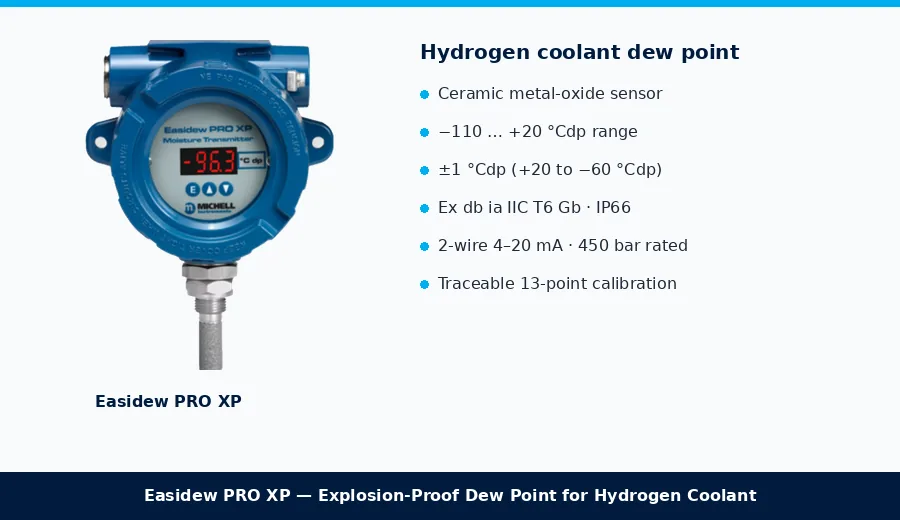
The Michell Easidew PRO XP lists hydrogen coolants among its applications. It is an explosion/flameproof dew-point transmitter with a ceramic metal-oxide sensor: measurement range −110 to +20 °Cdp (−100 °C variant available), accuracy ±1 °Cdp from +20 to −60 °Cdp (±2 °Cdp from −60 to −110 °Cdp), 2-wire 4–20 mA output configurable as dew point or ppmV, traceable 13-point calibration, 450 bar pressure rating and a 3/4"-16 UNF 316 SS process connection. Certification is ATEX/UKEX and IECEx Ex db ia IIC T6 Gb (IIC covers hydrogen), with cQPSus Class I Division 1 Groups A–D; housing is IP66, with an optional integral display. Michell’s sensor-exchange programme keeps recalibration downtime low. Its 4–20 mA signal can go to the DCS and, if wanted, to the XTC601 HCG’s external-sensor input for a local reading at the analyzer (confirm loop-power arrangement during design).
For general background on dryer-outlet dew point and sensor choice, see the Easidew online dew-point note and the trace-moisture technology comparison.
Sampling and installation — where generator analyzers usually go wrong
- Representative sample point — take the purity sample from the casing or the OEM-designated sampling header, with a continuous flow rather than a dead leg. Return or vent the sample as the OEM and hazardous-area dossier require.
- Pressure and flow — generator hydrogen is at elevated pressure, while the XTC601 HCG needs nominally atmospheric pressure at the cell and 270–330 ml/min; specify a pressure regulator and flow control, and do not exceed 1 barg at the analyzer.
- Clean, non-condensing gas — filter to <3 µm and keep the sample above its dew point; seal-oil mist must not reach the cell.
- Hazardous-area classification — confirm the zone and gas group around the generator and analyzer location; the XTC601 HCG is IIB+H₂ and the Easidew PRO XP is IIC.
- Calibration gases on site — plan certified H₂/air and CO₂ checks to match the recommended intervals (Phase 1 monthly, Phase 2 before each use, Phase 3 annually).
- Integrate the phase signal — wire mA 2 (phase indication) and the relays into the purge sequence and DCS so operators can see which mixture is being measured.
Practical use cases in Pakistan
- RLNG combined-cycle power plants — hydrogen-cooled gas-turbine and steam-turbine generators: running purity, air in-leakage alarms and outage purges on one XTC601 HCG per unit.
- Coal-fired plants (imported coal and Thar lignite) — large hydrogen-cooled turbo-generators where a few points of purity are worth hundreds of kilowatts; add Easidew PRO XP for dryer and casing dew point.
- Older thermal units being refurbished — replace legacy purity meters and manual purge checks with a phase-aware analyzer that reports to the DCS.
- Captive power at refineries, fertilizer and petrochemical complexes — hydrogen-cooled generators managed by in-house maintenance teams who need permit-free calibration through the glass.
- On-site hydrogen generation and storage — general XTC601 (SIL2-capable option) for H₂ purity; XPM601 where oxygen-in-hydrogen is the safety measurement.
Selection and integration tips
- Separate the three duties — purity, purge monitoring and dew point — on the datasheet.
- Choose XTC601 HCG for the generator — all three phases, phase selection by HMI, Modbus or 4–20 mA, phase indication on mA 2.
- Choose general XTC601 for other H₂ or binary duties — select the range and background gas, and the SIL2-capable option if it sits in a safety function.
- Add Easidew PRO XP for coolant dryness — IIC flameproof, −110 to +20 °Cdp, 2-wire 4–20 mA.
- Design the sample conditioning — pressure reduction, <3 µm filtration, non-condensing, 270–330 ml/min.
- Plan calibration gas logistics before commissioning, not after.
FAQ
Why do hydrogen-cooled generators need continuous purity monitoring?
Air leaking into the casing lowers hydrogen purity, which increases windage and reduces cooling efficiency. Michell’s published example is a 900 MW generator whose purity drops from 99% to 96% losing about 670 kW extra. Continuous H₂-in-air measurement also alarms on in-leakage long before the mixture approaches hydrogen’s 4–75% flammable range in air.
What does the Michell XTC601 HCG measure?
It measures the three binary mixtures of generator operation and maintenance by thermal conductivity: Phase 1 H₂ in air (80–100% or 90–100%, 0.01% resolution, T90 <20 s), Phase 2 H₂ in CO₂ (0–100%, T90 <20 s) and Phase 3 CO₂ in air (0–100%, T90 <50 s). The phase is selected on the HMI, over Modbus RTU or by a 4–20 mA input, and indicated on the second 4–20 mA output.
Is the XTC601 HCG suitable for hazardous areas?
Yes. It is certified ATEX and IECEx Ex db IIB+H₂ T6 Gb (plus Ex tb IIIC T85 °C Db), cQPSus Class I Division 1 Groups B, C, D and TR CU Ex, in an IP66 / NEMA 4 enclosure, and it can be calibrated through the glass without a hot-work permit.
When would I use the standard XTC601 instead of the HCG version?
Use the standard XTC601 for hydrogen or other binary-gas duties away from the generator casing — for example hydrogen generation or storage purity, helium recovery or air-separation products. It offers ranges from 0–1% to 0–100% and suppressed ranges up to 98–100%, accuracy better than ±1% of range (or ±0.05% for H₂/He), and an IEC 61508 SIL2-capable option.
Does the purity analyzer also measure moisture in the hydrogen?
No. Thermal conductivity measures the binary mixture, not water vapour. Hydrogen coolant dew point needs a separate sensor such as the flameproof Easidew PRO XP (−110 to +20 °Cdp, ±1 °Cdp from +20 to −60 °Cdp, Ex db ia IIC T6 Gb), whose 4–20 mA signal can be shown on the XTC601 HCG’s external-sensor input as well as in the DCS.
How Tetracon supports generator hydrogen monitoring
Tetracon supplies gas analysis, moisture and industrial instrumentation for Pakistan’s power and process industry, including Michell binary gas analyzers and dew-point transmitters. Application support through the contact page and services team can help match ranges, hazardous-area certification, sample conditioning and DCS signals to your generators. Start with the catalogue pages for the XTC601 HCG, XTC601 and Easidew PRO XP, browse gas analysis and moisture & dew point, or see all Michell Instruments products on the site. For a broader moisture primer, download the free Moisture & Dew-Point Measurement Guide.
Key takeaways
On a hydrogen-cooled generator, purity is both a safety measurement and a megawatt measurement. Write three duties down: running purity (H₂ in air), outage purges (H₂ in CO₂, CO₂ in air) and coolant dryness (dew point). The Michell XTC601 HCG covers the first two in one Ex d, IP66, phase-aware analyzer with Modbus and DCS-ready outputs; the general XTC601 covers other hydrogen and binary duties on site, with a SIL2-capable option; and the flameproof Easidew PRO XP adds hydrogen dew point. Design the sample conditioning and calibration-gas plan with the same care as the analyzer.