

Oxygen measurement shows up in two conversations that should not be confused. One is combustion control: how much excess air is leaving a boiler, furnace, or heater. The other is process safety and product quality: whether a blanketed vessel, nitrogen generator, glove box, or flare header is inside its safe oxygen band. Both use “O₂ analyzers,” but the sensor technologies, installations, and alarm philosophies differ.
This guide helps Pakistani power, process, and HSE engineers specify oxygen analysis for the job they actually have—without mixing flue-gas trim hardware into an inerting SIS, or expecting a ppm glove-box transmitter to survive a coal-fired duct.
Two problems, two success metrics
Combustion efficiency and emissions
In fired equipment, measuring flue-gas oxygen lets operators trim air/fuel ratio:
- Too little oxygen → incomplete combustion, CO/smoke, safety risk.
- Too much oxygen → wasted fan power, heat loss out the stack, higher NOx in many regimes.
Success looks like stable excess-O₂ control, fewer manual stack walks, and tighter energy intensity.
Process safety, inerting, and purity
Here oxygen is a hazard marker or purity parameter:
- Nitrogen-blanketed storage and reactors (keep O₂ below a limiting oxygen concentration related to the flammable inventory).
- Additive manufacturing, soldering, and heat-treatment atmospheres.
- Medical or process oxygen purity (high % O₂).
- Ambient oxygen deficiency near bulk nitrogen/argon systems.
- Pipeline or vapor-recovery streams where air ingress matters.
Success looks like trustworthy alarms, validated calibration, and sensors that survive the background gas.
Core sensor technologies
Zirconia (ZrO₂)
A heated zirconia electrolyte develops a Nernst EMF from the oxygen partial-pressure difference between a reference and the process side. It is the dominant technology for combustion flue gas because it is fast, rugged at high temperature, and accurate in the low-% O₂ region typical of boilers and furnaces.
Examples in industrial packages include Michell’s XZR500 combustion control analyzer and in-situ combustion analyzers such as RB Technologies’ ZTR-4. RB’s Pakistan line is listed under RB Technologies.
Watch-outs: zirconia sensors run hot; they are generally unsuitable for measuring oxygen in flammable process mixtures where the hot cell could be an ignition source unless the product is specifically designed and certified for that duty. Extractive/close-coupled combustion designs sample flue gas, not a flammable reactor headspace.
Paramagnetic / thermo-paramagnetic
Oxygen’s paramagnetism enables selective measurement in many process backgrounds. Thermo-paramagnetic and related paramagnetic analyzers suit process oxygen where zirconia’s hot cell is inappropriate—including certain purity and safety duties. Michell’s XTP601 thermo-paramagnetic oxygen analyzer sits in this class for process applications.
Watch-outs: background gases with significant magnetic or thermal effects need application review; sample conditioning still matters.
Electrochemical cells
Galvanic/electrochemical sensors are common for portable analyzers, ambient O₂ deficiency, and many OEM packages. They are compact and low power but are consumables with finite life, especially in extreme temperatures or when exposed to acidic gases.
Optical fluorescence (quenching) sensors
Optical oxygen sensors avoid electrolyte depletion and can work well in selected packaging, life-science, and OEM roles. They are less often the first choice for high-temperature flue ducts.
Combustion analyzer installation patterns
| Pattern | Description | Pros | Cons |
|---|---|---|---|
| In-situ probe | Sensor/probe in the flue | Fast, simple | Harsh dust/heat; access for service |
| Close-coupled extractive | Sensor head on duct flange, short extractive path | Sensor protected vs full in-situ; still fast | Needs correct probe/filter design |
| Fully extractive to analyzer house | Sample treated, then measured | Flexible analytics | Lag, condensation, higher CapEx |
Coal-fired and high-dust Pakistani power and cement applications often need blow-back, filters, and thoughtful probe metallurgy. Refinery process heaters may prioritise fast response and reliable low-% O₂ for trim and heater safety interlocks. Always confirm flue temperature versus probe rating.
For combustion safety instrumented functions, oxygen alone may be insufficient—many heater safety philosophies also consider combustibles or flame supervision. Coordinate with the burner-management and SIS owners; do not invent trip logic from an O₂ datasheet alone.
Inerting and process oxygen: specifying the band
Ask:
- Is the hazard deficiency (people), enrichment (materials/fire), or flammable mixture control (LOC/MOC type limits)?
- What range do you need—0–25% vol, 0–1000 ppm, or high-purity % O₂?
- What is the background gas (N₂, CO₂, hydrocarbons, H₂)?
- Do you need Ex certification and SIL capability statements?
- Is the measurement ambient, extractive process, or in-line?
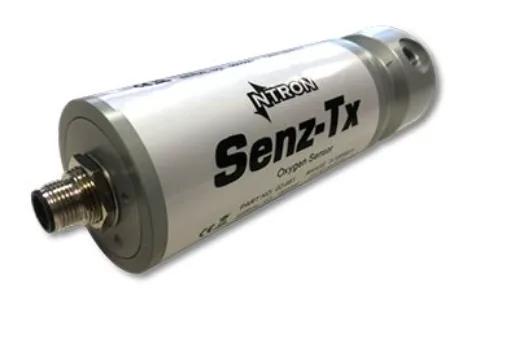
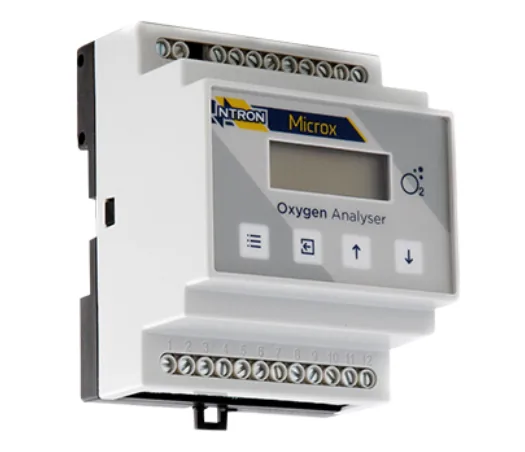
Compact transmitters such as Ntron’s SenzTx and analyzers such as Microx are aimed at nitrogen generation, glove boxes, and OEM integration where zirconia or electrochemical sensor choices depend on whether hydrocarbons are present in the background. Pick sensor chemistry that matches the gas—zirconia’s speed is useless if the application forbids a hot cell.
Alarm philosophy that operators will trust
Bad alarm design creates either nuisance trips or silent risk.
- Separate advisory and actionable thresholds where possible.
- Document setpoints in % vol or ppm with the engineering basis.
- For occupied spaces near inert gases, follow your corporate O₂ deficiency standard (commonly near 19.5% vol low alarm—confirm locally).
- For inerted flammable vessels, set O₂ limits with process safety input—not only vendor defaults.
- Prove final elements: valves, vents, shutdowns, and horns—not only the 4–20 mA reading.
- After calibration, verify the loop returns to process indication correctly (hold vs track behaviour).
Calibration and maintenance realities
Combustion zirconia
- Use appropriate calibration gases; some designs simplify with single-gas routines or sealed references—follow the OEM method.
- Keep probes clear of ash and condensation.
- Trend cell resistance / diagnostics where available to plan replacement before failure.
Process paramagnetic / electrochemical
- Schedule span/zero with certified mixtures.
- Replace electrochemical cells on life, not only on failure.
- Leak-check sample systems—air ingress makes N₂ blankets look unsafe (or hides real ingress, depending on location).
Portables used for verification
- Bump test and calibrate on the same quality programme as fixed heads.
- Do not equate a handheld ambient O₂ meter with a process analyzer rating.
Pakistan operating notes
- Fuel variability (gas, furnace oil, coal, biomass cofiring) changes flue dust and sulphur—specify probe materials and blow-back accordingly.
- High ambient temperatures in turbine and boiler houses stress electronics; use rated enclosures and sunshades outdoors.
- Monsoon humidity increases condensation risk in poorly heat-traced extractive lines.
- Spare parts logistics—prefer analyzers with local authorized support for cells, probes, and commissioning. Tetracon represents multiple oxygen OEM lines in Pakistan and can be reached via contact for application matching across Michell, RB Technologies, Ntron, and related principals.
Procurement checklist
- Duty: combustion trim, combustion SIS support, inerting, purity, or ambient safety?
- Technology allowed by the duty (zirconia vs paramagnetic vs electrochemical).
- Range, accuracy, T90 response, and analogue/digital outputs.
- Hazardous-area certificates and material compatibility.
- Probe length/temperature for flue applications.
- Sample system inclusions (filters, regulators, blow-back, heat tracing).
- Calibration concept and gas consumption.
- Integration to DCS/BMS and cause-and-effect ownership.
- Spares for 24 months and training for instrument technicians.
Common mistakes
- Using a hot zirconia cell on a flammable process stream without a suitable certified design.
- Buying a 0–25% ambient O₂ detector for a 100 ppm inerting duty.
- Ignoring dust loading on coal/biomass flues.
- No ownership of calibration gas after handover.
- Treating O₂ trim as a substitute for CO/combustibles monitoring where the safety case needs both.
- Mounting detectors where only dilution air is measured, not the real flue gas.
Key takeaways
Oxygen analyzers succeed when the duty is explicit. Zirconia combustion analyzers trim fired equipment and support stack-side efficiency; paramagnetic and carefully chosen electrochemical/optical devices protect inerting, purity, and OEM process duties. Installation pattern, background gas, and alarm philosophy matter as much as the sensor brand. Specify the hazard and the range first, then select technology—and fund calibration as part of the safety and energy function.
If your site runs both boiler trim and nitrogen blanketing, maintain two standards and two maintenance kits. The shared word “oxygen” is not a shared instrument strategy.