

A compressed air dryer is only as good as the dew point it delivers. When a refrigerant or desiccant dryer drifts, water reaches pneumatic valves, instrument air lines, paint booths, moulding machines and breathing-air manifolds, and the first sign is often corrosion, frozen lines or rejected parts rather than an alarm (general). Many plants in Pakistan still check dryers by eye on a dryer panel lamp, or only when something fails (general).
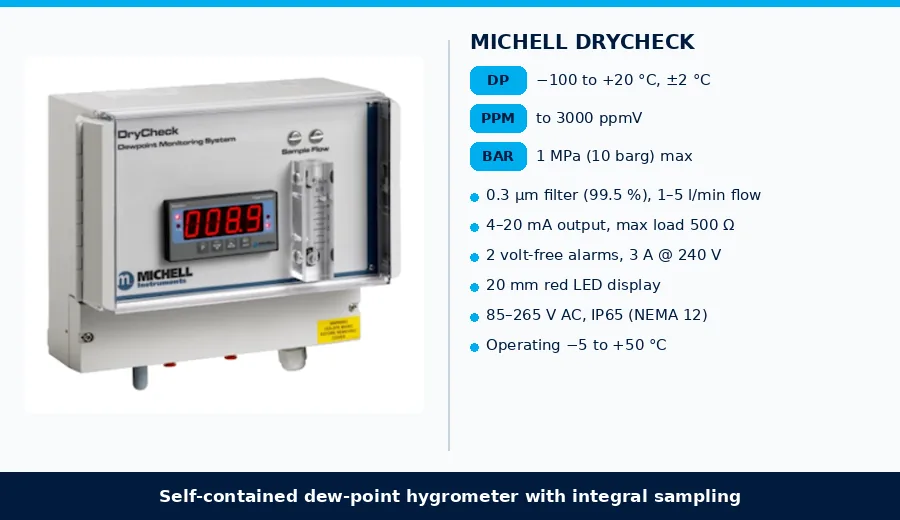
This note looks at the Michell DryCheck self-contained dew-point hygrometer, a wall-mounted instrument that combines a Michell Easidew sensor with its own filter, flow control, display, 4–20 mA output and two alarm relays. It covers what the DryCheck datasheet says, how to install it at a dryer outlet, how to set alarms, and when another Michell dew-point instrument is the better fit. Figures come from the DryCheck datasheet hosted on our product page and the current Tetracon product pages. General engineering advice is labelled as general, and nothing here goes beyond the published data. Tetracon (Pvt.) Ltd. is the sole authorized agent for Michell Instruments Ltd. in Pakistan.
Why a self-contained dew-point instrument
- Instrument and sampling system in one box. The DryCheck combines the hygrometer with an integral sampling system: a 0.3 µm particulate filter, a monolithic sampling block that houses the Easidew transmitter, and a valve and flowmeter for setting the sample flow (datasheet). There is no separate sample panel to design (general).
- Simple installation. Everything sits in a rugged IP65 (NEMA 12) polycarbonate case that can be wall mounted close to the gas sample, with quick-connect push fittings for 6 mm (¼″) OD Teflon tubing (datasheet).
- Display, output and alarms included. A 20 mm (¾″) red LED display shows dew point in °C or °F or moisture content in ppmV, and the unit provides a 4–20 mA output and two alarm relays, all configured from the front panel (datasheet).
- Proven sensor, low-cost recalibration. The DryCheck uses the Michell Easidew Online with Michell’s ceramic metal-oxide moisture sensor; calibration data is stored in the transmitter’s flash memory, which allows Michell’s sensor exchange scheme to keep calibration costs and downtime low (datasheet).
- System or atmospheric pressure. All components are rated to 1 MPa (10 barg / 145 psig), and the DryCheck can be configured to measure dew point at either system pressure or atmospheric pressure (datasheet).
DryCheck at a glance
| Item | Michell DryCheck (datasheet) |
|---|---|
| Sensor | Michell ceramic metal-oxide moisture sensor (Easidew Online), impedance technology |
| Measurement range | −100 to +20 °C (−148 to +68 °F) dew point, or moisture content to 3000 ppmV |
| Accuracy | ±2 °C (±3.6 °F) dew point |
| Display | 20 mm (¾″) red LED; dew point in °C or °F, or moisture content in ppmV |
| Output | 4–20 mA, maximum load 500 Ω |
| Alarms | 2 volt-free contacts, 3 A at 240 V; alarm points set from the front panel |
| Power supply | 85 to 265 V AC, 50/60 Hz; 2 m (6.5 ft) mains cable supplied |
| Gas pressure | 1 MPa (10 barg / 145 psig) max (high-pressure option available) |
| Sample flow rate | 1 to 5 l/min (2.1 to 10.5 scfh) |
| Filtration | 99.5 % removal of 0.3 µm particles |
| Gas connection | Quick-connect fittings for 6 mm OD Teflon tube |
| Operating temperature | −5 to +50 °C (+23 to +122 °F) |
| Storage temperature | −40 to +75 °C (−40 to +167 °F) |
| Enclosure | IP65 (NEMA 12) polycarbonate, wall mounted, clear cover over display and flowmeter |
The datasheet notes that a ppmV output or a non-standard dew-point range must be specified at the time of order, and refers to the Easidew Transmitter and Easidew Online datasheets for the full specification (datasheet).
How the ceramic sensor works
The DryCheck uses impedance technology based on Michell’s ceramic metal-oxide moisture sensor (datasheet). Water molecules adsorb onto a porous insulating layer sandwiched between two conductive layers on a ceramic substrate; because water has a much higher dielectric constant than the active layer and the carrier gas, the change is easy to detect (datasheet). The active layer is less than one micron thick and the porous top conductor less than 0.1 micron, so the sensor responds quickly both when the gas dries (on start-up) and when moisture breaks through (datasheet).
Installing it at a dryer outlet
- Take the sample after the dryer. Tap the sample point on the dry-air header downstream of the dryer and its after-filter, ideally from the top of the pipe so any liquid carry-over is not drawn into the line (general).
- Keep sample tubing short and clean. Use the 6 mm OD Teflon tubing the quick-connect fittings are designed for (datasheet), keep the run short, and avoid rubber or PVC hose, which absorbs and releases moisture and slows the reading (general).
- Set the flow. Use the built-in valve and flowmeter to set the sample flow within 1 to 5 l/min (datasheet). Steady flow gives a stable reading; vent the outlet safely (general).
- Choose pressure or atmospheric dew point. The DryCheck can be configured for measurement at system pressure or at atmospheric pressure (datasheet). Dryer performance is normally judged on pressure dew point, so decide which one your specification or ISO 8573-1 class refers to before commissioning (general).
- Respect the limits. Standard rating is 1 MPa (10 barg) maximum, with a high-pressure option available, and the operating temperature is −5 to +50 °C (datasheet). In hot compressor rooms, mount it in the coolest shaded spot near the sample point, away from the compressor discharge (general).
- Power and wiring. Mains input (85 to 265 V AC), the 4–20 mA output and the two voltage-free relay contacts are all behind the lower panel (datasheet). Bring the 4–20 mA signal to the PLC or BMS for trending (general).
Setting alarms that mean something
- Two relays, two jobs. Use one relay as an early warning a few degrees above the normal dryer dew point and the second as a high alarm at the limit your process can tolerate (general). Alarm points are set from the front panel (datasheet).
- Match the dryer type. Refrigerant dryers typically run around +3 °C pressure dew point and desiccant dryers around −40 °C or lower, so the alarm setpoints differ (general). The DryCheck’s −100 to +20 °C range covers both (datasheet).
- Use the alarm contacts. The relays are volt-free contacts rated 3 A at 240 V (datasheet), enough to drive a beacon, a local horn or an input to the dryer controller (general).
- Trend, not just alarm. A slow upward drift in dew point over weeks usually points to desiccant ageing, a purge problem or a failing drain, long before the high alarm trips (general).
Where it fits in Pakistan
- Compressed air dryers. The first listed application (datasheet). Textile mills, food and beverage, pharma, automotive and cement plants in Pakistan rely on dry instrument and process air, and summer humidity loads dryers heavily (general).
- Plastic moulding. Listed (datasheet). Wet process air or poorly dried resin shows up as surface defects and brittle parts, so a dew-point check on the dryer is a cheap safeguard (general).
- Medical gases and breathing air. Both are listed (datasheet). Hospitals and breathing-air compressor stations use dew point as part of air-quality monitoring (general); the applicable standard and limits should come from your project specification.
- Ozone generators, pneumatics and welding gases. All listed applications (datasheet), wherever dry feed gas protects equipment or weld quality (general).
When another Michell instrument is the better fit
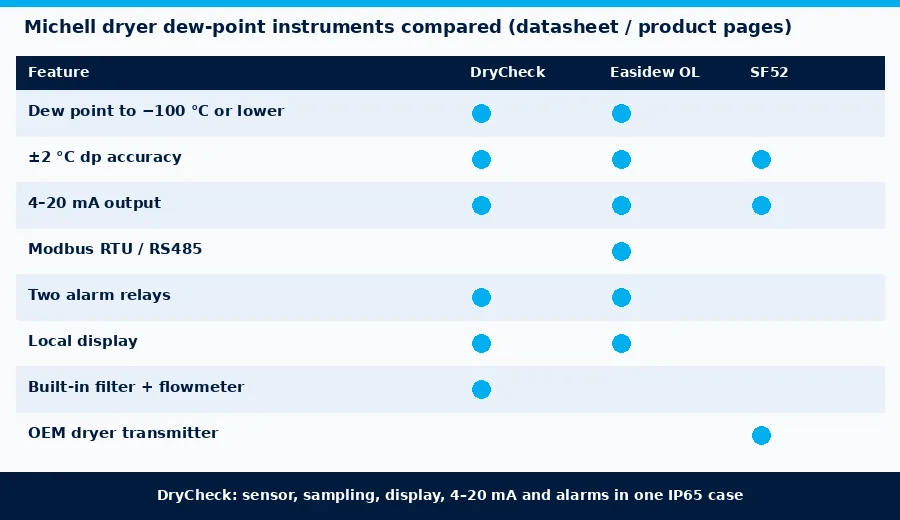
- Michell Easidew Online: 1/8 DIN dew-point hygrometer with a 2-wire Easidew sensor, sample block and display; −110 to +20 °C dp (−100 °C variant), ±2 °C dp, 4–20 mA or 0–20 mA, Modbus RTU over RS485, dual relay alarms, AC or DC supply (product page), when you want panel mounting, a Modbus output or higher pressure. See our Easidew compressed-air note.
- Michell SF52: cost-effective OEM dew-point transmitter, −40 to +60 °C dew point, ±2 °C dp, voltage or 4–20 mA 3-wire outputs, IP66 nickel-coated brass housing (product page), for dryer manufacturers building it into the dryer. See our SF52 note.
- Michell Easidew PDP: portable hygrometer for spot-checking dryer outlets, pressure dew point to 20 barg, ISO 8573-1 Class 1–4 air-quality compliance, touchscreen and datalogging (product page), when one instrument has to check many dryers.
- Michell MDM300: high-speed portable hygrometer for dew-point spot checks up to 350 barg, with an intrinsically safe I.S. variant (product page), for compressed air, natural gas and switchgear gas surveys. See our portable dew-point note.
Related products
| Need | Product | Key point |
|---|---|---|
| Wall-mounted dryer monitor with sampling | Michell DryCheck | −100 to +20 °C dp, ±2 °C, 4–20 mA, 2 relays, IP65 (datasheet) |
| Panel-mount hygrometer with Modbus | Michell Easidew Online | −110 to +20 °C dp, 4–20 mA, RS485 Modbus RTU, dual relays (product page) |
| OEM dryer transmitter | Michell SF52 | −40 to +60 °C dp, voltage or 4–20 mA, IP66 (product page) |
| Portable dryer spot checks | Michell Easidew PDP | Pressure dew point to 20 barg, ISO 8573-1, datalogging (product page) |
| High-pressure portable surveys | Michell MDM300 | Spot checks up to 350 barg, I.S. variant (product page) |
For more background, read our field calibration note for dew-point hygrometers and the trace moisture technology comparison. The wider range is on the Dew Point & Moisture category page, our selection guides and the Michell Instruments manufacturer page.
What to send with an enquiry
- The gas (compressed air, breathing air, medical gas, nitrogen, welding gas) and the dryer type and make.
- The normal and maximum line pressure, and whether you need pressure or atmospheric dew point.
- The expected dew point and the alarm limits you work to, or the ISO 8573-1 class in your specification.
- Where the 4–20 mA signal and alarm contacts will go (PLC, BMS, dryer controller, local beacon).
- The installation location and its ambient temperature range.
Send these to Tetracon and our engineers will confirm the right configuration and lead time. Our services team in Islamabad supports installation and commissioning across Pakistan.
FAQ
What does the Michell DryCheck measure?
It measures dew point from -100 to +20 °C (-148 to +68 °F), or moisture content up to 3000 ppmV, with an accuracy of ±2 °C dew point, using the Michell Easidew Online and its ceramic metal-oxide sensor (datasheet).
Does the DryCheck need a separate sampling system?
No. It includes a 0.3 µm particulate filter, a sampling block for the Easidew transmitter, and a valve and flowmeter for setting a 1 to 5 l/min sample flow, all in one IP65 wall-mounted case (datasheet).
What outputs and alarms does the DryCheck have?
A 4-20 mA output (maximum load 500 Ω) and two volt-free alarm relays rated 3 A at 240 V, with alarm points set from the front panel, plus a 20 mm red LED display (datasheet).
What pressure can the DryCheck handle?
All components are rated to 1 MPa (10 barg / 145 psig), with a high-pressure option available, and it can be configured to measure dew point at system or atmospheric pressure (datasheet).
Who supplies Michell DryCheck in Pakistan?
Tetracon (Pvt.) Ltd., Islamabad, is the sole authorized agent for Michell Instruments Ltd. in Pakistan and supplies the DryCheck with local technical support. Contact us with your dryer and pressure details for a quotation.
Checking dryer performance or planning a compressed air quality upgrade in Pakistan? Contact Tetracon with the gas, pressure and dryer details. You can also browse the DryCheck product page and the Michell Instruments manufacturer page, or the full product catalogue and all manufacturers.