

Every compressed-air dryer, plastics resin dryer and packaged gas dryer has one job: deliver gas that is dry enough. Yet many dryers in Pakistani plants run for years with no dew-point reading at all, so a failed drain, a saturated desiccant bed or a stuck purge valve only shows up when water reaches pneumatic valves, instruments or product. For dryer manufacturers and plant engineers, a small, rugged dew-point transmitter on the dryer outlet is the simplest way to turn "the dryer is running" into "the air is dry".
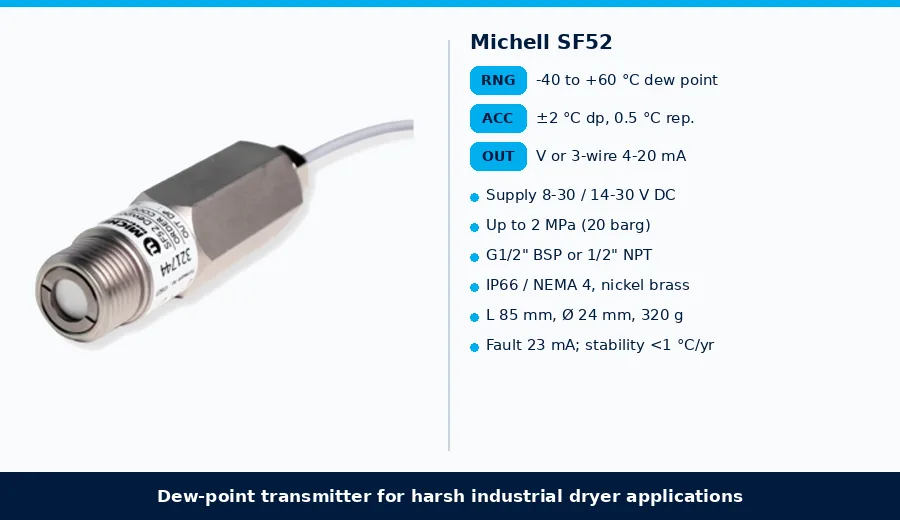
This note looks at the Michell SF52, a simple, cost-effective dew-point transmitter designed for harsh industrial dryer applications. Figures come from the Michell SF52 datasheet (issue SF52_97181_V6.1) hosted on our product page and from the current Tetracon product pages. Where we give general engineering advice, it is labelled as general. No prices are given; output, scaling and process connection should be confirmed at quotation.
Why dryers need a dew-point transmitter of their own
- Dryers fail quietly. A refrigerant dryer with a blocked condensate drain or a desiccant dryer with exhausted adsorbent still runs and still shows pressure; only the moisture content changes (general). A continuous dew-point signal is the only direct evidence that the dryer is doing its job.
- The signal is wanted inside the dryer, not just in the plant. The SF52 is described in its datasheet as ideal for OEM dryer use, with voltage or mA outputs that can feed the dryer's own controller, a PLC or a building management system. Dryer builders can use the reading for alarms, for dew-point dependent switching or simply to show dryness on the panel (general).
- Dryer environments are hard on sensors. Compressor rooms are hot, dusty and full of vibration and oil mist. The SF52 has a recessed and protected measuring element for an extended sensor life cycle, an HDPE front filter and an IP66 / NEMA 4 nickel-coated brass housing (datasheet).
How the SF52 works
The SF52 uses a polymer-based humidity sensor: water vapour is absorbed by a thin polymer layer and changes its electrical properties, which the onboard electronics convert into dew point or absolute humidity (datasheet, with general sensor principle). The unit is thermally characterised over its operating temperature range, and each transmitter is calibrated on Michell's high-volume traceable calibration system and shipped with a 3-point calibration certificate, which is what lets Michell supply OEM quantities on short deliveries (datasheet).
The output is either a voltage (0-1, 0-5 or 0-10 V) or a 3-wire 4-20 mA signal. The standard scaling is -40 to +60 °C dew point; -30 to +30 °C dew point and 0 to 200 g/m3 absolute humidity are also listed, and non-standard scaling is available on request (datasheet). Fault conditions are factory programmed on the mA output: 23 mA for a sensor fault, 4 mA under range and 20 mA over range (datasheet), so a controller can tell a sensor problem from a genuinely wet or dry reading.
Michell SF52 at a glance
| Item | SF52 datasheet |
|---|---|
| Type | Dew-point transmitter for harsh industrial dryer applications, polymer-based sensor |
| Measurement range | -40 to +60 °C (-40 to +140 °F) dew point |
| Accuracy | ±2 °C (±3.6 °F) dew point; 0.4 to 3 g/m3 on value of absolute humidity |
| Repeatability / stability | 0.5 °C dew point / <1 °C per year |
| Calibration | Traceable 3-point calibration certificate |
| Output | 0-1, 0-5, 0-10 V or 4-20 mA (3-wire); dew point or absolute humidity |
| Scaling | Standard -40 to +60 °Cdp; -30 to +30 °Cdp or 0-200 g/m3; non-standard on request |
| Supply | 14-30 V DC (0-10 V output); 8-30 V DC (0-1 V, 0-5 V or 4-20 mA output) |
| Current consumption | <9 mA (voltage output); <29 mA (mA output) |
| Operating conditions | -40 to +60 °C; 0-100 % RH; up to 2 MPa (20 barg / 290 psig) |
| Housing / protection | Nickel-coated brass, HDPE front filter; IP66 (BS EN 60529) / NEMA 4 |
| Process connection | G1/2" BSP or 1/2" NPT |
| Size / weight / cable | L = 85 mm, Ø 24 mm max / 320 g / 2 m halogen-free TPE cable |
| Diagnostics (mA output) | Sensor fault 23 mA; under range 4 mA; over range 20 mA |
| Marking | CE |
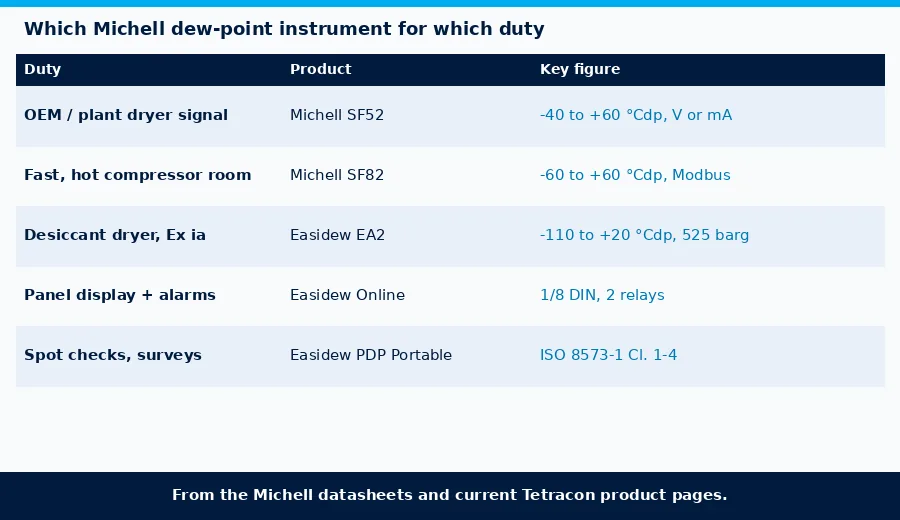
With ±2 °C accuracy and a -40 °C lower limit, the SF52 is a dryer-performance transmitter, not a trace-moisture analyser (general). It is a good match for refrigerant dryers and many desiccant dryers, but for very dry duties below -40 °C dew point a wider-range sensor is the better choice (see the comparison below).
Where it fits
- OEM dryer builders. The datasheet positions the SF52 for OEM dryer use, with traceable 3-point certificates and short deliveries in OEM quantities. A Pakistani dryer or compressor packager can build it into each unit and wire the voltage or mA signal to the dryer controller (general).
- Compressed-air dryer outlets. Our product page lists compressed air dryers. Under ISO 8573-1, humidity classes are set by pressure dew point (for example Class 4 at +3 °C, Class 3 at -20 °C and Class 2 at -40 °C), so a transmitter at the dryer outlet shows directly which class the dryer is achieving (general). Refrigerant dryers typically run at +3 to +10 °C pressure dew point, well inside the SF52 range (general).
- Plastics and polymer drying. Also listed on our product page. Desiccant resin dryers on injection moulding and extrusion lines rely on dry process air; a dew-point reading tells the operator when the bed needs regeneration or service before moisture defects appear in parts (general).
- Retrofits on existing dryers. At 85 mm long and 320 g with a standard G1/2" BSP or 1/2" NPT thread (datasheet), the SF52 can usually be fitted to a spare tapping or a small sample block on a dryer that never had a dew-point reading (general). Check the operating pressure stays within 20 barg.
Installation and selection notes
- Measure at line pressure, report pressure dew point. The SF52 reads the dew point at the pressure where it is installed (general). Mounting it in the pressurised line or in a sample block at line pressure gives pressure dew point, which is what ISO 8573-1 and dryer specifications use.
- Keep liquid water and oil away. Install after the dryer and its filters, not upstream where liquid condensate can reach the sensor, and use a small bleed flow through a sample block where the line has little movement (general). The recessed element and HDPE filter help, but no polymer sensor likes slugs of liquid.
- Pick the right output and supply. 0-10 V needs 14-30 V DC; 0-1 V, 0-5 V and 4-20 mA work from 8-30 V DC (datasheet). The mA version is 3-wire (white power, green output, brown common), so plan three cores back to the controller (datasheet). Use 4-20 mA for longer cable runs and electrically noisy compressor rooms (general).
- Use the diagnostics. Configure the controller to treat 23 mA as a sensor fault rather than a wet alarm (datasheet values, general advice).
- Watch the temperature limits. The SF52 operates from -40 to +60 °C (datasheet). Pakistani compressor rooms can get very hot in summer; keep the transmitter away from compressor discharge pipework and after-coolers so it stays within its rating (general).
- Plan verification. Stability is specified as <1 °C per year (datasheet). A periodic comparison against a calibrated portable hygrometer, such as the Easidew PDP Dryer Portable, keeps the reading honest (general).
Other Michell dew-point instruments and when to choose them
| Duty | Product | From the datasheet / product page |
|---|---|---|
| Economical dryer transmitter, OEM or retrofit, -40 °C and wetter | Michell SF52 | -40 to +60 °Cdp, ±2 °Cdp, 0-1 / 0-5 / 0-10 V or 3-wire 4-20 mA, 20 barg, nickel-coated brass, IP66, 3-point certificate |
| Faster response and drier duties in hot compressor rooms | Michell SF82 | -60 to +60 °Cdp, ±2 °Cdp, 63 % response 6 s / 40 s, 2-wire 4-20 mA (plus Modbus RTU on M12), 316 SS, 100 barg operating, 9-point certificate |
| Desiccant dryers to Class 1, industrial gases, hazardous areas | Michell Easidew EA2 | -110 to +20 °Cdp ceramic sensor, ±2 °Cdp, 2-wire 4-20 mA, 525 barg, 13-point certificate, I.S. variant with ATEX / IECEx / cQPSus |
| Complete online system with display and alarms | Michell Easidew Online | -110 to +20 °Cdp sensor, sample block and 1/8 DIN monitor, 4-20 / 0-20 mA, Modbus RTU, 2 relay alarms |
| Rail rolling-stock air dryers | Michell SF72 Rail | -60 to +60 °Cdp, ±2 °Cdp, 316 SS, IP66, M12, EN50121-3-2 and IEC 61373 approvals |
| Spot checks and dryer surveys | Michell Easidew PDP Dryer Portable | Pressure dew point to 20 barg, ISO 8573-1 Class 1-4, logs dew point, pressure and temperature, touchscreen |
As a rule of thumb, choose the SF52 when you need a low-cost, rugged dew-point signal on a dryer whose outlet stays at -40 °C or wetter, and step up to the SF82, Easidew EA2 or Easidew Online when the duty needs a drier range, faster response, higher pressure, a hazardous-area rating or a local display with alarms (general).
What to send with an enquiry
- The dryer type (refrigerant, desiccant, membrane, resin dryer or other) and whether you are an OEM builder or an end user.
- The expected and alarm dew points, and the ISO 8573-1 class or process specification you need to meet.
- Line pressure and temperature at the measuring point, and the process connection you prefer (G1/2" BSP or 1/2" NPT).
- The output you need (0-1, 0-5, 0-10 V or 4-20 mA), the scaling, and the controller, PLC or BMS it will connect to.
- Quantities and delivery schedule for OEM supply.
FAQ
What is the Michell SF52?
A simple, cost-effective dew-point transmitter from Michell Instruments for harsh industrial dryer applications. It uses a polymer-based sensor, measures -40 to +60 °C dew point with ±2 °C accuracy and outputs a voltage or 3-wire 4-20 mA signal.
Can it measure absolute humidity as well as dew point?
Yes. The datasheet lists dew point and absolute humidity as outputs, with a 0-200 g/m3 scaled range available and an absolute-humidity accuracy of 0.4 to 3 g/m3 on value.
Which outputs and supply voltages are available?
0-1 V, 0-5 V, 0-10 V or 4-20 mA (3-wire). The 0-10 V version needs 14-30 V DC; the 0-1 V, 0-5 V and 4-20 mA versions run from 8-30 V DC.
What pressure can it be installed at?
Up to 2 MPa, which is 20 barg or 290 psig, through a G1/2" BSP or 1/2" NPT process connection.
Is it suitable for desiccant dryers rated to -70 °C dew point?
No. The SF52 range ends at -40 °C dew point. For drier duties, the Michell SF82 reaches -60 °C dew point and the Easidew EA2 reaches -110 °C dew point.
How does it report a sensor fault?
On the mA output, the factory-programmed diagnostic conditions are 23 mA for a sensor fault, 4 mA for under-range dew point and 20 mA for over-range dew point.
Next steps
Tetracon (Pvt.) Ltd. is the sole authorized agent for Michell Instruments in Pakistan and supplies Michell dew-point transmitters, hygrometers and analysers with local technical support. Send us your dryer type, dew-point target, pressure and output requirement, and we will propose the right Michell transmitter and scaling. Use the contact page or see our services. Start with the SF52, compare the SF82, Easidew EA2, Easidew Online, SF72 Rail and Easidew PDP Dryer Portable, browse moisture and dew point and dew-point transmitters, or see all Michell Instruments products and the full product catalogue. Related notes: online dew-point monitoring for compressed air and process gases, choosing a portable dew-point hygrometer and field calibration of dew-point hygrometers. Free technical guides are collected under Guides.