

Every stack in a Pakistani cement plant, power or captive boiler house, sugar-mill bagasse boiler, steel reheating furnace, textile dryer line or waste incinerator carries a large and changing fraction of water vapour. That moisture comes from combustion of hydrogen in the fuel, from wet fuels and raw materials, and from scrubbers and quench sections. It matters because emission concentrations are frequently reported on a dry basis and normalised to a reference O₂ — so a CEMS that measures SO₂, NOₓ, CO or dust on wet gas needs a credible %VOL H₂O value to produce defensible dry-basis numbers, and dryer and kiln operators need the same number to control energy use. Too many projects still use an assumed moisture figure from a design sheet.
This note is for environmental, utilities and instrumentation teams specifying continuous flue gas humidity measurement. It maps selection to three DABECO catalogue models: the in-situ DB450N In-Situ Flue Gas Humidity Analyzer for CEMS (up to 200°C), the extractive DB460 Cabinet Extractable Flue Gas Humidity Analyzer, and the compact DB450 MINI Cabinet Extraction Type Flue Gas Humidity Analyzer. It is deliberately distinct from the site’s RB ZTR in-situ combustion O₂ / COe note (combustion control, not moisture), from HVAC and cleanroom humidity monitoring, and from compressed-air dryer dew point.
Why flue gas humidity matters on Pakistani stacks
Flue gas moisture is not a “nice to have” trend. Typical Pakistani contexts where it is written into a specification include:
- CEMS and emissions reporting — Converting wet-basis gas readings to dry basis and supporting reference-O₂ normalisation where provincial EPA / NEQS self-monitoring or continuous reporting applies to cement kilns, boilers, power units and incinerators.
- Combustion and heat-recovery optimisation — Moisture swings with fuel quality (coal, bagasse, biomass, RDF, furnace oil) and affect flue gas volume, heat losses and acid dew-point margins on economisers and air heaters.
- Industrial drying — Exhaust humidity from dryers, stenters, paper machines, wood and building-material kilns, tobacco and food dryers tells operators whether they are wasting hot air or under-drying product.
- Incinerators and furnaces — Hot, dusty, chemically polluted exhaust where the measurement must survive the duct, not just the specification sheet.
Write the stack conditions first — gas temperature at the measuring point, dust load, how close the gas is to its own dew point, and whether the gas is flammable or strongly corrosive — before you pick “a humidity analyzer.” Those four answers decide between in-situ (DB450N) and heat-traced extractive (DB460 / DB450 MINI), and whether a DABECO flue-gas unit is the right family at all.
In-situ vs extractive flue gas humidity — do not conflate
| Need | Typical approach | Catalogue / note fit |
|---|---|---|
| Real-time stack/duct moisture, gas within 0–200°C at the probe, no sample line | In-situ capacitance probe on DN65 flange | DABECO DB450N |
| Low-temperature, high-humidity or high-dust flue gas; protect the sensor from condensation | Extraction (split / pumped) sampling with optional 50–150°C heat tracing | DABECO DB460 |
| Same extractive duty where cabinet space is limited | Compact extractive cabinet | DABECO DB450 MINI |
| Very hot drying / setting-machine exhaust, humidity plus O₂ (to 400°C) | Limiting-current probe with touch screen | DABECO DB43 (related) |
| Burner O₂ and COe for combustion control | In-situ zirconia O₂ / COe | See RB ZTR combustion note |
| Compressed-air dryer dew point / trace moisture in process gases | Ceramic, chilled-mirror or TDL hygrometry | See Easidew note and trace-moisture comparison |
In-situ measurement removes sample-line lag and conditioning hardware, so readings reflect the duct in real time. Extractive measurement accepts a heated sample path in exchange for keeping the sensor out of the harshest gas — the right trade when the stack runs wet, cool and dusty (after a wet scrubber, for example). Neither replaces an O₂ / COe analyzer, and neither is a fuel-gas or hazardous-area moisture analyzer: the DABECO sample-gas requirement for all three models is no flammable gas and no strongly corrosive gas.
When the DB450N in-situ analyzer fits
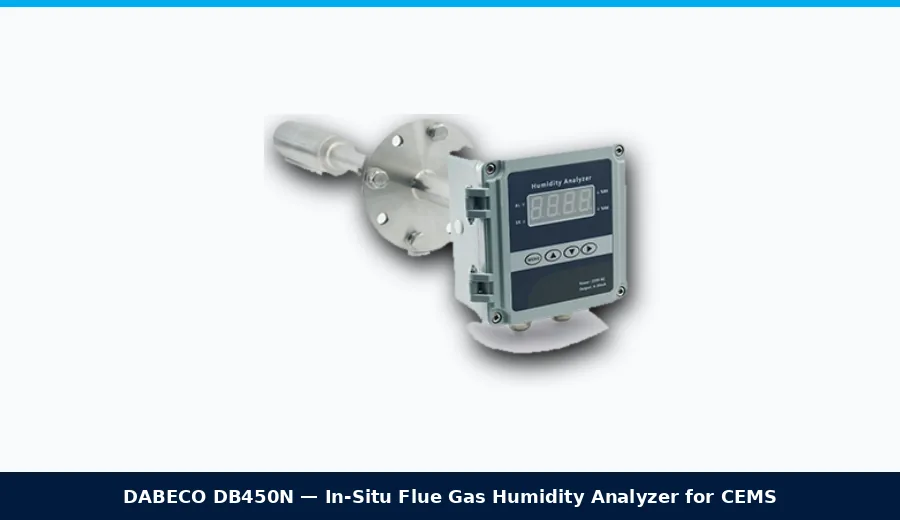
The DABECO DB450N measures humidity directly in the hot, wet flue gas stream — eliminating gas sampling and conditioning — using a capacitance sensing element on a 316L stainless steel stem inserted through a DN65 standard flange. Catalogue ranges are volume ratio 0–40 %VOL or relative humidity 0–100 %RH, with resolution 0.001, accuracy <±1.5% FS, repeatability <±1% and response time T90 <15 s. The stem is rated 0–200°C (analyzer housing −10 to +50°C), with standard lengths of 0.5 m, 1.0 m and 1.5 m and custom lengths up to 1.8 m; trace heating of 50–150°C is listed in the catalogue specification. Outputs are 4–20 mA (non-isolated, load <500 Ω), RS485 and two programmable dry-contact alarms (passive, max 220 VAC / 2 A). Supply is AC220V ±10%, 50/60 Hz at <15 VA; housing is IP65, with a selectable 4-digit display or blind version.
Prefer DB450N when the measuring point sits on a duct or stack that can take the flange and stem, gas temperature at the probe is inside the 200°C stem rating, and the written duty is real-time moisture for CEMS dry-basis correction, combustion optimisation, incinerators, industrial furnaces or drying processes. The IP65 housing and 316L stem are positioned for high dust concentration and some chemical pollution — but not for flammable or highly corrosive gas.
When the DB460 extractive cabinet fits
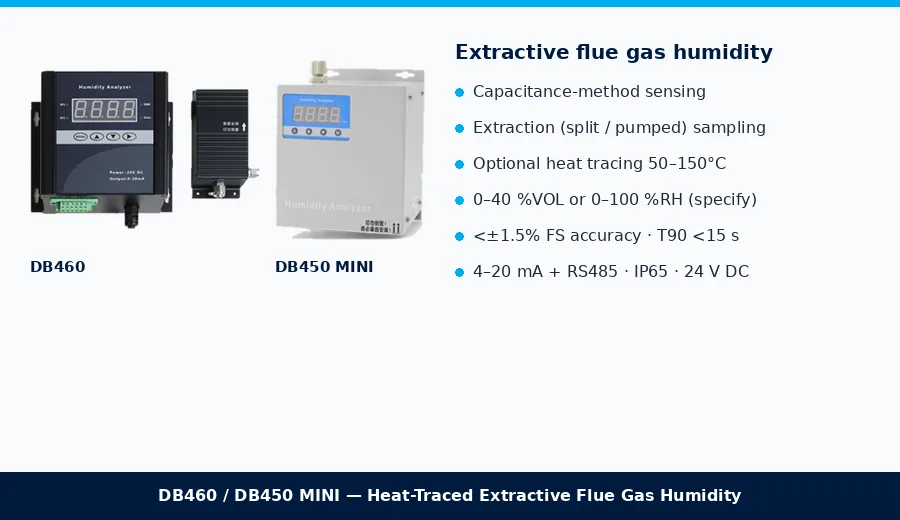
The DABECO DB460 is a wall-mounted cabinet analyzer that draws sample gas by extraction (split / pumped) sampling rather than in-situ insertion. Optional electric heat tracing at 50–150°C keeps the sample line above dew point so condensation does not form before the capacitance sensor. It displays either volume ratio (0–40 %VOL) or relative humidity (0–100 %RH) — one mode at a time, specified at order — on a four-digit tube display, with resolution 0.1%, accuracy <±1.5% FS, repeatability <±1% and T90 <15 s. Outputs are 4–20 mA and RS485; the instrument box is IP65, powered from 24 V DC, with catalogue service life of >36 months for the instrument and >24 months for the sensor under normal use.
Prefer DB460 when the flue gas is low-temperature, high-humidity and high-dust at the sampling point — conditions that would foul or flood an in-situ sensor — or when the analyzer must sit in a CEMS shelter or at grade rather than on the stack. DABECO also positions DB460 for humidity measurement and control in wood, building materials, paper, chemical, pharmaceutical, fiber, textile, tobacco, vegetable and food processing.
When the compact DB450 MINI fits
The DABECO DB450 MINI uses the same extractive principle — capacitance sensing, extraction (split / pumped) sampling, optional 50–150°C heat tracing, 0–40 %VOL or 0–100 %RH (one mode, specified at order), <±1.5% FS, T90 <15 s, 4–20 mA + RS485, IP65, 24 V DC — in a compact wall-mounted enclosure. Prefer it over the full-size DB460 when installation space on a platform, in an analyzer shelter or beside an existing CEMS rack is limited and the extractive duty is otherwise the same.
Installation, sampling and integration — brief but non-optional
Flue gas humidity readings are only as good as the measuring point. Pick a location with representative, well-mixed flow away from bends, dampers and air in-leakage; confirm gas temperature at that exact point across load and fuel cases; and decide in-situ vs extractive on that basis — not on habit. For extractive installs, heat tracing must cover the full sample path so the gas never drops below its dew point. Write down whether the CEMS or DCS expects %VOL (for dry-basis conversion) or %RH (for dryer control), because DB460 and DB450 MINI are ordered in one mode. Wire 4–20 mA into the DCS / PLC or bring RS485 into the CEMS data acquisition system, and use the DB450N alarm contacts for high-moisture or process-upset alerts. Plan sensor and stem inspection alongside the plant’s other CEMS maintenance.
Practical use cases in Pakistan
- Cement kiln and raw-mill stacks — Moisture for dry-basis CEMS reporting; DB450N where stack temperature at the probe is within 200°C, DB460 where the gas runs cooler and dustier.
- Captive power, utility and sugar-mill boilers — Flue gas moisture swings with coal, bagasse and biomass quality; pair humidity with in-situ O₂ / COe (see the RB ZTR note).
- Hospital and industrial waste incinerators — Real-time moisture for emissions correction and combustion control in dusty, polluted exhaust.
- Steel reheating and industrial furnaces — DB450N in-situ on suitable ducts for energy-efficiency programmes.
- Textile dryers, stenters, paper and building-material kilns — Exhaust humidity to cut wasted hot air; DB43 where exhaust exceeds 200°C and O₂ is also needed.
- Post-scrubber / wet stacks — Extractive DB460 or DB450 MINI with heat tracing where gas is close to saturation.
Selection and integration tips
- Measure gas temperature at the actual probe location — the DB450N stem is rated to 200°C.
- Choose in-situ for real-time, no-sample-line moisture — DB450N on a DN65 flange with the right stem length.
- Choose extractive for cool, wet, dusty gas — DB460, or DB450 MINI where space is tight, with heat tracing specified.
- Specify %VOL vs %RH before ordering extractive units.
- Check the gas — no flammable and no strongly corrosive gas for these models.
- Keep O₂ / COe as a separate layer — humidity corrects the report; combustion analyzers run the burner.
FAQ
Why does a CEMS need flue gas humidity at all?
Stack gas carries a large and variable fraction of water vapour from combustion and from wet fuels or raw materials. Emission concentrations are frequently reported on a dry basis (and often normalised to a reference O₂), so the moisture fraction is needed to convert wet readings to dry, and to correct flow-based mass emissions. Without a credible %VOL H₂O value, the dry-basis numbers in a CEMS report are only as good as an assumed moisture figure.
When should I choose the DABECO DB450N in-situ analyzer?
Choose the DB450N when the duct or stack can take a DN65 flanged probe, flue gas at the measuring point is within the 0–200°C stem rating, and you want real-time humidity without a sample line or conditioning hardware. It reads 0–40 %VOL or 0–100 %RH with <±1.5% FS accuracy and T90 under 15 s, has a 316L stem in 0.5 m, 1.0 m or 1.5 m standard lengths (custom up to 1.8 m), and provides 4–20 mA, RS485 and two programmable dry-contact alarms on AC220V.
When is an extractive DB460 or DB450 MINI the better fit?
Choose an extractive cabinet when flue gas is low-temperature, high-humidity or high-dust at the sampling point and an in-situ sensor would be exposed to condensation or fouling. DB460 and DB450 MINI draw sample gas by extraction (split/pumped) with optional electric heat tracing at 50–150°C to keep the line above dew point, then measure with a capacitance sensor. DB450 MINI is the compact footprint; both are wall-mounted, IP65, 24 V DC, with 4–20 mA and RS485.
Can these analyzers be used on flammable or strongly corrosive gas?
No. The DABECO catalogue sample-gas requirement for DB450N, DB460 and DB450 MINI is no flammable gas and no strongly or highly corrosive gas. Fuel-gas streams, hydrocarbon process gas and hazardous-area duties need differently certified moisture analyzers—see the trace-moisture technology comparison and online dew-point note.
Does flue gas humidity replace an O₂ or combustion analyzer?
No. Humidity tells you how much water vapour is in the flue gas; O₂ and COe tell you how well the burner is running and are used for reference-O₂ normalisation. Most CEMS and combustion-optimisation projects need both layers—for in-situ zirconia O₂/COe, see the RB ZTR combustion note.
How Tetracon supports flue gas humidity and CEMS choices
Tetracon supplies gas analysis, emissions and industrial instrumentation for Pakistan industry, including DABECO flue gas humidity analyzers for CEMS, boilers, kilns, furnaces, incinerators and dryers. Application support through the contact page and services team can help match in-situ or extractive models, stem lengths, heat tracing and outputs to your stacks and data systems. Start with the catalogue pages for DB450N, DB460 and DB450 MINI, or browse DABECO on the site.
Key takeaways
Flue gas humidity is the number that turns wet stack readings into defensible dry-basis CEMS data and tells dryer and kiln operators how much hot air they are wasting. Write the stack conditions first. The DABECO DB450N answers real-time in-situ moisture on ducts within its 200°C stem rating; the heat-traced extractive DB460 answers low-temperature, high-humidity, high-dust gas; the DB450 MINI answers the same extractive duty in a compact cabinet. Keep O₂ / COe combustion analysis, fuel-gas moisture and compressed-air dew point as separate written measurements.